Spiritual Warfare

The Conflict in the Heavenlies

Spiritual warfare – spiritual attack – is not only real, but it’s also not rare. Every evil thing that besets the Earth – sin, injury, illness, depression, heartbreak, poverty, disparity, injustice, war, weather disaster, death – is a result of the Fall, the great work of the devil (Diabolos=“slanderer”) and can be considered an attack by him, as we will see. But it also can be a direct effort by powers and principalities that hover around mankind.

So the question arises from the Christian, why doesn’t God put a stop to all this for His redeemed people? Just as He does not make us sinless super-Christians, He does not relieve us of the consequences of life on Earth. In the theology of the recapitulatio – as described by Church Father Irenaeus (A.D. 125-202) – Christ recaptures His creation and defeats His enemies under His universal headship in the Cross. This is the ancient view of the atonement known as Christus Victor, in a a nutshell Christ using death to defeat death, and sealing the doom of His enemies. Now the Church continues the work of the Cross (Eph. 3:10). “The Recapitulation does not end with the triumph of Christ over the enemies which had held man in bondage; it continues in the work of the Spirit in the Church.” (Gustav Aulen, Christus Victor, p. 22.) Suffering is the soil in which the roots of faith grow deepest.

As usual, Christ goes before us in this conflict. In fact, He went before anything was in place for us to join in. Rev. 13:8 reads, “And all that dwell on the earth shall worship (the beast), whose names are not written in the book of life of the Lamb slain from the foundation of the world.” (NKJV) This closing phrase has deep ramifications for our understanding of both the spiritual and physical worlds. But first, a couple of explanations:

• Many English translations move the phrase “from the foundation of the world” from its place in this quotation to a place modifying “written.” This is incorrect syntax according to the original Greek; the phrase does indeed modify “crucified.” I suspect the alternate translation is used because the correct way doesn’t fit into a neat timeline of events on Earth; even so, there it is to challenge us. In the end, though, the point is moot because the Lamb’s book of life doesn’t exist without the Lamb’s Crucifixion.

• This phrase appears in the New Testament 10 times, including from the mouth of Christ. In most of those occurrences, the word translated “from” is apo, which can mean (among other things) either “from” or “before.” But in three cases (Jn. 17:24, Eph. 1:4 and 1 Pet. 1:20) the word used is pro, the meaning of which is primarily “before.” This is straining at a gnat, but the use of pro indicates that the idea is that the Crucifixion was a spiritual reality before its manifestation as part of the Incarnation, indeed before the theater (Earth) and the vehicle (mankind) for it existed. It is of note too that the phrase appears in the writings of Matthew, Luke, John, Paul, Peter and whomever you like as the author of Hebrews – and it is not limited to the New Testament (see below.)

So the necessity for the Crucifixion before physical time as we know it had begun shows that spiritual conflict was going on long before we arrived. But nothing is new to God; all things have always been in His mind. Why He has chosen to act as He has remains within His own counsel, and it is for us only to marvel. And so it pleases God to require a physical demonstration of what is already settled spiritually, and the Church plays its part in the recapitulation.

“Haven’t you known? Haven’t you heard? Haven’t you been told from the beginning? Haven’t you understood from the foundations of the earth?

“It is he who sits above the circle of the earth, and its inhabitants are like grasshoppers; who stretches out the heavens like a curtain, and spreads them out like a tent to dwell in, who brings princes to nothing, who makes the judges of the earth meaningless.

“They are planted scarcely. They are sown scarcely. Their stock has scarcely taken root in the ground. He merely blows on them, and they wither, and the whirlwind takes them away as stubble.

“ ‘To whom then will you liken me? Who is my equal?’ says the Holy One.

“Lift up your eyes on high, and see who has created these, who brings out their army by number. He calls them all by name. By the greatness of his might, and because he is strong in power, not one is lacking.” (Is. 40:21-26)

This is quite a passage: Within it God references His tent (tabernacle) as being all of the heavens, and mentions the curtain (veil) within; it invokes creation, and notes mankind is like just so many insects before Him; He is declared all powerful, the Holy One, and none can be compared to Him – though one aspired to that; all are doomed to death, and yet He knows each one by name, and of the ones He counts by His power none goes missing.

What does this passage in Isaiah mean?  The reader has to go back to v. 3 – “The voice of one who calls out, ‘Prepare the way of the LORD in the wilderness! Make a level highway in the desert for

our God.’ “ This is the clarion call of the Incarnation, the central event in the history of the universe. In the Incarnation, God joins the grasshoppers – His connection to us that the spiritual creation lacks – and the physical demonstration begins.

What, and Who, Became Its Cause

“How you have fallen from heaven, shining one, son of the dawn! How you are cut down to the ground, who laid the nations low! You said in your heart, ‘I will ascend into heaven! I will exalt my throne above the stars of God! I will sit on the mountain of assembly, in the far north! I will ascend above the heights of the clouds! I will make myself like the Most High!’ ” (Is. 14:12-14)

We know precious little about what happened before the foundations. This passage is one of the few hints, and we know Christ was witness to it (Lk. 10:18), and it seems to have an eternal manifestation (Rev. 12:3-4). What this fall means is uncertain; the serpent is cast to the ground (Gen. 3:14-15 – to grovel in the stuff of incarnation), but Diabolos also appears in the courts of God (Job 1:6, 2:1).

Regardless, the telling point of Diabolos’ boast is the phrase “I will;” this statement stands opposed to Jesus’ “I Am” statements in John’s gospel. Diabolos operates according to his own will, and seeks to elevate himself to God’s likeness. “God said, ‘Let’s make man in our image, after our likeness. Let them have dominion over the fish of the sea, and over the birds of the sky, and over the livestock, and over all the earth, and over every creeping thing that creeps on the earth.’ God created man in his own image. In God’s image he created him; male and female he created them.” (Gen. 1:26-27) An essential part of that likeness is joining in God the Son’s physicality. So God begins His physical demonstration against Diabolos by making man in His likeness – it is the first step of Ps. 82:6: “I said, ‘You are gods, all of you are sons of the Most High.’ ” He builds the bridge across the void for us.

But first God built the theater – the Earth is to be the focus of this conflict, so Man is placed in a Garden and Diabolos is cast to the ground.

God’s Purposes Put in Motion

“Now the serpent was more subtle than any animal of the field which the LORD God had made. He said to the woman, ‘Has God really said, “You shall not eat of any tree of the garden”?’

“The woman said to the serpent, ‘We may eat fruit from the trees of the garden, but not the fruit of the tree which is in the middle of the garden. God has said, “You shall not eat of it. You shall not touch it, lest you die.” ’

“The serpent said to the woman, ‘You won’t really die, for God knows that in the day you eat it, your eyes will be opened, and you will be like God, knowing good and evil.’

“When the woman saw that the tree was good for food, and that it was a delight to the eyes, and that the tree was to be desired to make one wise, she took some of its fruit, and ate. Then she gave some to her husband with her, and he ate it, too. Their eyes were opened, and they both knew that they were naked. They sewed fig leaves together, and made coverings for themselves.

“They heard the LORD God’s voice walking in the garden in the cool of the day, and the man and his wife hid themselves from the presence of the LORD God among the trees of the garden.” (Gen. 3:1-8)

This is Diabolos at work, unusual as an overt out-in-the-open attack, a face-to-face temptation to disobedience. Behind it all Diabolos actually was aiming for unbelief, and this remains his goal. His attack was to lie about death, for they truly died spiritually at that moment, and to twist the truth – in disobedience Adam and Eve became unlike the image of God, not in physicality but in spiritual character and standing. And indeed they were denied the Tree of Life and set about their physical dying.

We should not expect this kind of clear attack, the like of which appears only one other time in Scripture: the temptation of Jesus. “Then Jesus was led up by the Spirit into the wilderness to be tempted by the devil.” Not surprisingly these attacks were upon the first Adam and the Second Adam, and they both included questioning what God had said, and shared the element of food. But the powers and principalities prefer to operate in the shadows, so we’re not likely to get this kind of confrontation. That is not to say that we should not be wary, though; Mt. 6:13a reads “Bring us not into temptation, but deliver us from the evil one. …” Obviously, this is from Jesus teaching His disciples to pray, and perhaps not so obviously, it follows closely Him being “led up by the Spirit” for temptation by ”the evil one.” Not only should we be discerning about such a direct test we can’t possibly survive, but also should pray against it.

“When men began to multiply on the surface of the ground, and daughters were born to them, God’s sons saw that men’s daughters were beautiful, and they took any that they wanted for themselves as wives.” (Gen. 6:1-2) Much debate has been applied to these verses, and we’re not going to settle it here. However, we can say the term “sons of God” in Scripture often refers to angels. This will be an important point shortly in this lesson. For now, if indeed these beings are of the spiritual creation, that means there was a widespread, ongoing attack on the purity of humanity – the vehicle of the Incarnation – to the point that God wiped out all but eight in the Flood.

Judgment Already Demonstrated

“Angels who didn’t keep their first domain, but deserted their own dwelling place, he has kept in everlasting bonds under darkness for the judgment of the great day.” (Jude 6)

This statement is a clear reference to Diabolos and those other spiritual beings he brought down with him. Many were and currently are incarcerated in the pit, a place of dread for them: “Jesus asked him, ‘What is your name?’ He said, ‘Legion,’ for many demons had entered into him. They begged him that he would not command them to go into the abyss.” This also likely is behind the prophecies of the first woe of Rev. 9.

“Because Christ also suffered for sins once, the righteous for the unrighteous, that he might bring you to God, being put to death in the flesh, but made alive in the Spirit, in whom he also went and  preached to the spirits in prison, who before were disobedient when God waited patiently in the days of Noah while the ship was being built. In it, few, that is, eight souls, were saved through water.” (1 Pet. 3:18-20)

 This passage indicates further ramifications of the Flood, the incarceration of demons. Apparently the spiritual beings were somewhat different before the Flood – rebellion requires free will – and some autonomy was taken from them afterwards – witness their panicked obeisance to Christ and the apostles. Many different  interpretations have been applied to Peter’s statement here, but it seems the most important aspect is God the Son demonstrating His death to imprisoned spirits, the Crucifixion accomplished before the foundations of the word testified to within time and space – again, Isaiah 40, “Haven’t you known? Haven’t you heard? Haven’t you been told from the beginning? Haven’t you understood from the foundations of the earth?”

 ­God’s purposes were then drawing toward completion, and He proceeded down that path by leaving the pit. Rev. 1:17-18 tells us this – “He laid his right hand on me, saying, ‘Don’t be afraid. I am the first and the last, and the Living one. I was dead, and behold, I am alive forever and ever. Amen. I have the keys of Death and of Hades.’ ” His sovereignty over death itself – Diabolos’ greatest work – is what He is demonstrating. Here He does the loosing and binding (Lk. 8:31), so there the demons remain for now, but that would then lead us to Rev. 9:1 – “The fifth angel sounded, and I saw a star from the sky which had fallen to the earth. The key to the pit of the abyss was given to him.”

These spirits held in bondage might also be lost souls – “I will give to you the keys of the Kingdom of Heaven, and whatever you bind on earth will have been bound in heaven; and whatever you release on earth will have been released in heaven.” (Mt. 16:19) Jesus makes this promise to the Church, and it is similar to His power stated above. If that’s the proper interpretation, the spirits are all descendants of Adam who chose disobedience (which boils down to unbelief) – God first chose Seth out of all Adam’s sons, then after the Flood He chose Shem from Noah’s sons, then chose his descendant Abram, then Isaac from Abraham’s sons, then Jacob, and from Jacob He chose all his sons as His people, the nation of Israel – all others were free agents, according to God’s will. “Professing themselves to be wise, they became fools, and traded the glory of the incorruptible God for the likeness of an image of corruptible man, and of birds, four-footed animals, and creeping things. Therefore God also gave them up in the lusts of their hearts to uncleanness, that their bodies should be dishonored among themselves; who exchanged the truth of God for a lie, and worshiped and served the creature rather than the Creator, who is blessed forever. Amen.” (Rom. 1:22-25)

The Spiritual Rulers

“When the Most High gave to the nations their inheritance, when he divided mankind, he fixed the borders of the peoples according to the number of the sons of God. But the Lord’s portion is his people, Jacob his allotted heritage.” (Dt. 32:8-9, ESV)

In this verse it is revealed that all the nations of the world were given over to the powers and principalities. We can assume these are evil forces, as illustrated in Dan. 10:20 – “Then he said, ‘Do you know why I have come to you? Now I will return to fight with the prince of Persia. When I go out, behold, the prince of Greece will come.’ ” The angel Gabriel is speaking these words (Dan. 9:21), speaking of battles engaged alongside Michael the archangel (Dan. 10:21), so the only conclusion can be that the princes of Persia and Greece are also spiritual beings, the powers these nations were put under by God. 

But at the Cross Christ reclaimed His headship over all creation – Irenaeus’ recapitulation, the capitulation of demons back to the sovereignty of the Godhead. In the Church age that features the inclusion of gentiles in God’s heritage of Judah, the powers and principalities are losing their people, enraging the demons, as testified by Mt. 8:29 – “Behold, they cried out, saying, ‘What do we have to do with you, Jesus, Son of God? Have you come here to torment us before the time?’ ” Here the demons proclaim Jesus’ power to “torment” them in their evil, and they acknowledge being subject to a time period. “Therefore rejoice, heavens, and you who dwell in them. Woe to the earth and to the sea, because the devil has gone down to you, having great wrath, knowing that he has but a short time.” (Rev. 12:12) Part of being cast out of heaven was becoming a prisoner of time, and all works together to madden Diabolos. 

“The devil, leading him up on a high mountain, showed him all the kingdoms of the world in a moment of time. The devil said to him, ‘I will give you all this authority and their glory, for it has been delivered to me, and I give it to whomever I want. If you therefore will worship before me, it will all be yours.’ Jesus answered him, ‘Get behind me, Satan! For it is written, “You shall worship the Lord your God, and you shall serve him only.” ’ “ (Lk. 4:5-8) This portion of Christ’s temptation illustrates the warfare that Jesus engaged in from the very beginning of His ministry. It also gives us a look into Diabolos: he’s a subtle liar. He did indeed have authority over all the nations, but Christ’s mission was to regain those nations anyway. Behind the offer was tempting Jesus to follow His will and not the Father’s, an inroad into worship which Diabolos desires. 

• “You were made alive when you were dead in transgressions and sins, in which you once walked according to the course of this world, according to the prince of the power of the air, the spirit who now works in the children of disobedience. We also all once lived among them in the lusts of our flesh, doing the desires of the flesh and of the mind, and were by nature children of wrath, even as the rest.” (Eph. 2:1-3) Diabolos is given authority of the world and its powers, and he struggles to maintain that control.

• “I will no more speak much with you, for the prince of the world comes, and he has nothing in me.” (Jn 14:30) But he has no authority over Christ, nor the Holy Spirit; the Godhead is thoroughly and utterly separate from Diabolos.

• “ ‘Father, glorify your name!’ Then a voice came out of the sky, saying, ‘I have both glorified it and will glorify it again.’ Therefore the multitude who stood by and heard it said that it had thundered. Others said, ‘An angel has spoken to him.’ Jesus answered, ‘This voice hasn’t come for my sake, but for your sakes. Now is the judgment of this world. Now the prince of this world will be cast out. … When (the Holy Spirit) has come, he will convict the world about sin, about righteousness, and about judgment; about sin, because they don’t believe in me; about righteousness, because I am going to my Father, and you won’t see me anymore; about judgment, because the prince of this world has been judged.’ “ (Jn. 12:28-31, 16:8-11)

Diabolos is already condemned, the Father and the Holy Spirit joining with the Son. And where does the Holy Spirit abide? Within the Church, gentiles grafted into the olive tree of Judah. All this incites Diabolos into madness.

• The Incarnation I

The Beginning of the End

“In (the Logos) was life, and the life was the light of men. The light shines in the darkness, and the darkness hasn’t overcome it. There came a man sent from God, whose name was John. The same came as a witness, that he might testify about the light, that all might believe through him. He was not the light, but was sent that he might testify about the light. The true light that enlightens everyone was coming into the world. … ‘This is the judgment, that the light has come into the world, and men loved the darkness rather than the light, for their works were evil. For everyone who does evil hates the light and doesn’t come to the light, lest his works would be exposed. But he who does the truth comes to the light, that his works may be revealed, that they have been done in God.’ ” (Jn. 1:4-9, 3:19-21)

“God said, ‘Let there be light,’ and there was light. God saw the light, and saw that it was good. God divided the light from the darkness.” (Gen. 1:3-4)

From the very beginning, God separated light from darkness – good from evil – and indeed pronounces each step of His creation as “good.” But the introduction of sin mixed light with darkness again. In the Incarnation, Jesus joined us on Earth to consolidate the physical demonstration of Diabolos’ humiliation, his failure to corrupt mankind beyond the reach of grace, engaging His enemies as the obedient second Adam. Rev. 12 – the narrative of the woman and the dragon – illustrates the demonic assault upon the Incarnation through mankind.

“God said, ‘Let’s make man in our image, after our likeness. Let them have dominion over the fish of the sea, and over the birds of the sky, and over the livestock, and over all the earth, and over every creeping thing that creeps on the earth.’ God created man in his own image. In God’s image he created him; male and female he created them.” (Gen. 1:26-27)

Man and woman were created in God’s image in a number of ways – including an understanding of divinity, authority, blamelessness, as a reflection of His sovereignty, access to the Tree of Life. He began as a blend of spiritual and physical being like God the Son. In the Incarnation, Jesus of Nazareth steps down from glory to humble himself for his physicality to be “made” wholly human: “Have this in your mind, which was also in Christ Jesus, who, existing in the form of God, didn’t consider equality with God a thing to be grasped, but emptied himself, taking the form of a servant, being made in the likeness of men. And being found in human form, he humbled himself, becoming obedient to the point of death, yes, the death of the cross.” (Phil. 2:5-8)

“Mary said to the angel, ‘How can this be, seeing I am a virgin?’ The angel answered her, ‘The Holy Spirit will come on you, and the power of the Most High will overshadow you. Therefore also the holy one who is born from you will be called the Son of God.’ “ (Lk. 1:34-35) The Spirit hovers (Gen. 1:1-2), and Mary becomes pregnant; this is the beginning of the Christ’s sacrifice.

“They came with haste and found both Mary and Joseph, and the baby was lying in the feeding trough.” (Lk. 2:16) The Christ arrived as an infant, the humble body utterly helpless, and He was raised as a fully human child. This is the moment He went from exclusively Son of God to also taking on His identity as Son of man, the name He most often applied to Himself.

“Now when they had departed, behold, an angel of the Lord appeared to Joseph in a dream, saying, ‘Arise and take the young child and his mother, and flee into Egypt, and stay there until I tell you, for Herod will seek the young child to destroy him.’ He arose and took the young child and his mother by night and departed into Egypt, and was there until the death of Herod, that it might be fulfilled which was spoken by the Lord through the prophet, saying, ‘Out of Egypt I called my son.’Then Herod, when he saw that he was mocked by the wise men, was exceedingly angry, and sent out and killed all the male children who were in Bethlehem and in all the surrounding countryside, from two years old and under, according to the exact time which he had learned from the wise men.” (Mt. 2:13-16)

Attacks against the Incarnate God began immediately, and many families paid the price of martyrdom. But why did God wait to kill Herod? It is all part of the Christ joining in the human condition – nothing would be easy. Joseph and Mary are also suffering in this running around the region, but they are steadfastly faithful in their obedience.

“The child was growing, and was becoming strong in spirit, being filled with wisdom, and the grace of God was upon him.” (Lk. 2:40)

“… Though he was a Son, yet learned obedience by the things which he suffered.” (Heb. 5:8)

Even with His bond with the Father, full of spirit, wisdom and grace, still it was required of Him to learn wisdom and obedience through suffering. Rom. 8:36 invokes the Psalm, “Even as it is written, ‘For your sake we are killed all day long. We were accounted as sheep for the slaughter.’ ” Just like any human.

“For we don’t have a high priest who can’t be touched with the feeling of our infirmities, but one who has been in all points tempted like we are, yet without sin.” (Heb. 4:15) There’s one outstanding difference between His humanity and ours – while submitting to creation, He did submit to the Fall. This is how He can say in Jn. 10:18 that nobody could kill Him (the penalty of sin); He must lay down His life on His own accord.

“Immediately there was in their synagogue a man with an unclean spirit, and he cried out, saying, ‘Ha! What do we have to do with you, Jesus, you Nazarene? Have you come to destroy us? I know who you are: the Holy One of God!’ Jesus rebuked him, saying, ‘Be quiet, and come out of him!’ The unclean spirit, convulsing him and crying with a loud voice, came out of him.” (Mk. 1:23-26)

Throughout His earthly ministry, the Son of man was beset by demonic attack: it began with attempts to undermine His mission of death, burial and resurrection; eventually it evolved to directly use His followers. “From that time, Jesus began to show his disciples that he must go to Jerusalem and suffer many things from the elders, chief priests, and scribes, and be killed, and the third day be raised up. Peter took him aside and began to rebuke him, saying, ‘Far be it from you, Lord! This will never be done to you.’ But he turned and said to Peter, ‘Get behind me, Satan! You are a stumbling block to me, for you are not setting your mind on the things of God, but on the things of men.’ ” (Mt. 16:21-23)

That was a devastating rebuke, but it’s better than damnation. Eventually, an attack through a disciple succeeded: “During supper, the devil having already put into the heart of Judas Iscariot, Simon’s son, to betray him … when he had dipped the piece of bread, he gave it to Judas, the son of Simon Iscariot. After the piece of bread, then Satan entered into him. Then Jesus said to him, ‘What you do, do quickly.’ ” (Jn. 13:2, 26-27) “Jesus answered them, ‘Didn’t I choose you, the twelve, and one of you is a devil?’ ” (Jn. 6:70)

“For it was not an enemy who insulted me, then I could have endured it. Neither was it he who hated me who raised himself up against me, then I would have hidden myself from him. But it was you, a man like me, my companion, and my familiar friend.” (Ps. 55:12-13). This all amounts to the promise of Gen. 3:15 – “He will bruise your head, and you will bruise His heel.” – all the vexation of the enemy against Jesus amounts to an annoyance in His divinity.

“Because Christ also suffered for sins once, the righteous for the unrighteous, that he might bring you to God, being put to death in the flesh, but made alive in the Spirit, in whom he also went and preached to the spirits in prison, who before were disobedient when God waited patiently in the days of Noah while the ship was being built. In it, few, that is, eight souls, were saved through water.” (1 Pet. 3:18-20)

Again, the risen Christ shows Himself to the captive spirits – He has completed physically what was a spiritual reality reaching back into eternity past. Dan. 10:20 – “Then he said, ‘Do you know why I have come to you? Now I will return to fight with the prince of Persia. When I go out, behold, the prince of Greece will come.’ ” – makes clear spiritual warfare is focused upon Earth. The Incarnation is the Christ joining the earthly battlefield where the heavenly conflict plays out.

• The Incarnation II

The End of the Beginning

In the Atonement, Jesus of Nazareth both redeemed us from our sin debt and re-capitated the creation, restoring His sovereign headship over all. The main avenue for these accomplishments was in Christ using death to defeat death, the greatest work of Diabolos. “He made you alive together with him, having forgiven us all our trespasses, wiping out the handwriting in ordinances which was against us. He has taken it out of the way, nailing it to the cross. Having stripped the principalities and the powers, he made a show of them openly, triumphing over them in (the Cross).” (Col. 2:13b-15)

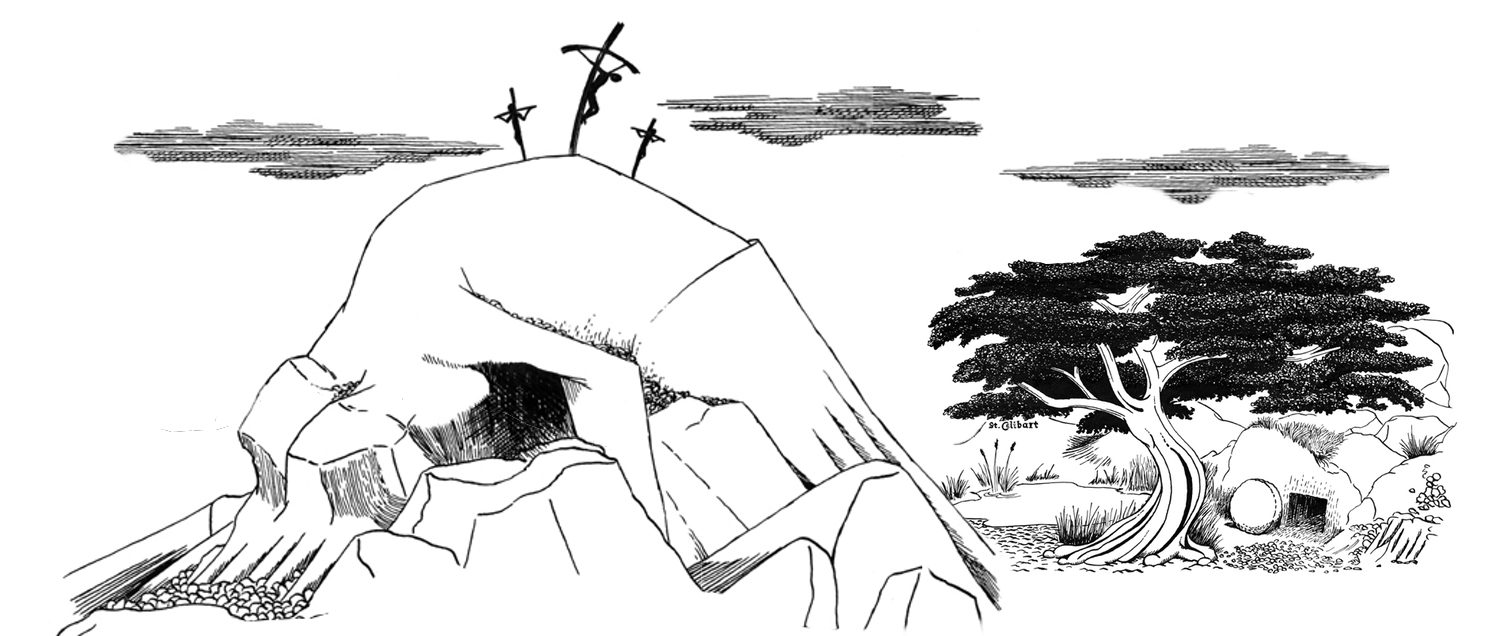
The Crucifixion is the key event in the physical demonstration that God requires. He takes Diabolos’ great work and makes of it a greater work. “He has swallowed up death forever! The Lord God will wipe away tears from off all faces. He will take the reproach of his people away from off all the earth, for the LORD has spoken it. It shall be said in that day, ‘Behold, this is our God! We have waited for him, and he will save us! This is the LORD! We have waited for him. We will be glad and rejoice in his salvation!’ ”  (Is. 25:8-9) 

And also, “I saw a new heaven and a new earth, for the first heaven and the first earth have passed away, and the sea is no more. I saw the holy city, New Jerusalem, coming down out of heaven from God, prepared like a bride adorned for her husband. I heard a loud voice out of heaven saying, ‘Behold, God’s dwelling is with people; and he will dwell with them, and they will be his people, and God himself will be with them as their God. He will wipe away every tear from their eyes. Death will be no more; neither will there be mourning, nor crying, nor pain any more. The first things have passed away.’ ” (Rev. 21:1-4)

Jesus tells us in Jn. 12:31-32, “Now is the judgment of this world. Now the prince of this world will be cast out. And I, if I am lifted up from the earth, will draw all people to myself.” Again Diabolos is declared to be cast out, the judgment is leveled against him as Jesus is lifted up for execution on the Cross. But the Christ is also elevated for glory and honor and praise, gloriously putting His enemies to ruin. Jn. 11:38-40 reads, “Jesus therefore, again groaning in himself, came to the tomb. Now it was a cave, and a stone lay against it. Jesus said, ‘Take away the stone.’ Martha, the sister of him who was dead, said to him, ‘Lord, by this time there is a stench, for he has been dead four days.’ Jesus said to her, ‘Didn’t I tell you that if you believed, you would see God’s glory?’ ” – this work was not so much focused on raising Lazarus as it was revealing the glory of God.

“I saw, in the right hand of him who sat on the throne, a book written inside and outside, sealed shut with seven seals. I saw a mighty angel proclaiming with a loud voice, ‘Who is worthy to open the book, and to break its seals?’ No one in heaven above, or on the earth, or under the earth, was able to open the book or to look in it. Then I wept much, because no one was found worthy to open the book or to look in it. One of the elders said to me, ‘Don’t weep. Behold, the Lion who is of the tribe of Judah, the Root of David, has overcome: he who opens the book and its seven seals.’ I saw in the middle of the throne and of the four living creatures, and in the middle of the elders, a Lamb standing, as though it had been slain …” (Rev. 5:1-6a) The work of the Godhead is not really about us: His suffering is His glory. But we have a role, being conformed to the image of Christ, being conformed to steadfastly share in His suffering.

An analogy: In the Western world we love our dogs. In the past 200 years, mankind has made astounding advances in technology, and our dogs have benefited from these things: They can ride in cars instead of running alongside horses; when the conditions outside are extreme, they can come inside for the air-conditioning; they don’t have to scavenge for food, and they get excellent medical care. But mankind’s progress was not driven for the benefit of dogs, it was to the glory of man (Prov. 25:2). However, we are gladly willing to let dogs benefit as well, because we love them. And so it is with God’s redeeming work.

“Jesus said to him, ‘I am the way, the truth, and the life. No one comes to the Father, except through me.’ “ (Jn. 14:6) Diabolos makes death, but Christ is life; Diabolos tells lies, but Christ is truth. Christ declares He is the physical manifestation of many things that are abstract – non-concrete, things that are very real but can’t be physically touched or contained – the way, truth, life, light, love.

We know what Christ’s will for us is in this matter – to glorify Him before His enemies – and we can act accordingly under His will and His authority. Through faith we can persevere and obey, and He will work out His will just as He did in arranging for the Upper Room, and providing a colt on which to ride into the city as a King.

• An Emulsion of Creations

But what is this arrangement that we live within? An emulsion is a forced joining of two substances that don’t mix – the classic example is oil and vinegar. The two elements won’t become one, but they can be forced into a suspension in which they temporarily co-exist. This is an apt description of the joining of the spiritual and material creations.

“Therefore rejoice, heavens, and you who dwell in them. Woe to the earth and to the sea, because the devil has gone down to you, having great wrath, knowing that he has but a short time.” (Rev. 12:12)

It is said that what enrages Diabolos most is that God offers forgiveness to fallen man, but not to fallen spirits. That redemption is found in the Incarnation, the connection mankind has to the Godhead that spirit beings can’t obtain (though I suspect demon-possession is an attempt at it.) Diabolos so desired to take part in the physical creation that it became part of his curse: It’s a captivity in a world of time and space where he once didn’t belong. Jesus willingly submitted to time, but Diabolos is forced into it and its limits; he is consigned to the physical creation for now:

• “There was war in the sky. Michael and his angels made war on the dragon. The dragon and his angels made war. They didn’t prevail. No place was found for them any more in heaven. The great dragon was thrown down, the old serpent, he who is called the devil and Satan, the deceiver of the whole world. He was thrown down to the earth, and his angels were thrown down with him.” (Rev. 12:7-9);

• Also Is. 14:12-15, “How you have fallen from heaven, shining one, son of the dawn! How you are cut down to the ground, who laid the nations low! You said in your heart, ‘I will ascend into heaven! I will exalt my throne above the stars of God! I will sit on the mountain of assembly, in the far north! I will ascend above the heights of the clouds! I will make myself like the Most High!’ Yet you shall be brought down to Sheol, to the depths of the pit;”

• And also Lk. 10:18-20 “He said to them, ‘I saw Satan having fallen like lightning from heaven. Behold, I give you authority to tread on serpents and scorpions, and over all the power of the enemy. Nothing will in any way hurt you. Nevertheless, don’t rejoice in this, that the spirits are subject to you, but rejoice that your names are written in heaven.’ ” Perhaps not about time and space so much as Diabolos being dominated by the physical creation. Even in Gen. 3:14 – “The LORDGod said to the serpent, ‘Because you have done this, you are cursed above all livestock, and above every animal of the field. You shall go on your belly and you shall eat dust all the days of your life’ ” – we see that the unholy alliance of Diabolos and the serpent, each taking on attributes of the other, ends in rubbing the Enemy’s nose in the stuff of the Incarnation.

“Concerning this salvation, the prophets sought and searched diligently. They prophesied of the grace that would come to you, searching for who or what kind of time the Spirit of Christ which was in them pointed to when he predicted the sufferings of Christ and the glories that would follow them. To them it was revealed that they served not themselves, but you, in these things, which now have been announced to you through those who preached the Good News to you by the Holy Spirit sent out from heaven; which things angels desire to look into.” (1 Pet. 1:10-12) A mystery follows after the eternal covenant – the work of the Christ winning a Bride – as prophets understood they weren’t to grasp their spiritual writings, and angels know they must glorify God without insight.

So for now the emulsion persists. Angels of all sorts have no part in incarnation, no oneness with God, no grace through humanity; so Diabolos uses the human creation out of ignorance as he did with Judas, dumbly facilitating the Crucifixion.

• His Body on Earth

God’s two creations don’t really mix together as of now – except in the person of Christ, in His identity as the Second Adam, reclaiming what the first Adam lost. As fully God and fully man, He is the perfect completion. And one day we also will be complete, we will be like Him, because we will see Him as He is. (1 Jn. 3:2)

For now, though, our perseverance as little Christs on the Earth is defined by struggle. “To me, though I am the very least of all the saints, this grace was given, to preach to the Gentiles the unsearchable riches of Christ, and to bring to light for everyone what is the plan of the mystery hidden for ages in God who created all things, so that through the church the manifold wisdom of God might now be made known to the rulers and authorities in the heavenly places. This was according to the eternal purpose that he has realized in Christ Jesus our Lord.” (Eph. 3:8-11, ESV)

There are a number of things to note here: The specific mystery is the inclusion of gentiles, God stealing them away (Is. 49:5-6) from the powers and principalities to whom they had been consigned (Dt. 32:8-9). But it goes beyond that and is still partially hidden (Rev. 10:7). This wisdom of God is expressed through His Church, i.e., the people He chose before the foundation of the world – “Blessed be the God and Father of our Lord Jesus Christ, who has blessed us with every spiritual blessing in the heavenly places in Christ, even as he chose us in him before the foundation of the world, that we would be holy and without defect before him in love, having predestined us for adoption as children through Jesus Christ to himself, according to the good pleasure of his desire …” (Eph. 1:3-5) – a people that will remain faithful to Him in spite of attacks from the powers and principalities. In this way they vindicate His choice of them.

“For our wrestling is not against flesh and blood, but against the principalities, against the powers, against the world’s rulers of the darkness of this age, and against the spiritual forces of wickedness in the heavenly places.” (Eph. 6:12)

In every generation, this is the very battle that rages around us, though we don’t see it. A rare overt example of this warfare appears in 2 Ki. 6:15-17 – “When the servant of the man of God had risen early and gone out, behold, an army with horses and chariots was around the city. His servant said to him, ‘Alas, my master! What shall we do?’ He answered, ‘Don’t be afraid, for those who are with us are more than those who are with them.’ Elisha prayed, and said, ‘LORD, please open his eyes, that he may see.’ The LORD opened the young man’s eyes, and he saw; and behold, the mountain was full of horses and chariots of fire around Elisha.”

The situation remains the same now, and it is part of our faith to acknowledge that. But more so, because we are the body of Christ on Earth – “Or don’t you know that your body is a temple of the Holy Spirit who is in you, whom you have from God? You are not your own, for you were bought with a price. Therefore glorify God in your body and in your spirit, which are God’s.” (1 Cor. 6:19-20) God is not just all around us but within us, that we might submit to His will.

We see here too that persecution is not human-based; you are suffering for Christ regardless of where it’s coming from or the form it takes. Again, Gustav Aulen: “The Recapitulation does not end with the triumph of Christ over the enemies which had held man in bondage; it continues in the work of the Spirit in the church.” This conflict began immediately: “… Summoning the apostles, they beat them and commanded them not to speak in the name of Jesus, and let them go. They therefore departed from the presence of the council, rejoicing that they were counted worthy to suffer dishonor for Jesus’ name.” (Acts 5:40b-41)

Saul of Tarsus was a big part of this early persecution, but God turned it around on him ­– “But the Lord said to him, ‘Go your way, for he is my chosen vessel to bear my name before the nations and kings, and the children of Israel. For I will show him how many things he must suffer for my name’s sake.’ ” (Acts 9:15-16) This promise escalated alarmingly – “Are they servants of Christ? (I speak as one beside himself.) I am more so: in labors more abundantly, in prisons more abundantly, in stripes above measure, and in deaths often. Five times I received forty stripes minus one from the Jews. Three times I was beaten with rods. Once I was stoned. Three times I suffered shipwreck. I have been a night and a day in the deep. I have been in travels often, perils of rivers, perils of robbers, perils from my countrymen, perils from the Gentiles, perils in the city, perils in the wilderness, perils in the sea, perils among false brothers; in labor and travail, in watchings often, in hunger and thirst, in fastings often, and in cold and nakedness. Besides those things that are outside, there is that which presses on me daily: anxiety for all the assemblies. Who is weak, and I am not weak? Who is caused to stumble, and I don’t burn with indignation?” (2 Cor. 11:23-30)

These difficulties all Paul’s life sound pretty bad, but he saw only glory in it  – “By reason of the exceeding greatness of the revelations, that I should not be exalted excessively, a thorn in the flesh was given to me: a messenger of Satan to torment me, that I should not be exalted excessively. Concerning this thing, I begged the Lord three times that it might depart from me. He has said to me, ‘My grace is sufficient for you, for my power is made perfect in weakness.’ Most gladly therefore I will rather glory in my weaknesses, that the power of Christ may rest on me. Therefore I take pleasure in weaknesses, in injuries, in necessities, in persecutions, and in distresses, for Christ’s sake. For when I am weak, then am I strong.” (2 Cor. 12:7-10)

Indeed, these were all spiritual attacks approved by God – “However, I consider those things that were gain to me as a loss for Christ. Yes most certainly, and I count all things to be a loss for the excellency of the knowledge of Christ Jesus, my Lord, for whom I suffered the loss of all things, and count them nothing but refuse, that I may gain Christ.” (Phil. 3:7-8) 

“Let Mount Zion be glad! Let the daughters of Judah rejoice because of your judgments.” (Ps. 48:11) Whatever His judgments are, whether they go our way or not, let us rejoice in them!

The Incarnation and the Cross make up a great mystical work, and God is pleased to include us. It is our privilege – again, Acts 5:40-41 – in fact, it appears to be essential. “Now I rejoice in my sufferings for your sake, and fill up on my part that which is lacking of the afflictions of Christ in my flesh for his body’s sake, which is the assembly …” (Col. 1:24) What could be lacking in His suffering? While each generation is stuck in time and space and the Fall, we will continue as His body on Earth. His suffering has ended, but as time winds down we do it for Him wherever, and whenever, we are. As His body here and now, a giant bull’s eye hangs on our backs before the powers and principalities. We take part in His suffering, and we will take part in His completed victory.

Beyond all these things, Scripture tells us struggles also develop character. “Not only this, but we also rejoice in our sufferings, knowing that suffering produces perseverance; and perseverance, proven character; and proven character, hope; and hope doesn’t disappoint us, because God’s love has been poured into our hearts through the Holy Spirit who was given to us.” (Rom. 5:3-5) Much of these gains are character changes marked by the fruit of the Spirit – “But the fruit of the Spirit is love, joy, peace, patience, kindness, goodness, faith, gentleness, and self-control. Against such things there is no law.” (Gal. 5:22-23) As we grow ever closer to the character of Christ, this as well is a victory humiliating Diabolos.

• The Battle Means Attacks

The battle of Christus Victor began with Jesus taking on a human body, and it continues in the form of His body on Earth, the Church. The spiritual victory is sealed already, even before the foundation of the world, but it pleases God to make a physical demonstration in the appointed time. The Church Age, between advents, is where it lies now.

So expect spiritual attack. Often it’s apparent a believer is attacked just at the point of conversion, or at a time when he turns a corner in his walk with Christ. But it can arise at any moment.

“Be sober and self-controlled. Be watchful. Your adversary, the devil, walks around like a roaring lion, seeking whom he may devour. Withstand him steadfast in your faith, knowing that your brothers who are in the world are undergoing the same sufferings.” (1 Pet. 5:8-9) It is significant that Peter wrote this, as Jesus gave him warnings and promises concerning himself: “The Lord said, ‘Simon, Simon, behold, Satan asked to have all of you, that he might sift you as wheat, but I prayed for you, that your faith wouldn’t fail. You, when once you have turned again, establish your brothers.’ ” (Lk. 22:31-32) Diabolos did not stop attacking at that time, and he hasn’t stopped with Peter. This is his strategy for all of us.

Faith is the testing ground, and it is faith that will either fail or prevail. Across time and space, believers suffer the very same attacks, part of the communion of saints. Jesus did not hide this from His followers – He presents to them many promises of persecution and conflict. Jesus never says He’ll prevent attacks, just that He’s interceding on our behalf – “I heard a loud voice in heaven, saying, ‘Now the salvation, the power, and the Kingdom of our God, and the authority of his Christ has come; for the accuser of our brothers has been thrown down, who accuses them before our God day and night.’ ” (Rev. 12:10) 

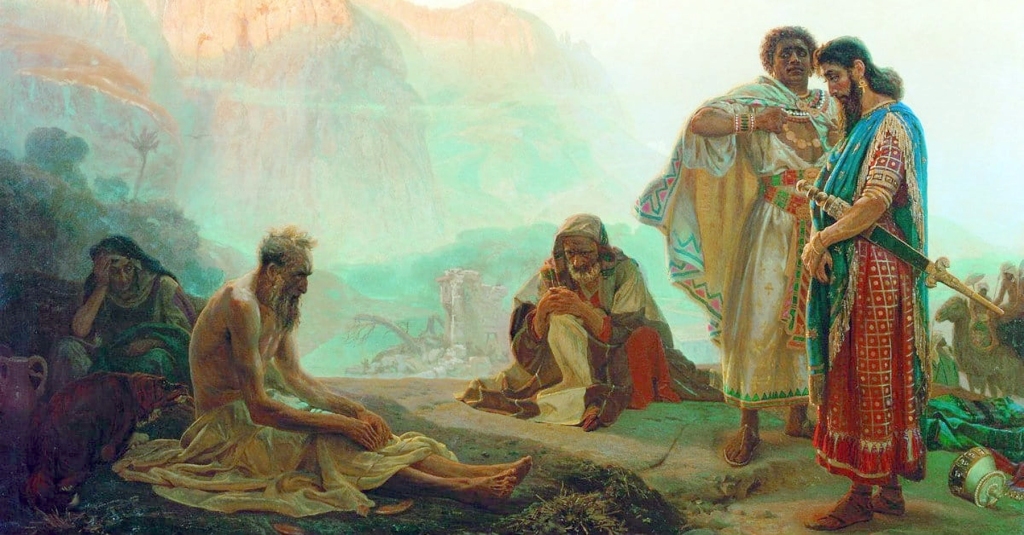
We are all Peter; we are all Job. “The LORD said to Satan, ‘Have you considered my servant Job? For there is no one like him in the earth, a blameless and an upright man, one who fears God, and turns away from evil. He still maintains his integrity, although you incited me against him, to ruin him without cause.’ Satan answered the LORD, and said, ‘Skin for skin. Yes, all that a man has he will give for his life. But stretch out your hand now, and touch his bone and his flesh, and he will renounce you to your face.’ ” (Job 2:3-4) God dangles every one of His chosen before Diabolos – we have taken His name, but in vain or not must be proven – and, like Job, the attack continues to be focused on the stuff of incarnation (again, Gen. 3:14.)

“O afflicted one, storm-tossed and not comforted, behold, I will set your stones in antimony, and lay your foundations with sapphires. I will make your pinnacles of agate, your gates of carbuncles, and all your wall of precious stones. All your children shall be taught by the Lord, and great shall be the peace of your children. In righteousness you shall be established; you shall be far from oppression, for you shall not fear; and from terror, for it shall not come near you. If anyone stirs up strife, it is not from me; whoever stirs up strife with you shall fall because of you.” (Is. 54:11-15, ESV) Diabolos is defeated already, but he continues and doesn’t fall now only because of God’s permissions. But he knows his time is short.

• What Attacks Look Like I

Overt

Sometimes overt attacks will occur.

Persecution: Some of the most obvious spiritual attacks come through persecution, either personal or official. One of the first pogroms faced by Jews is recorded in Esther (which is a parable of the Church) – “After these things King Ahasuerus promoted Haman the Agagite, the son of Hammedatha, and advanced him and set his throne above all the officials who were with him. And all the king’s servants who were at the king’s gate bowed down and paid homage to Haman, for the king had so commanded concerning him. But Mordecai did not bow down or pay homage. Then the king’s servants who were at the king’s gate said to Mordecai, ‘Why do you transgress the king’s command?’

“And when they spoke to him day after day and he would not listen to them, they told Haman, in order to see whether Mordecai’s words would stand, for he had told them that he was a Jew. And when Haman saw that Mordecai did not bow down or pay homage to him, Haman was filled with fury. But he disdained to lay hands on Mordecai alone. So, as they had made known to him the people of Mordecai, Haman sought to destroy all the Jews, the people of Mordecai, throughout the whole kingdom of Ahasuerus.” (Esth. 3:1-6, ESV) 

Mordecai, a type of the Church in suffering, showed through Chapter 2 of the book that he was no rebel; he obeyed the king and even acted to save his life. But the order to worship Haman, a type of Diabolos, violated his core principles too much, and led to all God’s people being targeted.

We also have many examples of persecution to the point of martyrdom in Church history. One of the most famous comes from the death of St. Ignatius around the turn of the 1st Century. Here is part of a letter he wrote to the church in Rome on his way to execution:

“All the way from Syria to Rome I am fighting with wild beasts, by land and sea, night and day, chained as I am to ten leopards (I mean to a detachment of soldiers), who only get worse the better you treat them. But by their injustices I am becoming a better disciple, ‘though not for that reason am I acquitted.’ What a thrill I shall have from the world beasts that are ready for me! I hope they will make short work of me. I shall coax them on to eat me up at once and not to hold off, as sometimes happens, through fear. And if they are reluctant, I shall force them to it. Forgive me – I know what is good for me. Now is the moment I am beginning to be a disciple. May nothing seen or unseen begrudge me making my way to Jesus Christ. Come fire, cross, battling with wild beasts, wrenching of bones, mangling of limbs, crushing of my whole body, cruel tortures of the devil – only let me get to Jesus Christ!

“Neither the wide bounds of earth nor the kingdoms of this world will avail me anything. ‘I would rather die’ and get to Jesus Christ, than reign over the ends of the earth. That is whom I am looking for – the One who died for us. That is whom I want – the One who rose for us. I am going through the pangs of being born. Sympathize with me, my brothers! Do not stand in the way of my coming to life – do not wish death on me. Do not give back to the world one who wants to be God’s. Let me go into the clear light and become a human being. Let me imitate the Passion of my God.”

This was a mighty victory.

Possession: Another overt example of attack is seen in Mk. 5:1-15, et al – possession. “They came to the other side of the sea, into the country of the Gadarenes. When he had come out of the boat, immediately a man with an unclean spirit met him out of the tombs. He lived in the tombs. Nobody could bind him anymore, not even with chains, because he had been often bound with fetters and chains, and the chains had been torn apart by him, and the fetters broken in pieces. Nobody had the strength to tame him. Always, night and day, in the tombs and in the mountains, he was crying out, and cutting himself with stones. 

“When he saw Jesus from afar, he ran and bowed down to him, and crying out with a loud voice, he said, ‘What have I to do with you, Jesus, you Son of the Most High God? I adjure you by God, don’t torment me.’ For he said to him, ‘Come out of the man, you unclean spirit!’ He asked him, ‘What is your name?’ He said to him, ‘My name is Legion, for we are many.’ He begged him much that he would not send them away out of the country. Now on the mountainside there was a great herd of pigs feeding. All the demons begged him, saying, ‘Send us into the pigs, that we may enter into them.’ 

“At once Jesus gave them permission. The unclean spirits came out and entered into the pigs. The herd of about two thousand rushed down the steep bank into the sea, and they were drowned in the sea. Those who fed the pigs fled, and told it in the city and in the country. The people came to see what it was that had happened. They came to Jesus, and saw him who had been possessed by demons sitting, clothed, and in his right mind, even him who had the legion; and they were afraid.”

There is much to take from this story, but one thing we see plainly is the demons’ submission to Jesus’ authority when He is in His flesh – the ultimate superiority of humankind over angels. Also, while they had invaded the Gadarene to attain his humanity, in the end they had succeeded only in destroying his humanity.

“Now the LORD’s Spirit departed from Saul, and an evil spirit from the LORD troubled him.” (1 Sam 16:14) This is a frightening prospect, God sending an evil spirit into a man. This is an indication of Saul being a type of antichrist. So what kind of protection do we have against possession? “Now he who establishes us with you in Christ and anointed us is God, who also sealed us and gave us the down payment of the Spirit in our hearts.” (2 Cor. 1:21-22) The Holy Spirit, obviously, is greater than any number of created spirits.

­Spiritism: However, we can be tempted into another form of possession, spiritism. “Then Saul said to his servants, ‘Seek for me a woman who has a familiar spirit, that I may go to her and inquire of her.’ His servants said to him, ‘Behold, there is a woman who has a familiar spirit at Endor.’ Saul disguised himself and put on other clothing, and went, he and two men with him, and they came to the woman by night. Then he said, ‘Please consult for me by the familiar spirit, and bring me up whomever I shall name to you.’ ” (1 Sam. 28:7-8) This practice leads not to the taking hold of our physicality, but to taking hold of our thoughts. “Beloved, don’t believe every spirit, but test the spirits, whether they are of God, because many false prophets have gone out into the world.” (1 Jn. 4:1)L ow-level occultism like astrology and Tarot are only asking for trouble.

Paganism: “What am I saying then? That a thing sacrificed to idols is anything, or that an idol is anything? But I say that the things which the Gentiles sacrifice, they sacrifice to demons and not to God, and I don’t desire that you would have fellowship with demons.” (1 Cor. 10:19-20) The modern world has determined to make room for ancient religions. There is no equality of cultures. We must be steadfast in our insistence on Truth.

• What Attacks Look Like II

Covert

More often attacks will be covert in nature.

Our best biblical example is Job, and an overview of chapters 1-2 will assist the reader. Job never knew until the end – and perhaps not even then (more on that below) – what had happened to him. What went on in the heavenly courts materialized as a mysterious, completely covert string of disasters. “For the thing which I fear comes on me, that which I am afraid of comes to me.” (Job 3:25) Job, who had been so meticulous in his devotions to God, now was left thinking God had made him His enemy – the very thing he feared. He did not know what was behind it, and fell into interpreting God from his circumstances. This was rooted in a superficial theology of animal sacrifice, which through his narrative develops to astounding heights, as Job clings doggedly to his faith.

The forms of covert spiritual attack Job experienced were legion – physical illness (2:7), poverty (1:13-17), death of children (1:18-19), shame (2:8), anguish (1:20), accusations (4:7-8, et al), pressured to curse God (2:9), faith put in jeopardy (1:22), despair (3:11) and supposed betrayal by God (3:25). Job’s case was a direct result of diabolic activity, but all these things can be traced to Diabolos in every case, because they are all results of the Fall.

Throughout the narrative, Job steadfastly expresses his desire for an audience with God. This may be arrogant, but it displays a trust in God, not only that Job will not be summarily destroyed but that God cares and wants him to know what’s behind it all. “If you, LORD, kept a record of sins, Lord, who could stand? But there is forgiveness with you, therefore you are feared.” (Ps. 130:3-4) If God were not merciful, why not just curse Him and die? The result would be the same either way – judgment. But with God mercy is possible, so we can go before Him, but with fear and trembling.

So Diabolos made a bet with God, but not according to anything Job had done – he bet on what Job might do. All of his attacks on us are the same, just hoping that we might run off the tracks of our faith.

The last word on Job belongs to James – “Behold, we call them blessed who endured. You have heard of the perseverance of Job and have seen the Lord in the outcome, and how the Lord is full of compassion and mercy.” (Ja. 5:11) Suffering is the soil in which the roots of faith grow deepest.

The fruit of sin: The obvious first example in recognizing an attack would be temptation to sin, and it is possible demons can tempt us. But there are only two recorded events of direct temptation, Adam in the Garden and Christ in the wilderness. We do well to pray, “And lead us not into temptation, but deliver us from the evil one.” In Matthew the Lord’s Prayer appears during the Sermon on the Mount, Jesus’ first major event recorded directly after His being driven by the Spirit to be tempted. We should be very wary of such an encounter, because we are not Christ.

Though we know little about the spiritual creation, we can say they are limited in scope. There’s no way to number them, but as we have already seen they amount to no more than a third of the total angels, and many of those currently are incarcerated. They are not omnipresent, not even Diabolos, so they cannot be behind most of our sin problem. Indeed, the Epistle of James lays that problem squarely at our feet – “But each one is tempted when he is drawn away by his own lust and enticed.” (Ja. 1:14) 

But even though we’re responsible for ongoing sin, that doesn’t remove it from the equation – spiritual attack can arise from our besetting sins. As we recognize its power over us, doubt, loathing, attacks of conscience and other consequences can follow. This is the very point of spiritual attack, to knock us off our complete faith and assurance in the work of Christ. But doubt is our weakness, not His. None of us is truly merciful, but He is full of mercy. Our conscience will berate us, but God is greater than that – “My little children, let’s not love in word only, or with the tongue only, but in deed and truth. And by this we know that we are of the truth and persuade our hearts before him, because if our heart condemns us, God is greater than our heart, and knows all things.” (1 Jn. 3:18-20) 

Having said all that, Diabolos will take the opportunity of individual sin to mount an attack on the corporate Church. “But Peter said, ‘Ananias, why has Satan filled your heart to lie to the Holy Spirit and to keep back part of the price of the land?’ ” (Acts. 5:3) This of course is the event of Ananias and Sapphira selling their land but conspiring to lie about the price to hold some back from the Church. It was the deception that was corrupting – a direct attack within the early Church that led to extreme judgment. Keep in mind the apostles and believers were already under extreme persecution from the outside, but this attack from within was far more serious.

“Or don’t you know that your body is a temple of the Holy Spirit who is in you, whom you have from God? You are not your own, for you were bought with a price. Therefore glorify God in your body and in your spirit, which are God’s.” (1 Cor. 6:19-20) It is right for us to police our behavior – we must act upon our regeneration – for the sake of the corporate body, and because we will be given judgment over those who are attacking us now. But still there remains 1 Cor. 5:1, 4-5 – “It is actually reported that there is sexual immorality among you, and such sexual immorality as is not even named among the Gentiles, that one has his father’s wife. … In the name of our Lord Jesus Christ, when you are gathered together with my spirit with the power of our Lord Jesus Christ, you are to deliver such a one to Satan for the destruction of the flesh, that the spirit may be saved in the day of the Lord Jesus.”

Hidden danger: In other hidden spiritual attacks, sometimes – and I emphasize sometimes – a situation comes up that we naturally think is perfectly good and right, but it’s a disguised attack. “He began to teach them that the Son of Man must suffer many things, and be rejected by the elders, the chief priests, and the scribes, and be killed, and after three days rise again. He spoke to them openly. Peter took him and began to rebuke him. But he, turning around and seeing his disciples, rebuked Peter, and said, ‘Get behind me, Satan! For you have in mind not the things of God, but the things of men.” (Mk. 8:31-33) That is an extreme example, but in my own life I have seen a number of times romance and marriage, advancement in a job and even miraculous deliverance were used to undermine a believer’s walk.

Misguided devotions: This leads to another subtle problem, the over emphasis on anything creating a type of idolatry. Again, “What am I saying then? That a thing sacrificed to idols is anything, or that an idol is anything? But I say that the things which the Gentiles sacrifice, they sacrifice to demons and not to God, and I don’t desire that you would have fellowship with demons. You can’t both drink the cup of the Lord and the cup of demons. You can’t both partake of the table of the Lord and of the table of demons.” (1 Cor. 10:19-21) This can happen with marriage or family, with jobs, hobbies, even Scriptural interpretations – anything that usurps faithfulness that rightly belongs to God. This idea is expressed in the Seven Deadly Sins, which are all things that are natural or even necessary to mankind, but exceed their right place.

Disunity: Another attack is the use of disunity within the body – “Now I mean this, that each one of you says, ‘I follow Paul,’ ‘I follow Apollos,’ ‘I follow Cephas,’ and, ‘I follow Christ.’ Is Christ divided? Was Paul crucified for you? Or were you baptized into the name of Paul? … Dare any of you, having a matter against his neighbor, go to law before the unrighteous, and not before the saints?”  (1 Cor. 1:12-13, 6:1) This problem vexes individual congregations and the universal Church.

Infirmity: More obvious attacks can include a direct physical infirmity. “He was teaching in one of the synagogues on the Sabbath day. Behold, there was a woman who had a spirit of infirmity eighteen years. She was bent over and could in no way straighten herself up. When Jesus saw her, he called her and said to her, ‘Woman, you are freed from your infirmity. … Ought not this woman, being a daughter of Abraham whom Satan had bound eighteen long years, be freed from this bondage on the Sabbath day?’ As he said these things, all his adversaries were disappointed; and all the multitude rejoiced for all the glorious things that were done by him.” ­(Lk. 13:10-12, 16-17)

“By reason of the exceeding greatness of the revelations, that I should not be exalted excessively, a thorn in the flesh was given to me: a messenger of Satan to torment me, that I should not be exalted excessively.” (2 Cor. 12:7) These physical ailments are attributed directly to Diabolos, but that need not be the case. In 1 Tim. 5:23 – “Be no longer a drinker of water only, but use a little wine for your stomach’s sake and your frequent infirmities.” – Paul acknowledges that health problems just develop and can benefit from medicinal treatment. Still, all the evil within the world arises from the Fall, the great destructive work of Diabolos, so all sicknesses can be traced back to him.

This also holds true for mental or emotional infirmities, which should be considered no differently than physical illness.

Antichrists: Sometimes in the experience of the Church close facsimiles to godliness arise, and this too is spiritual attack. “But even though we, or an angel from heaven, should preach to you any ‘good news’ other than that which we preached to you, let him be cursed.” (Gal. 1:8) We have been warned to be discerning. “Then if anyone tells you, ‘Look, here is the Christ!’ or, ‘Look, there!’ don’t believe it. For false christs and false prophets will arise and will show signs and wonders, that they may lead astray, if possible, even the chosen ones. But you watch.” (Mk 13:21-22) These close facsimiles are sent by the enemy to the goal of distracting us from Truth.

During the 1st Century there was a Greek man named Apollonius. He was a  philosopher and religious leader from Cappadocia, just north of the Holy Land where many early churches existed. He was one of the most famous “miracle workers” of his day. His exceptional personality and his mystical and moral way of life led to a lasting legacy. A large part of the ancient legends of Apollonius consist of reports about miracles that he was said to have performed as a wandering sage. He was tried for allegedly having used magic as a means of conspiring against the emperor; after his conviction and subsequent death penalty, his followers believed he underwent heavenly ascension.

This story is clearly taking a number of elements of Jesus’ life and work and applying them to a pretender, targeting the very gentiles God was reclaiming for the Church. This kind of effort continues today: For instance, many claim that the life of Christ is just a redux of the Egyptian god Horus. But the alleged overlapping elements are a fiction, created in 1877 by the satanic scoffer William R. Cooper. This exposes how Diabolos’ human agents operate.

Deception: Finally, though this list is not comprehensive, we have direct deception – “Beloved, don’t believe every spirit, but test the spirits, whether they are of God, because many false prophets have gone out into the world.” (1 Jn. 4:1) This attack adjusts to the culture that time and space dictates to us. For instance, since the beginning of the Space Age, a flood of UFO encounters have been reported.

Here is an analysis from Father Seraphim Rose from the late 20th Century:

“The Life of St. Martin of Tours by his disciple, Sulpicius Severus, has an interesting example of demonic power in connection with a strange physical manifestation. A certain youth named Anatolius became a monk near St. Martin’s monastery, but out of false humility he became the victim of demonic deception. He fancied that he conversed with ‘angels,’ and in order to persuade others of his sanctity, these ‘angels’ agreed to give him a ‘shining robe from out of heaven’ as a sign of the ‘Power of God’ that dwelt in the youth. One night at about midnight there was a tremendous thudding of dancing feet and a murmuring as of many voices in the hermitage, and Anatolius’ cell became ablaze with light. Then came silence, and the deceived one emerged from his cell with the ‘heavenly’ garment. … It was exceedingly soft, with a surpassing luster, and of a brilliant scarlet, but it was impossible to tell the nature of the material. At the same time, under the most exact scrutiny of eyes and fingers it seemed to be a garment and nothing else. 

“The following morning, Anatolius’ spiritual father took him by the hand in order to lead him to St. Martin to discover whether this was actually a trick of the devil. In fear, the deceived one refused to go, ‘and when he was being forced to go against his will, between the hands of those who were dragging him, the garment disappeared. … It was so fully within (St. Martin’s) power to see the devil that he recognized him under any form, whether he kept to his own character or changed himself into any of the various shapes of spiritual wickedness’ – including the forms of pagan gods and the appearance of Christ Himself, with royal robes and crown and enveloped in a bright red light.

“So why bring this up?

“It is clear that the manifestations of today’s ‘flying saucers’ are quite within the ‘technology’ of demons; indeed nothing else can explain them as well. The multifarious demonic deceptions of Orthodox literature have been adapted to the mythology of outer space, nothing more…”

So demons are happy to adopt the technology, such as it is, of any era. In the rustic 1820s America, they appeared as the angel Moroni with Moses-like tablets to re-invigorate an old heresy. In today’s world, there are already media reports of ‘beings’ asserting themselves through artificial intelligence, destroying marriages and encouraging suicides.

• Faith

For our best analysis of the benefits of spiritual attack, we must turn again to Job. “His sons went and held a feast in the house of each one on his birthday; and they sent and called for their three sisters to eat and to drink with them. It was so, when the days of their feasting had run their course, that Job sent and sanctified them, and rose up early in the morning, and offered burnt offerings according to the number of them all. For Job said, ‘It may be that my sons have sinned, and renounced God in their hearts.’ Job did so continually.” (1:4-5)

 “For he is not a man, as I am, that I might answer him, that we should come to trial together. There is no arbiter between us, who might lay his hand on us both..” (9:32-33, ESV)

“But as for me, I know that my Redeemer lives. In the end, he will stand upon the earth. After my skin is destroyed, then I will see God in my flesh, whom I, even I, will see on my side. My eyes will see, and not as a stranger.” (19:25-27)

Job’s early theology, rooted in prosperity, begins with appeasement sacrifices, his own works, though the blood of animals never saved anyone (Heb. 10:4). Through intense suffering it develops into redeeming work by God – but the essential middle step is the need for a Mediator. Job fulfilled the role of priest for his family or tribal unit, but he sees he is insufficient – he cannot touch the shoulder of God. Then, his declaration of the Redeemer includes a statement of faith in the resurrection – his own resurrection. And the LXX, in some extra verses at the end of Job, declares flatly that he is considered one of those whom God will raise from the dead.

“I commit this instruction to you, my child Timothy, according to the prophecies which were given to you before, that by them you may wage the good warfare, holding faith and a good conscience, which some having thrust away made a shipwreck concerning the faith …” (1 Tim. 1:18-19) Holding onto faith is the good warfare, and proving it out with faithful behavior, even when all seems hopeless – “Then Mordecai told them to reply to Esther, ‘Do not think to yourself that in the king’s palace you will escape any more than all the other Jews. For if you keep silent at this time, relief and deliverance will rise for the Jews from another place, but you and your father’s house will perish. And who knows whether you have not come to the kingdom for such a time as this?’ Then Esther told them to reply to Mordecai, ‘Go, gather all the Jews to be found in Susa, and hold a fast on my behalf, and do not eat or drink for three days, night or day. I and my young women will also fast as you do. Then I will go to the king, though it is against the law, and if I perish, I perish.’ ” (Esth. 4:13-16, ESV)

“What then shall we say about these things? If God is for us, who can be against us? He who didn’t spare his own Son, but delivered him up for us all, how would he not also with him freely give us all things? Who could bring a charge against God’s chosen ones? It is God who justifies. Who is he who condemns? It is Christ who died, yes rather, who was raised from the dead, who is at the right hand of God, who also makes intercession for us. 

“Who shall separate us from the love of Christ? Could oppression, or anguish, or persecution, or famine, or nakedness, or peril, or sword? Even as it is written, ‘For your sake we are killed all day long. We were accounted as sheep for the slaughter.’ No, in all these things we are more than conquerors through him who loved us. For I am persuaded that neither death, nor life, nor angels, nor principalities, nor things present, nor things to come, nor powers, nor height, nor depth, nor any other created thing will be able to separate us from God’s love which is in Christ Jesus our Lord.” (Rom. 8:31-39) We should accept attacks of all sorts, always knowing that God has us in complete security.

The full chapter of Jer. 31 lays out a long declaration of redemption and rejoicing, glorifying God in His grace – until v. 15. “The LORD says: ‘A voice is heard in Ramah, lamentation and bitter weeping, Rachel weeping for her children. She refuses to be comforted for her children, because they are no more.’ ” Then the language of great rejoicing picks up again. Why is this statement of deep human suffering – obviously the prophecy Matthew attaches to the slaughter of the innocents – placed within a great glorification passage? Its connection to the Incarnation says it all: the crossroads of Deity and humanity, the crossroads of the glorious eternal work of God and abject despair within time and space.

“Be subject therefore to God. Resist the devil, and he will flee from you.” (Ja. 4:7) Being subject to God means you resist Diabolos, and that alone is what makes him flee.

“Not that I speak because of lack, for I have learned in whatever state I am, to be content in it. I know how to be humbled, and I also know how to abound. In any and all circumstances I have learned the secret both to be filled and to be hungry, both to abound and to be in need. I can do all things through Christ who strengthens me.” (Phil. 4:11-13) “Do all things” in this context means persevering in faith, successfully “doing” suffering or prosperity (which can be dangerous ground.)

Consider the experience of Horatio Spafford: n 1871 he was a successful lawyer and owned a number of buildings in Chicago. Then a series of tragedies beset his family. It began with the death of his son at the age of two in the Great Chicago Fire of 1871, an event that also destroyed many of the Spaffords’ financial investments. His business interests were further hit by the economic downturn of 1873, at which time he had planned to travel to Europe with his family. In a late change of plans, he sent the family ahead while he remained behind to deal with those business losses. While crossing the Atlantic Ocean, the family’s ship sank rapidly after a collision with another vessel, killing all four of Spafford’s daughters, aged two to eleven. His wife Anna survived and sent him the telegram, “Saved alone. What shall I do ….” Shortly afterwards, as Spafford traveled to rejoin his wife, he wrote the hymn “It Is Well With My Soul” after his ship passed near where his daughters had died.

But that was not the end of it. The Spaffords eventually had three more children. In 1880, a new son died at the age of four of scarlet fever. Their church regarded their suffering as divine punishment – they preferred to represent Diabolos rather than Christ. Consequently, the Spaffords formed a Messianic sect, and in 1881, they set sail for Ottoman-held Palestine, leaving their church and investments behind. The Spaffords settled in Jerusalem and helped found a group called the American Colony. Colony members engaged in philanthropy among the people of Jerusalem regardless of their religious affiliation. The Spaffords’ spiritual war, far from defeating them, boiled them down to simply pursuing works of mercy and grace in the name of Christ.

“Though Satan should buffet, though trials should come,

“Let this blest assurance control,

“That Christ has regarded my helpless estate,

“And hath shed His own blood for my soul.”

• Resistance I

Defense

“Therefore put on the whole armor of God, that you may be able to withstand in the evil day, and having done all, to stand. Stand therefore, having the utility belt of truth buckled around your waist, and having put on the breastplate of righteousness, and having fitted your feet with the preparation of the Good News of peace, above all, taking up the shield of faith, with which you will be able to quench all the fiery darts of the evil one. And take the helmet of salvation …” (Eph. 6:13-17a)

“The LORD saw it, and it displeased him that there was no justice. He saw that there was no man, and wondered that there was no intercessor. Therefore his own arm brought salvation to him; and his righteousness sustained him. He put on righteousness as a breastplate, and a helmet of salvation on his head. He put on garments of vengeance for clothing, and was clad with zeal as a mantle. According to their deeds, he will repay as appropriate: wrath to his adversaries, recompense to his enemies. He will repay the islands their due. So they will fear the LORD’s name from the west, and his glory from the rising of the sun; for he will come as a rushing stream, which the LORD’s breath drives. ‘A Redeemer will come to Zion, and to those who turn from disobedience in Jacob,’ says the LORD.” (Is. 59:15b-20)

The armor of God belongs to Christ, sealed by the Spirit, and so we too can claim it, sealed by the Spirit as well. Here are the details:

• The belt of truth – this item expresses a readiness for action – “This is how you shall eat it: with your belt on your waist, your sandals on your feet, and your staff in your hand; and you shall eat it in haste: it is the LORD’s Passover.” (Ex. 12:11) In other words, gird up your loins.

• The breastplate of righteousness – this item protects all the vital organs, what is graven on our hearts, that keep us alive – “But since we belong to the day, let’s be sober, putting on the breastplate of faith and love, and for a helmet, the hope of salvation.” (1 Thess. 5:8)

• The shoes of readiness for the gospel of peace – shoes protect what makes us beautiful and makes us mobile and nimble, like the Tabernacle – “How beautiful on the mountains are the feet of him who brings good news, who publishes peace, who brings good news, who proclaims salvation, who says to Zion, ‘Your God reigns!’ ” (Is. 52:7)

The characteristic of beauty runs deep in Christ’s attitude toward His bride. “Husbands, love your wives, even as Christ also loved the assembly and gave himself up for her, that he might sanctify her, having cleansed her by the washing of water with the word, that he might present the assembly to himself gloriously, not having spot or wrinkle or any such thing, but that she should be holy and without defect.” (Eph. 5:25-27, reflected in Esth. 2:12)

• The shield of faith – a shield represents armor that is put forward from the body, the frontline of defense – “For you will bless the righteous. LORD, you will surround him with favor as with a shield.” (Ps. 5:12) The corporate Church should act as a phalanx, the ancient column of interlocked warriors standing tall behind a wall of shields. Our identity as the unified body of Christ founded and bound together by faith is our best defense.

• The helmet of salvation – the final defensive item guards our thoughts, preserves the mind of Christ within us – “ ‘For who has known the mind of the Lord that he should instruct him?’ But we have Christ’s mind.” (1 Cor. 2:16) The final exhortation from Eph. 6:17a stands in contrast with antichrist’s wound, “I will put hostility between you and the woman, and between your offspring and her offspring. He will bruise your head, and you will bruise his heel. … One of his heads looked like it had been wounded fatally. His fatal wound was healed, and the whole earth marveled at the beast.” (Gen. 3:15, Rev. 13:3) Diabolos has suffered his fatal wound, he’s just not dead yet.

“But you, beloved, remember the words which have been spoken before by the apostles of our Lord Jesus Christ. They said to you, ‘In the last time there will be mockers, walking after their own ungodly lusts.’ These are those who cause divisions and are sensual, not having the Spirit. But you, beloved, keep building up yourselves on your most holy faith, praying in the Holy Spirit. Keep yourselves in God’s love, looking for the mercy of our Lord Jesus Christ to eternal life.” (Jude 17-21) Our greatest defense is still and will continue to be the Holy Spirit.

• Resistance II

Offense

The two passages that open the above section do not stop at defensive armor, but go on to the weapons we have to go on offense:

“ … And (take) the sword of the Spirit, which is the word of God; with all prayer and requests, praying at all times in the Spirit, and being watchful to this end in all perseverance and requests for all the saints. Pray for me, that utterance may be given to me in opening my mouth, to make known with boldness the mystery of the Good News …” (Eph. 6:17b-19)

“ ‘As for me, this is my covenant with them,’ says the LORD. ‘My Spirit who is on you, and my words which I have put in your mouth shall not depart out of your mouth, nor out of the mouth of your offspring, nor out of the mouth of your offspring’s offspring,’ says the LORD, ‘from now on and forever.’ ” (Is. 59: 21)

What is the connection? “He is clothed in a garment sprinkled with blood. His name is called ‘The Word of God.’ The armies which are in heaven, clothed in white, pure, fine linen, followed him on white horses. Out of his mouth proceeds a sharp, double-edged sword that with it he should strike the nations. He will rule them with an iron rod. He treads the wine press of the fierceness of the wrath of God, the Almighty.” (Rev. 19:13-15) 

The sword of the Spirit is not only the written word of God promised in the Isaiah passage, but the Logos Himself. We are to go out in confidence in Him, also wielding the Scriptures, again by the power of the Holy Spirit. “For the word of God is living and active, and sharper than any two-edged sword, piercing even to the dividing of soul and spirit, of both joints and marrow, and is able to discern the thoughts and intentions of the heart.” (Heb. 4:12) As this study has attempted to illustrate, God has hidden His overarching purposes in His word, and knowing His designs for His creation is our secret weapon. “He answered them, ‘To you it is given to know the mysteries of the Kingdom of Heaven, but it is not given to them.’ ” (Mk. 13:11)

“For though we walk in the flesh, we don’t wage war according to the flesh; for the weapons of our warfare are not of the flesh, but mighty before God to the throwing down of strongholds, throwing down imaginations and every high thing that is exalted against the knowledge of God and bringing every thought into captivity to the obedience of Christ, and being in readiness to avenge all disobedience when your obedience is made full.” (2 Cor. 10:3-6)  Whether we gain the knowledge we need or not is our decision.

“He said, ‘Naked I came out of my mother’s womb, and naked will I return there. The LORD gave, and the LORD has taken away. Blessed be the LORD’s name.’ … Then his wife said to him, ‘Do you still maintain your integrity? Renounce God, and die.’ But he said to her, ‘You speak as one of the foolish women would speak. What? Shall we receive good at the hand of God, and shall we not receive evil?’ In all this Job didn’t sin with his lips.” (Job 1:21, 2:9-10) Most of what Job says throughout his book is wanting God to either prove him right or wrong. God finishes the narrative with 42:7-8 – “It was so, that after the LORD had spoken these words to Job, the LORD said to Eliphaz the Temanite, ‘My wrath is kindled against you, and against your two friends; for you have not spoken of me the thing that is right, as my servant Job has. Now therefore, take to yourselves seven bulls and seven rams, and go to my servant Job, and offer up for yourselves a burnt offering; and my servant Job shall pray for you, for I will accept him, that I not deal with you according to your folly. For you have not spoken of me the thing that is right, as my servant Job has.’ ” Job, seeking a mediator between himself and God, through suffering becomes the mediator between his counselors and God.

“For the Lord GOD will help me. Therefore I have not been confounded. Therefore I have set my face like a flint, and I know that I won’t be disappointed.” (Is. 50:7) We must take what we know about warfare and prepare to face it. A flint is useful when it is struck, and one of its properties is it doesn’t break. “I have made your forehead as a diamond, harder than flint. Don’t be afraid of them, neither be dismayed at their looks, though they are a rebellious house.” (Ezek. 3:9)

Our preparations for battle can include the spiritual disciplines – meditation, prayer, fasting, study in our faith life; also simplicity, solitude, submission, service in our faith behavior; confession, worship, guidance (a Spirit-led purpose) and celebration within our community life.

How do these things work themselves out? First, in direct opposition – “But Michael, the archangel, when contending with the devil and arguing about the body of Moses, dared not bring against him an abusive condemnation, but said, ‘May the Lord rebuke you!’ ” (Jude 9) Invoking the power of Christ is irresistible to His enemies. “He showed me Joshua the high priest standing before the LORD’s angel, and Satan standing at his right hand to be his adversary. The LORD said to Satan, ‘The LORDrebuke you, Satan! Yes, the LORD who has chosen Jerusalem rebuke you! Isn’t this a burning stick plucked out of the fire?’ ” (Zech. 3:1-2) The stick is Joshua the priest, wielded by the LORD Himself, burning with trials by fire.

Second, resisting by the Holy Spirit. “Nevertheless I tell you the truth: It is to your advantage that I go away; for if I don’t go away, the Counselor won’t come to you. But if I go, I will send him to you. When he has come, he will convict the world about sin, about righteousness, and about judgment; about sin, because they don’t believe in me; about righteousness, because I am going to my Father, and you won’t see me anymore; about judgment, because the prince of this world has been judged.” (Jn. 16:7-11) It is only by the Holy Spirit that the Church can continue the work of  Christus Victor, the recapturing of God’s creation under His authority. Through His witness the powers and principalities are faced with their sin, their need for righteousness, but their hopeless fate of judgment. 

“But some of the itinerant Jews, exorcists, took on themselves to invoke over those who had the evil spirits the name of the Lord Jesus, saying, ‘We adjure you by Jesus whom Paul preaches.’ There were seven sons of one Sceva, a Jewish chief priest, who did this. The evil spirit answered, ‘Jesus I know, and Paul I know, but who are you?’ The man in whom the evil spirit was leaped on them, overpowered them, and prevailed against them, so that they fled out of that house naked and wounded.” (Acts 19:13-16) The demons know who has the authority and who doesn’t. Don’t hesitate to exercise it.

Third, battles can be won through the Church body. “Is any among you suffering? Let him pray. Is any cheerful? Let him sing praises. Is any among you sick? Let him call for the elders of the assembly, and let them pray over him, anointing him with oil in the name of the Lord; and the prayer of faith will heal him who is sick, and the Lord will raise him up. If he has committed sins, he will be forgiven. Confess your sins to one another and pray for one another, that you may be healed. The insistent prayer of a righteous person is powerfully effective.” (Ja. 5:13-16)

Besides simple obedience (Heb. 10:25), spiritual warfare is one of the most important reasons for gathering together. Like any soldier, a Lone Ranger believer makes a tempting and easy target. The protection of a prayerful and powerful community – the phalanx – goes a long way. “Bear one another’s burdens, and so fulfill the law of Christ.” (Gal. 6:2)

• Who Sees Clearly

So a real battle rages, with very real combatants, and we’re stuck in the middle. Though we feel the effects of warfare, we’re at a definite disadvantage: We can’t see what’s going on. Like Job, we may never really understand what’s happening. But God sees clearly, not only across space but across time. And I believe He gave Job a hint at what led to his suffering.

To reveal this hint we must tie together some loose threads in Scripture, beginning with Job 40. As God makes His testimony based on the wonders and mysteries of creation, He comes to the creature Behemoth – “See now behemoth, which I made as well as you. He eats grass as an ox. Look now, his strength is in his thighs. His force is in the muscles of his belly. He moves his tail like a cedar. The sinews of his thighs are knit together. His bones are like tubes of bronze. His limbs are like bars of iron. He is the chief of the ways of God. He who made him gives him his sword.” (40:15-19)

“Behemoth” is clearly a magnificent land animal, in all of Scripture mentioned only here. This passage marks a turn in God’s “defense” of Himself (“Where were you when I laid the foundations of the Earth?”), where He leaves aside known images of deer and the movements of the cosmos, and turns to the mystical. The Church Fathers were not sure of how to interpret Behemoth, but many believed it to represent demonic powers.

Then in Job 41 God becomes more direct – “Can you draw out Leviathan with a fish hook, or press down his tongue with a cord? Can you put a rope into his nose, or pierce his jaw through with a hook? Will he make many petitions to you, or will he speak soft words to you? Will he make a covenant with you, that you should take him for a servant forever? Will you play with him as with a bird? Or will you bind him for your girls?… Lay your hand on him. Remember the battle, and do so no more. Behold, the hope of him is in vain. Won’t one be cast down even at the sight of him? None is so fierce that he dare stir him up. Who then is he who can stand before Me?” (41:1-5, 8-10)

“Leviathan” is not unknown to the rest of Scripture – “In that day, the LORD with his hard and great and strong sword will punish leviathan, the fleeing serpent, and leviathan, the twisted serpent; and he will kill the dragon that is in the sea.” (Is. 27:1) Also the Psalms – “You broke the heads of Leviathan in pieces. You gave him as food to people and desert creatures,” (74:14) and “There the ships go, and leviathan, whom you formed to play there.” (104:26)

All these references display God’s authority over Leviathan, even His conclusion to Job: If none can stand before him, much less stand before God, then even the mighty Leviathan must cower before Him. With all this evidence, the Church Fathers are sure about this beast – he represents Diabolos.

So Job is teased with a mighty beast of the land, and a mighty beast from the sea, both enwrapped in mystery. We can now turn our attention to Rev. 13 – “Then I stood on the sand of the sea. I saw a beast coming up out of the sea, having ten horns and seven heads. On his horns were ten crowns, and on his heads, blasphemous names. The beast which I saw was like a leopard, and his feet were like those of a bear, and his mouth like the mouth of a lion. The dragon gave him his power, his throne, and great authority. One of his heads looked like it had been wounded fatally. His fatal wound was healed, and the whole earth marveled at the beast. They worshiped the dragon because he gave his authority to the beast; and they worshiped the beast, saying, ‘Who is like the beast? Who is able to make war with him?’ ” (vv. 1-4) The beast from the sea bears many of the characteristics of Leviathan from the Old Testament, with added aspects that belong to the spiritual creation – his description reflects the descriptions of cherubim. He also bears the mark of Gen. 3:15, “He shall bruise your head.”

Then in short order another beast appears – “I saw another beast coming up out of the earth. He had two horns like a lamb and it spoke like a dragon. He exercises all the authority of the first beast in his presence. He makes the earth and those who dwell in it to worship the first beast, whose fatal wound was healed.” (Rev. 13:11-12) This is a beast of the land, like Behemoth. With an open mind, one can easily interpret these beasts as Diabolos and his antichrist, representatives of the spiritual and physical creation in unholy conspiracy against Christ and His people.

So when God brings both of these beasts up with Job, He is indicating to him the source of this suffering – spiritual warfare arising in chapters 1 and 2. Whether Job understood or not can’t be said, but for the purposes of this study, just know that God does not want us to be ignorant of our situation. Job’s story was recorded as a benefit to all those who would follow after him.

“We know that all things work together for good for those who love God, for those who are called according to his purpose.” (Rom. 8:28) This familiar exhortation brings a lot of comfort and hope, but within it lies a challenge. Jesus has already said, “No one is good except one – God.” (Mk. 10:18) By definition, then, only God knows what truly is good; our own idea of “goodness” is twisted at best, evil at worst, usually measured only by our self-interest. So what God knows to be good for us may be unrecognizable to our current state, particularly in the midst of spiritual battle. He sees good and evil purely, He divides light and dark. In the words of the old hymn, our best approach is to simply trust and obey.

We cannot see the conflict that surrounds us, and we may not understand every aspect of it, but God does. The Triune Godhead sees everything, knows everything and has not abandoned us. He knows our hearts and has shared in every aspect of our humanity except sin. It is no accident that the magnificent declaration of Christ’s crucifixion before the foundation of the world also appears in Rev. 13 (v. 8). Leviathan and Behemoth debut in perhaps the oldest writing of the Old Testament, and their spiritual counterparts in the last writing of the New Testament – spanning the entire historical record of the conflict in the heavenlies.

Note also in Job that God plays Leviathan like a fish on a hook, He will give him as if he were food to His physical creation; He has reduced Behemoth to eating grass. He is Lord of all.

• Our Eternal Role

Spiritual warfare is ongoing and will not cease until the arrival of Christ and the fulfillment of His kingdom. But there is a point to it even now, besides developing a Christlike character. “Don’t you know that the saints will judge the world? And if the world is judged by you, are you unworthy to judge the smallest matters? Don’t you know that we will judge angels? How much more, things that pertain to this life?” (1 Cor. 6:2-3) Spiritual warfare now prepares us to judge under Christ – “Those who see you will stare at you. They will ponder you, saying, ‘Is this the man who made the earth to tremble, who shook kingdoms, who made the world like a wilderness, and overthrew its cities, who didn’t release his prisoners to their home?’ ” (Is. 14:16-17) This gaping wonder of a victorious people will be the completion of Diabolos’ humiliation, bested by those he bet against. 

The victory of Christ is combined with the image of His suffering in Rev. 5:6 – “I saw in the middle of the throne and of the four living creatures, and in the middle of the elders, a Lamb standing, as though it had been slain, having seven horns and seven eyes, which are the seven Spirits of God, sent out into all the earth.” As with Christ, so also with us.

What will the moment of this judgment look like? We have only Scriptural types to go by:

“Then Queen Esther answered, ‘If I have found favor in your sight, O king, and if it please the king, let my life be granted me for my wish, and my people for my request. For we have been sold, I and my people, to be destroyed, to be killed, and to be annihilated. If we had been sold merely as slaves, men and women, I would have been silent, for our affliction is not to be compared with the loss to the king.’ Then King Ahasuerus said to Queen Esther, ‘Who is he, and where is he, who has dared to do this?’ And Esther said, ‘A foe and enemy! This wicked Haman!’ Then Haman was terrified before the king and the queen.  

“And the king arose in his wrath from the wine-drinking and went into the palace garden, but Haman stayed to beg for his life from Queen Esther, for he saw that harm was determined against him by the king. And the king returned from the palace garden to the place where they were drinking wine, as Haman was falling on the couch where Esther was. 

“And the king said, ‘Will he even assault the queen in my presence, in my own house?’ As the word left the mouth of the king, they covered Haman’s face. Then Harbona, one of the eunuchs in attendance on the king, said, ‘Moreover, the gallows that Haman has prepared for Mordecai, whose word saved the king, is standing at Haman’s house, fifty cubits high.’ And the king said, ‘Hang him on that.’ So they hanged Haman on the gallows that he had prepared for Mordecai. Then the wrath of the king abated.”  (Esth. 7:3-10, ESV)

Ps. 137 – This is a captivity psalm, a song of the Church in sojourn. Its final two verses read, “Daughter of Babylon, doomed to destruction, he will be happy who repays you, as you have done to us. Happy shall he be, who takes and dashes your little ones against the rock.” This is a difficult saying for us, but who are the children of Babylon? We can refer to Is. 21:9 – “ ‘Behold, here comes a troop of men, horsemen in pairs.’ He answered, ‘Fallen, fallen is Babylon; and all the engraved images of her gods are broken to the ground.’ ” The gods of Babylon – the demons behind the idols – certainly qualify. “But I say that the things which the Gentiles sacrifice, they sacrifice to demons and not to God, and I don’t desire that you would have fellowship with demons.” (1 Cor. 10:20)

The angel speaking in Rev. 18-19 first invokes Isaiah’s pronunciation – “He cried with a mighty voice, saying, ‘Fallen, fallen is Babylon the great, and she has become a habitation of demons, a prison of every unclean spirit, and a prison of every unclean and hated bird,’ ” – and follows with a multitude of judgments as Babylon weeps. The four horsemen of the apocalypse represent Babylon’s power bases – government, warfare, economics, even death itself, and Christ uses them to defeat them. “The sea gave up the dead who were in it. Death and Hades gave up the dead who were in them. They were judged, each one according to his works. Death and Hades were thrown into the lake of fire. This is the second death, the lake of fire.” (Rev. 6:1-8) These are truly also the children of Babylon.

• Encouragement

 “All day long they twist my words. All their thoughts are against me for evil. They conspire and lurk, watching my steps. They are eager to take my life. Shall they escape by iniquity? In anger cast down the peoples, God. You count my wanderings. You put my tears into your container. Aren’t they in your book? Then my enemies shall turn back in the day that I call. I know this: that God is for me.” (Ps. 56:5-9)

As I write this, flash flooding in Texas has killed probably more than 200, many of them little girls and young women at a Christian summer camp. This kind of mass trauma strikes at the hearts of not just those who have lost family and friends, but of the whole Church. Events of this kind are not rare; sometimes it’s a natural disaster, and, even worse, sometimes it’s human-driven. We have no easy way to deal with the onslaught of suffering, but we know there is one behind it and defeated through it. We have only to know it to be so, to turn our faces like flint before him and be Christ to one another. I will fill up what is lacking in His suffering within my own time and place, as His body on Earth (Col. 1:24). 

“Jesus wept.” (Jn. 11:35)

Like Jesus at Lazarus’ tomb, He weeps still at the grip of evil upon His creation. Just as Christ chose to join us in our suffering, we can know that with eternity in view, the crucifixion being a spiritual reality before creation, we are actually joining in His suffering.

That is our lot as we wait. Still, there is hope even in the here and now – “Bear one another’s burdens, and so fulfill the law of Christ.” (Gal. 6:2) As members of the same body, it is for our own good to take care of each other. “When one member suffers, all the members suffer with it. When one member is honored, all the members rejoice with it.” (1 Cor. 12:26)

There is beauty in the communal life that we must not neglect, because it too is a foreshadowing of the future – “Let’s not be weary in doing good, for we will reap in due season if we don’t give up.” (Gal. 6:9) What exactly will we reap? 

“So the LORD blessed the latter end of Job more than his beginning. He had fourteen thousand sheep, six thousand camels, one thousand yoke of oxen, and a thousand female donkeys. He had also seven sons and three daughters. He called the name of the first, Jemimah; and the name of the second, Keziah; and the name of the third, Keren Happuch. In all the land were no women found so beautiful as the daughters of Job. Their father gave them an inheritance among their brothers. After this Job lived one hundred forty years, and saw his sons, and his sons’ sons, to four generations. So Job died, being old and full of days. It is written that he will rise with those whom the Lord resurrects.“ (Job 42:12-18, v. 18 from LXX) God certainly cares about our current well-being, but He cares far more about our spiritual, eternal well-being. 

“To the angel of the assembly in Pergamum write: ‘He who has the sharp two-edged sword says these things: “I know your works and where you dwell, where Satan’s throne is. You hold firmly to my name, and didn’t deny my faith in the days of Antipas my witness, my faithful one, who was killed among you, where Satan dwells.” ’ ” (Rev. 2:12-13) “Pergamum” means “married” – we have taken wedding vows with Christ. Like His foreshadow Ahasuerus, He is violently jealous of His bride, and He will set all things right concerning attacks on us. “He who has an ear, let him hear what the Spirit says to the assemblies. To him who overcomes, to him I will give of the hidden manna, and I will give him a white stone, and on the stone a new name written which no one knows but he who receives it,” (v. 17) – our married name is hidden in Him.

“I saw the holy city, New Jerusalem, coming down out of heaven from God, prepared like a bride adorned for her husband. … The foundations of the city’s wall were adorned with all kinds of precious stones. The first foundation was jasper, the second sapphire; the third chalcedony, the fourth emerald, the fifth sardonyx, the sixth sardius, the seventh chrysolite, the eighth beryl, the ninth topaz, the tenth chrysoprase, the eleventh jacinth, and the twelfth amethyst. The twelve gates were twelve pearls. Each one of the gates was made of one pearl. The street of the city was pure gold, like transparent glass.” (Rev. 21:2, 19-21) The combined images of marriage and precious stones continues.

“The nations will see your righteousness, and all kings your glory. You will be called by a new name, which the LORD’s mouth will name. You will also be a crown of beauty in the LORD’s hand, and a royal diadem in your God’s hand. You will not be called Forsaken any more, nor will your land be called Desolate anymore; but you will be called Hephzibah, and your land Beulah; for the LORD delights in you, and your land will be married. For as a young man marries a virgin, so your sons will marry you. As a bridegroom rejoices over his bride, so your God will rejoice over you.” (Is. 62:2-5) 

And to His bride He makes this promise: “But as it is written, ‘Things which an eye didn’t see, and an ear didn’t hear, which didn’t enter into the heart of man, these God has prepared for those who love him.’ ” (1 Cor. 2:9)

This one thing I know, that God is for us.

All Scripture quotations are from the World English Bible, unless otherwise noted.

The Lord’s Prayer

Kingdom of Heaven

“And (Jesus) charged them that they should not make Him known, that it might be fulfilled which was spoken by Isaiah, the prophet, saying, ‘Behold my servant, whom I have chosen; my beloved in whom my soul is well pleased; I will put my Spirit upon Him, and He shall show justice to the Gentiles. He shall not strive, nor cry; neither shall any man hear His voice in the streets. A bruised reed shall He not break, and smoking flax shall He not quench, till He send forth justice unto victory. And in His name shall the Gentiles trust.’ ”  — Mt. 12:16-21.

Jesus had just been confronted by the Jewish officials, accused of breaking the Sabbath – He and His disciples had gleaned grain on the day of rest, and He had healed a paralytic man. So they wanted to kill Him (12:14), but at the same time many among His followers wanted to make Him king (12:23). But Matthew writes that His mission was something very different – He was to be more than the Messiah of the Jews, more than the King of Judah, more than the God of Israel. He was to be all these things, but to the gentiles as well as to the Jews.

“And the disciples came, and said unto him, ‘Why speak you unto them in parables?’ He answered and said unto them, ‘Because it is given unto you to know the mysteries of the kingdom of heaven, but to them it is not given.’ ” — Mt. 13:10-11

Jesus tells His followers that He is about to explain to them a mystery, and He will do it in the form of parables, so that they will understand while those who do not believe in Him will not. What follows in Matthew 13 are a series of parables that illustrate the kingdom of heaven, the answer to a mystery that vexed the Jews: Why is Messiah portrayed by the prophets both in suffering and in glory?

First we must draw a distinction between the kingdom of heaven and the kingdom of God: The Jews and the disciples both were looking and hoping for the kingdom of God. “When they, therefore, were come together, they asked of Him, saying, ‘Lord, will you at this time restore again the kingdom to Israel?’ And he said unto them, ‘It is not for you to know the times or the seasons, which the Father has put in His own power.’ ” — Acts 1:6-7. It was logical for the disciples to think the risen Christ would take His seat of authority, but that was not the plan. The mystery was to use a long period of time to separate the Messiah in suffering from the Messiah in glory, the Suffering Servant from the Conquering King, the first advent from the second advent.

The term “kingdom of heaven” is found only in Matthew, not surprisingly since it is the gospel of the King. In the rest of the New Testament the term “kingdom of God” is used, sometimes in events that seem to parallel “kingdom of heaven” in Matthew, but usually to indicate Christ’s kingdom after the second advent. For this reason many take the phrases to mean the same thing. “Many current Matthean scholars argue that Matthew employs the phrase ‘kingdom of heaven’ as a circumlocution for the divine name. However, by analyzing the author’s rhetorical and sociological strategies one finds that ‘kingdom of heaven’ combines with other ‘heavenly’ language (especially ‘Father in heaven’) to reaffirm the readers’ identity as the true people of God.” (Robert Foster, Why On Earth Use ‘Kingdom of Heaven’?: Matthew’s Terminology Revisited, Cambridge University). Indeed, there is much disagreement among theologians about how to interpret this term. Foster notes how Matthew uses both phrases, and concludes (using shorthand) “… KG refers to God’s rule over both the obedient and disobedient, while KH exclusively designates his reign over those who become his family through faith in Jesus.” That would be the Church.

This premise finds support in, for instance, a quick comparative look at two passages from Matthew and Revelation. Rev. 11:1-2 reads: “Then I was given a measuring rod like a staff, and I was told, ‘Rise and measure the temple of God and the altar and those who worship there, but do not measure the court outside the temple; leave that out, for it is given over to the nations, and they will trample the holy city for forty-two months.’” The patristics saw the temple and the people within worshipping God as the Church, and the act of measuring as a sign of protection. Outside were unbelieving gentiles and Jews, at the threshold of the Church, trampling the holy city. This meshes with Jesus’ statement of Mt. 11:12, where He says of the “kingdom of heaven” – the Church – that since the days of John the Baptist it suffers violence and that the violent bear it away.

Along those lines, this study will consider the “kingdom of heaven” as used by Matthew as the time of mystery between the advents, the Church Age. It is the time period in which God is no longer recognized only as the God of Israel, but God of everything under heaven, that is, all creation. Although throughout the Old Testament God is recognized as creator of all that was created and king of all the nations, still He is considered God of Israel, not of the nations. Now, in the kingdom of heaven, the revelation expands, and God demonstrates the change by no longer considering only the nation Israel His people, but by making a new nation of all peoples of the Earth to be His people: the Church.

This interpretation of the kingdom of heaven is connected most often with dispensational theology, and one of its leading voices, theologian Lewis Sperry Chafer. “Since the kingdom of heaven is no other than the rule of God on the Earth, He must now be ruling to the extent of full realization of those things which are termed ‘the mysteries’ in the N.T. and which constitute the new message of the N.T.” (Chafer, Systematic Theology). However, dispensational theology falls short by focusing on a return of the Theocratic Kingdom of Israel: Missing out at the first advent of Christ, now they must wait for the second advent. This is an error. If one accepts Paul’s teaching that the Church is now the “Israel of God” (Gal. 6:16) – as Foster noted – then kingdom of heaven would be rightly identified as the Church here and now. In this way it fits into covenant theology – the new kingdom of the new Israel under the New Covenant – and that is the path taken here.

The kingdom of heaven was foreshadowed in the Old Testament: “Thou therefore, O Lord God of hosts, the God of Israel, awake to visit all the nations …” — Ps. 59:5. Note the identification of the Deity as the God of Israel.

Both John the Baptist and Jesus declared, “The kingdom of heaven is at hand.” (Mt. 3:2, 4:17) First, what does “at hand” mean? To have something at hand means that thing is placed in near proximity, within reach of the hand. So both the Baptist and Christ say the Kingdom is in the midst of those listening to them; and indeed, there was the King standing among them. The same holds true for us, for the Kingdom has not retreated; it has only spread.

The call of the Baptist and the Christ was to repentance — not just repentance from sin, but also from “dead works” (Heb. 6:1), the Jewish system of sacrifices. The message God had hinted at all along becomes an open reality: Salvation comes not through sacrifice but through mercy (Hos. 6:6). This is the mystery that they were announcing as described by Paul: “For I would not, brethren, that you should be ignorant of this mystery, lest you should be wise in your own conceits; that blindness in part is happened to Israel, until the fullness of the gentiles be come in.” — Rom. 11:25

“(He) came and preached peace to you (gentiles) who were afar off, and to them that were near. For through him we both have access by one Spirit unto the Father. Now, therefore, you are no more strangers and sojourners, but fellow citizens with the saints, and of the household of God; and are built upon the foundation of the apostles and prophets, Jesus Christ himself being the chief corner stone, in whom all the building fitly framed together grows unto a holy temple in the Lord; in whom you also are built together for a habitation of God through the Spirit.” — Eph. 2:17-22. Paul notes that the cross was always preached by the representatives of Christ, by him and other apostles to those who were “afar off,” the gentiles, and by prophets (including the prophecy of types) to those who were “near,” the Jews. What was once kept silent toward the gentiles is now openly declared, to build the Church.

And again: “For this cause I, Paul, the prisoner of Jesus Christ for you gentiles, if you have heard of the dispensation of the grace of God which is given me to you: How that by revelation He made known unto me the mystery; (as I wrote before in few words, whereby, when you read, you may understand my knowledge in the mystery of Christ) which in other ages was not made known unto the sons of men, as it is now revealed unto His holy apostles and prophets by the Spirit; that the gentiles should be fellow heirs, and of the same body, and partakers of his promise in Christ by the gospel …” — Eph. 3:6 The impact of this revelation, the “mystery of Christ,” is largely lost on us today, but in Paul’s time it was Earth-shattering, particularly to the Jews, who for centuries had considered themselves God’s own by birthright, completely separate from unclean gentiles.

As well, consider the imagery Jesus used in Jn. 15:5-6 to describe the winnowing of the Jewish elect: “I am the vine, you are the branches. He that abides in me, and I in him, the same brings forth much fruit; for without me you can do nothing. If a man abides not in me, he is cast forth as a branch, and is withered; and men gather them, and cast them into the fire, and they are burned.” The use of “vine” and “vineyard” was well-established in the Old Testament text as a type of Israel (Ps. 80:8-16, Is. 5:1-7, Jer. 12:10-11, Ezek. 17:1-10). Compare then Paul’s description of the Church in Rom. 11:17, 23-24: “… Some of the branches be broken off, and you, being a wild olive tree, were grafted in among them, and with them partake of the root and fatness of the olive tree … And they also, if they abide not still in unbelief, shall be grafted in; for God is able to graft them in again. For if you were cut out of the olive tree which is wild by nature, and were grafted contrary to nature into a good olive tree, how much more shall these, who are the natural branches, be grafted into their own olive tree?” The use of similar allusion is no mistake, as God prunes and grafts to make His Church, a people that were at one time no nation (Rom. 10:19). Note too Paul’s insistence that even branches that are broken off can be grafted back in; for both those “afar off” and those “near,” conversion through faith is still required.

When Jesus began His public ministry, He preached the “gospel of the kingdom” (Mt. 4:23). There is only one true gospel: “But though we, or an angel from heaven, preach any other gospel unto you than that which we have preached unto you, let him be accursed. As we said before, so say I now again, If any man preach any other gospel unto you than that you have received, let him be accursed.” – Gal. 1:8-9. Therefore, the gospel of the kingdom is the same gospel that the prophets and then Paul and all the apostles preached, the death, burial and resurrection of Christ (1 Cor. 15:1-8). This gospel is the very thing that draws people to repentance and into the Church, into the kingdom of heaven.

This is the mystery, the kingdom of heaven. In the Old Testament (KJV) the phrase “God of Israel” appears nearly 200 times. At the advent of Christ, God demonstrated that He is sovereign God over all creation, over everything in heaven and Earth, and would no longer be considered just the God of Israel: In the New Testament the term appears only twice, in incidental contexts: Lk. 1:68, Zacharias’ Benedictus (in effect an Old Testament text, before Jesus’ birth — cp. Simeon in 2:32 after the Nativity, “A light to lighten the Gentiles, and the glory of thy people, Israel”) and Mt. 15:31 as a crowd reacts to a miracle; the term is not found in Acts or the epistles, not in any doctrinal passage — but instead the phrase “Israel of God” appears in Gal. 6:16. God would manifest this new revelation of Himself by grafting gentiles onto the vine, adopting them as sons of the “true Israel,” the circumcised of heart — the Church. “The next day John saw Jesus coming unto him, and said, ‘Behold the Lamb of God, who takes away the sin of the world.’ ” — Jn. 1:29. Not the sin of Israel, but of the whole world, declared by the same man who preached the kingdom of heaven as at hand.

We see too a picture of the kingdom of heaven, the Church Age, when Jesus sends out the seventy (Lk. 10:1-12). The disciples were sent out to the cities Jesus would visit, a type of missions; He makes His exhortations about the harvest being great but laborers few, the harvest being a symbol of conversion; the disciples were told to establish themselves in a single house, like church membership; and He tells His Jewish followers to eat whatever is placed before them, a foreshadowing of the end of kosher law (1 Cor. 1:27).

As well, compare Old Testament with New:

“And I will pour upon the house of David, and upon the inhabitants of Jerusalem, the Spirit of grace and of supplications; and they shall look upon Me whom they have pierced, and they shall mourn for Him, as one mourns for his only son, and shall be in bitterness for Him, as one that is in bitterness for his firstborn.” — Zech. 12:10

These two verses are very similar. Zechariah speaks of Israel’s mourning at seeing Christ’s return; in Revelation the whole world wails. This is further evidence of the presence of the kingdom of heaven, God the Son revealed as Lord over all creation, no longer recognized as just God of Israel. Jesus becomes known as not merely the King of the Jews, as Pilate declared, but King of kings.

For the Jews of Jesus’ time who understood these things — being among the Jews who wanted the kingdom of God, not the kingdom of heaven — this was not a welcome message (Acts 21:30, 22:21-22). For some 1,500 years they believed themselves the unique people of God, the chosen nation, and they didn’t want that to change, they wanted it fulfilled (Jn. 11:50). But clearly their own scriptures outlined a different plan, and they were appointed to bring it about (Acts 4:27-28). Foster notes, “Furthermore, the KH sayings unique to Matthew (in all there are 20) reinforce the gospel’s emphasis of validating the disciples of Jesus …” – the Church, to the exclusion of the established Jewish officials. Of these 20, many were in the form of parables, and most of them appear in Chapter 13.

***

Matthew 13

With that foundation in place, let’s look at a number of parables Jesus used, all beginning with the phrase “The kingdom of heaven is like …” We will see that He is describing what His followers should expect, and what we have witnessed ourselves, in the Church Age. These analogies follow the parable of the sower and the seed, describing the reaction the world would have to hearing the word of the gospel.

“Another parable put he forth unto them, saying, ‘The kingdom of heaven is likened unto a man who sowed good seed in his field; but, while men slept, his enemy came and sowed tares among the wheat, and went his way. But when the blade was sprung up, and brought forth fruit, then appeared the tares also. So the servants of the householder came and said unto him, “Sir, did you not sow good seed in your field? From where, then, has it tares?” He said to them, “An enemy has done this.” The servants said to him, “Will you, then, that we go and gather them up?” But he said, “No; lest while you gather up the tares, you root up also the wheat with them. Let both grow together until the harvest; and in the time of harvest I will say to the reapers, ‘Gather together first the tares, and bind them in bundles to burn them, but gather the wheat into my barn.’ ” ’ ” — vv. 24-30

Here the man represents God, the field is the Church and the good seed are real believers. The enemy is Satan, and the tares are non-believers. The parable stands as a warning that God’s enemy will make overt efforts to corrupt the Church, but we are not to try to separate the false from the true. Christ will make those judgments after the reaping of His return. Jesus Himself makes this explanation in vv. 36-43.

Interestingly, this parable is almost immediately illustrated in 15:13-14: “But he answered and said, ‘Every plant, which my heavenly Father has not planted, shall be rooted up. Let them alone; they are blind leaders of the blind. And if the blind lead the blind, both shall fall into the ditch.’ ” Jesus had just reprimanded the Pharisees for honoring their traditions more than the law of Moses, which of course offended them. The reference to plants is unmistakable; but even the judgment to leave the Pharisees be touches on the parable’s directive not to try to uproot the tares of the field before God’s appointed time. Unfortunately, in Church history many innocent lives have been sacrificed in violent and often misguided attempts to weed out impolitic belief, when in truth we are instructed not to require the lives of even the guilty.

“Another parable put he forth unto them, saying, ‘The kingdom of heaven is like a grain of mustard seed, which a man took, and sowed in his field; which, indeed, is the least of all seeds; but when it is grown, it is the greatest among herbs, and becomes a tree, so that the birds of the air come and lodge in the branches of it.” — vv. 31-32

Again God plants a seed, and the tree it produces becomes huge. In fact, the church covered the Earth, after the decree of Roman Emperor Theodosius making Christianity the only legal religion of the empire. Paganism has few martyrs, and most Roman citizens “converted” in order to save their skins. General references to birds in scripture always represent evil, and here Jesus prophesies that even unbelievers will find safety in the branches of the church, which they certainly did and have ever since Theodosius. This figure is another warning about coming corruption, this time as a result of the Church’s natural growth.

“Another parable spoke he unto them, saying, ‘The kingdom of heaven is like leaven, which a woman took, and hid in three measures of meal, till the whole was leavened.’ ” — vv. 32-33

Yet a third parable addresses coming corruption. Leaven is always a symbol of corruption in scripture, hence the unleavened bread required for Passover. In the story a woman adds evil to the kingdom of heaven expecting something good to come out of it (leavening makes dough rise.) There are three measures; each becomes corrupt. Here we have a prophecy about the three divisions of Christianity — Orthodox, Catholic and Protestant — and a lesson about how each begins pure but is eventually corrupted in some way. Jesus warns us this will be the nature of the kingdom of heaven.

Note as well that according to this interpretation, this parable could not be accurately understood until about the year 1500. Past is present is future for the Christ.

At this point Jesus withdraws from the multitudes and begins counseling His disciples, presumably the twelve. They ask Him about the parable of the wheat and tares, and then He continues with more teaching.

“ ‘Again, the kingdom of heaven is like treasure hidden in a field, which when a man has found, he hides, and for joy of it goes and sells all that he has, and buys that field.’ ” — v. 44

Turning away from the theme of corruption, this parable describes the great joy God takes in His Church. Here the man is God, in particular God the Son, who stepped down from everything He had — even gave up the human life He took on — to save the precious treasure out of the vast field. The treasure represents the Church, and the field the world. Note that though He purchased the whole field, His desire was to acquire only the treasure. “For there is one God, and one mediator between God and men, the man, Christ Jesus, who gave himself a ransom for all, to be testified in due time.” — 1 Tim. 2:5-6

Should this story have sounded strange to a Jewish audience? Probably not, considering it had been illustrated centuries before in Ruth 4:5: “Then said Boaz, ‘What day you buy the field of the hand of Naomi, you must buy it also of Ruth, the Moabitess, the wife of the dead, to raise up the name of the dead upon his inheritance.’ ” Boaz, as the kinsman-redeemer a type of Christ, didn’t want the field he was buying, he wanted Ruth, the bride, the treasure that was attached to the field. In the same way our Redeemer bought the entire world for the sake of His Church.

“ ‘Again, the kingdom of heaven is like a merchant man, seeking fine pearls, who, when he had found one pearl of great price, went and sold all that he had, and bought it.’” — vv. 45-46

Similarly, the pearl of great price is the Church, whom God seeks out and pays the dearest price to acquire. And men have a tendency to jealously guard what they treasure most.

“ ‘Again, the kingdom of heaven is like a net, that was cast into the sea, and gathered of every kind, which, when it was full, they drew to shore, and sat down, and gathered the good into vessels, but cast the bad away. So shall it be at the end of the age; the angels shall come forth, and separate the wicked from among the righteous, and shall cast them into the furnace of fire; there shall be wailing and gnashing of teeth.’ ” — vv. 47-50

Again, Jesus labors (Lk. 22:44) for all, for the sake of the few He has chosen. He pulls a full net out of the sea, but only the fish valuable to Him does He save; the others are cast out. As well, in this parable Jesus returns to His warnings about corruption. The Church will become a dragnet, a visual that would have said a lot to the fishermen in His entourage. Every kind of worthless man will be drawn in along with the valuable men. Then God will separate them out. Just as Peter and his partners would not let an inexperienced man try to figure out which fish are good and which bad, we should not try to judge among men and women whom God has chosen.

“Then said he unto them, ‘Therefore, every scribe who is instructed concerning the kingdom of heaven is like a man that is a householder, who brings forth out of his treasure things new and old.’ ” — v. 52

First, Jesus asks His men if they understand His teaching, and they say yes (v. 51). He follows with a precious promise to those who immerse themselves in the scripture, His teaching through the ages. Jesus says that the secrets of the word — the secrets of the kingdom of heaven, the secrets of the Church Age — would be revealed to them, and He did just that after the Resurrection. “And beginning at Moses and all the prophets, he expounded unto them, in all the scriptures, the things concerning himself. … And he said unto them, ‘These are the words which I spoke unto you, while I was yet with you, that all things must be fulfilled, which were written in the law of Moses, and in the prophets, and in the psalms, concerning me.’ ” — Lk. 24:27, 44  The great Old Testament revelation of the character of God can now be seen through the magnifying prism of Christ, old and new things brought out of a man’s greatest treasure, and they are available to all, for the Kingdom of Heaven is at hand, to be fulfilled only after the Cross.

Matthew 20

“For the kingdom of heaven is like a man that is a householder, who went out early in the morning to hire laborers into his vineyard. And when he had agreed with the laborers for a denarius a day, he sent them into his vineyard. And he went out about the third hour, and saw others standing idle in the market place, and said unto them, ‘Go also into the vineyard, and whatever is right, I will give you.’ And they went their way. Again he went out about the sixth and ninth hour, and did the same. And about the eleventh hour he went out, and found others standing idle, and said unto them, ‘Why stand you here all the day idle?’ They said unto him, ‘Because no man has hired us.’ He said to them, ‘Go also into the vineyard, and whatever is right, that shall you receive.’ So when evening was come, the lord of the vineyard said unto his steward, ‘Call the laborers, and give them their hire, beginning from the last unto the first.’ And when they came that were hired about the eleventh hour, they received every man a denarius. But when the first came, they supposed that they should have received more; and they likewise received every man a denarius. And when they had received it, they murmured against the householder, saying, ‘These last have worked but one hour, and you have made them equal unto us, who have borne the burden and heat of the day.’ But he answered one of them, and said, ‘Friend, I do you no wrong. Did you not agree with me for a denarius? Take what is yours, and go your way; I will give unto this last, even as unto you. Is it not lawful for me to do what I will with my own? Is your eye evil, because I am good?’ So the last shall be first, and the first last; for many are called, but few chosen.” — vv. 1-16

Though this parable is often applied to death-bed conversion, as pertaining to the kingdom of heaven it is better understood as speaking of God’s sovereignty. The kingdom of heaven is portrayed as a long time of waiting. At the end of this time the Jews, those tenders of the vineyard from the beginning, express jealousy of the equal blessing to those who came into the work late, even at the last hour, the gentiles. (But this is the same jealousy Paul hopes for as expressed in Rom. 11:11-14.) Cyril of Alexandria even applies a different group of OT people to each hour described in the parable: first hour – Adam, third hour – Noah, etc. Again, the picture is a group of workers made up of Jews and gentiles, the Church. Jesus further teaches that God is actively engaged in seeking out workers, and in His generosity will repay by grace equally to all whom He chooses. “The last shall be first, and the first last” describes equality of the workers, regardless of quantity or quality of their labors, and payment is based on grace, not works. The enigmatic statement, “Many are called, but few chosen,” puts the final stamp upon the parable: God is sovereign, and those who consider themselves called should not complain against those others who are chosen.

Matthew 22

“The kingdom of heaven is like a certain king, who made a marriage for his son, and then sent forth his servants to call them that were bidden to the wedding; and they would not come. Again, he sent forth other servants, saying, ‘Tell them who are bidden, “Behold, I have prepared my dinner; my oxen and my fatlings are killed, and all things are ready; come unto the marriage.” ’ But they made light of it, and went their ways, one to his farm, another to his merchandise; and the remnant took his servants, and treated them shamefully, and slew them. But when the king heard of it, he was angry; and he sent forth his armies, and destroyed those murderers, and burned up their city. Then said he to his servants, ‘The wedding is ready, but they who were bidden were not worthy. Go, therefore, into the highways, and as many as you shall find, bid to the marriage.’ So those servants went out into the highways, and gathered together all, as many as they found, both bad and good; and the wedding was furnished with guests.

“And when the king came in to see the guests, he saw there a man who had not on a wedding garment. And he said unto him, ‘Friend, how came you in here not having a wedding garment?’ And he was speechless. Then said the king to the servants, ‘Bind him hand and foot, and take him away, and cast him into outer darkness;’ there shall be weeping and gnashing of teeth. For many are called, but few are chosen.” — vv. 2-14

Similar to the parable of the laborers, this illustration nonetheless makes a significant distinction: While all the laborers who were called all responded to the work, here those invited to the wedding feast refused and even returned the invitation with violence. Here then Jesus teaches not only that gentiles will be invited into the kingdom, but He warns those of the Jewish nation first invited, who refuse the invitation, will face ruin. In the parable of the laborers, the unjust workers would not recognize the householder’s right to decide; in the parable of the wedding, the guests were not willing to accept the gifts of the king — refusing God’s generosity is just as dire as rebelling against His authority. Yet beyond that, even among those who enter into the marriage feast, those not clothed appropriately will face judgment, and apparently only the householder can make that judgment. Throughout scripture clothing is a symbol of righteousness, and in the marriage of the Lamb, only the righteousness of Christ will suffice (Rev. 3:18). There is no mention of the bride in this parable, for those who attend are the bride. Again, “Many are called, but few are chosen.”

Matthew 25

“Then shall the kingdom of heaven be likened unto ten virgins, who took their lamps, and went forth to meet the bridegroom. And five of them were wise, and five were foolish. They that were foolish took their lamps, and took no oil with them; but the wise took oil in their vessels with their lamps. While the bridegroom tarried, they all slumbered and slept. And at midnight there was a cry made, ‘Behold, the bridegroom comes; go out to meet him.’ Then all those virgins arose and trimmed their lamps. And the foolish said unto the wise, ‘Give us of your oil; for our lamps are gone out.’ But the wise answered, saying, ‘Not so, lest there be not enough for us and you; but go rather to them that sell, and buy for yourselves.’ And while they went to buy, the bridegroom came, and they that were ready went in with him to the marriage; and the door was shut. Afterward came also the other virgins, saying, ‘Lord, Lord, open to us.’ But he answered and said, ‘Verily I say unto you, “I know you not.” ’ Watch, therefore; for you know neither the day nor the hour in which the Son of man comes.” — vv. 1-13

Here again Jesus indicates a long time of waiting — the Church Age — to end with the return of the Bridegroom, and warns about the exclusion of those who don’t prepare. Ten is God’s number of testing, five the number of grace; therefore the parable speaks of a time of testing, followed by grace shown to only a portion. But how does one prepare, though one is unspoiled as a virgin? Oil is a type of the Holy Spirit, and those virgins who have not received the baptism of the Spirit, signifying and sealing belief in the gospel (Eph. 1:13-14), are excluded from entering unto the returning bridegroom. “Many will say to me in that day, ‘Lord, Lord, have we not prophesied in your name? And in your name have cast out demons? And in your name done many wonderful works?’ And then will I profess unto them, ‘I never knew you; depart from me, you that work iniquity.’ ” — Mt. 7:22-23  “When once the master of the house is risen up, and has shut the door, and you begin to stand outside, and to knock at the door, saying, ‘Lord, Lord, open unto us;’ and he shall answer and say unto you, ‘I know you not from where you are; …’ ” — Lk. 13:25  The Lord stands at the door knocking, ready to come in to all who will open, but eventually it is He who will shut the door against unbelief.

“For the kingdom of heaven is like a man traveling into a far country, who called his own servants, and delivered unto them his goods. And unto one he gave five talents, to another two, and to another one, to every man according to his ability; and straightway took his journey. Then he that had received the five talents went and traded with the same, and made other five talents. And likewise he that had received two, he also gained other two. But he that had received one went and dug in the earth, and hid his lord’s money. After a long time the lord of those servants came, and reckoned with them. And so he that had received five talents came and brought other five talents, saying, ‘Lord, you delivered unto me five talents; behold, I have gained beside them five talents more.’ His lord said unto him, ‘Well done, you good and faithful servant; you have been faithful over a few things, I will make you ruler over many things. Enter you into the joy of your lord.’ He also that had received two talents came and said, ‘Lord, you delivered unto me two talents; behold, I have gained two other talents beside them.’ His lord said unto him, ‘Well done, good and faithful servant; you have been faithful over a few things, I will make you ruler over many things. Enter you into the joy of your lord.’ Then he that had received the one talent came and said, ‘Lord, I knew you, that you are a hard man, reaping where you have not sown, and gathering where you have not spread, and I was afraid, and went and hid your talent in the earth; lo, there you have what is yours.’ His lord answered and said unto him, ‘You wicked and slothful servant, you knew that I reap where I sowed not, and gather where I have not spread? You ought, therefore, to have put my money to the exchangers, and then, at my coming, I should have received mine own with interest. Take, therefore, the talent from him, and give it unto him who has ten talents. For unto every one that has shall be given, and he shall have abundance; but from him that has not shall be taken away even that which he has. And cast the unprofitable servant into outer darkness; there shall be weeping and gnashing of teeth.’ ” — vv. 14-30

First, the King James Version adds the words “the kingdom of heaven” to this text; other translations simply say “it.” Therefore, the parable may refer to the kingdom of heaven in its entirety, or it may refer to the closest antecedent of “it,” the return of the bridegroom that culminates the kingdom, spoken of in v. 13.

Second, know that a “talent” is a monetary unit worth about 20 years’ labor. It was no mean sum, so the single talent given to the lesser servant, according to his ability, was still a great treasure.

So the parable reads, again, over a long period of waiting, servants of the Lord are given works to accomplish until His return. Most do well, but one servant did no more that bury his talent, not unlike putting a light under a basket. In effect he denied his lord his due return by hoarding the talent. He feared his lord, the beginning of wisdom, but it was a fear born of disrespect rather than love; indeed, he even accused his master of all sorts of injustice. The householder’s response could be taken as, “First you cheat me, and now you level accusations as well?” “Turn away the reproach which I fear; for your ordinances are good.” — Ps. 119:39  The true servant of God fears His reproach, but knows that even so it emerges from a law that is good. During the Church Age, the kingdom of heaven, we must persevere to see to our callings faithfully.

What is most puzzling about this parable is the judgment that befalls the servant, which sounds a lot like damnation based upon poor works. How could this befall a true servant of the Lord, even an unprofitable one? Let scripture interpret scripture: “Little children, it is the last time; and as you have heard that antichrist shall come, even now are there many antichrists, by which we know that it is the last time. They went out from us, but they were not of us; for if they had been of us, they would no doubt have continued with us; but they went out, that they might be made manifest that they were not all of us.” — 1 Jn. 2:18-19  Like the tares of the field, the bad fish caught up in the dragnet, the unfaithful servant of the parable was not “of us,” but we must rest content that only the Lord can sort this out and make it manifest.

The Day the Church Faced Down Babylon

The book of Revelation warns us of Babylon. Revelation is usually considered to represent future events, but Babylon is upon us now, and indeed has been with us since – well, since Babylon. It is the signature of the times of the gentiles (Lk. 21:24), the imposition of power of every kind as opposed to the sovereignty of God, first in opposition to the theocratic kingdom of Israel and now in contrast to the Church. It has gone to battle against the Church, usurped the Church’s mandates, conspired in the creation of a political Christendom, and sought worship throughout its history. It is no wonder that the ancient city is often used in Scripture as shorthand for all the world’s systems – every political system, every economic system, every military system, every celebrity-privilege system, every scheme for the exercise of power. In Revelation 18, as a triumphant Christ brings a sudden and debilitating end to Babylon, kings, merchants and shippers mourn the end of their entitlement, and Heaven exults: “Hallelujah! For the smoke arises from her forever and ever!”

A big part of the problem in getting across this view of the world boils down to this: In the United States we consider ourselves blessed of God and righteous in our power and prosperity. God bless America. But can God really be pleased with a system that murders a million babies every year? Will God bless us as we embrace sodomy? Will God bless the imposition of military might across the globe? Should God smile upon an economic system that often leads to child labor in some markets and crippling job losses in other markets? Will God bless charity that has nothing to do with altruism but only the building of political power bases? Lest you think I’m simply anti-American, neither will I argue that God would be happy with babies being born to single mothers in abject poverty, the persecution of those lost in ruinous sin, markets controlled by authoritarians, or governments that grind minorities of any sort underfoot. The point is, it’s all Babylon. There are forms of Babylon that are more benevolent than others, and there are some that are downright evil, but none of them are the Church, and the Church should stand in contrast to all of them. “Come out of her, my people, lest you take part in her sins.” We are all born into a particular time and place, and we’re appointed to live within Babylon, but the Church must always strive to stand in contrast.

“By the waters of Babylon, there we sat down and wept, when we remembered Zion. On the willows there we hung up our lyres. For there our captors required of us songs, and our tormentors, mirth, saying, ‘Sing us one of the songs of Zion!’ How shall we sing the Lord’s song in a foreign land? If I forget you, O Jerusalem, let my right hand forget its skill! Let my tongue stick to the roof of my mouth, if I do not remember you, if I do not set Jerusalem above my highest joy! Remember, O Lord, against the Edomites the day of Jerusalem, how they said, ‘Lay it bare, lay it bare, down to its foundations!’ Daughter of Babylon, doomed to be destroyed, blessed shall he be who repays you with what you have done to us! Blessed shall he be who takes your little ones and dashes them against the rock!” Ps. 137 is a lament by Jews literally held captive in Babylon. The Church must take it up as her anthem, mourning her separation from her Beloved, her King and Kingdom, while resisting the demand to join the pleasures of Babylon’s hedonism. Like Solomon, our song is sacred. Let us joyfully dwell upon Zion, the Old Testament symbol of the grace that covers us. And lest you draw back from Ps. 137’s final sentiment, remember this is the judgment described in Revelation 18.

There was a blip in modern history that I consider Christianity’s last great moment in Europe. It came at a time when developed nations in the world were undergoing profound change. Industrialization had really taken hold, changing western nations from agriculture-dominated cultures to urbanized capitalist dynamos. Ghettos and tenements packed with laborers illustrated the desperation of the new paradigm, and the sense of loss of humanity was reflected in the arts. Governments run for centuries by monarchs were under pressure to transform into constitutional republics, or nationwide communes. Within this milieu arose World War I, the bloody baptism of the dawn of industrial warfare. The end of this most futile war saw many European monarchs abdicate and representative governments arise, the beginning of the end for Christendom, that bastard child of Babylon and the institutional church. Without monarchs, nations no longer needed divine right to justify their leadership; the right to rule was sorted out by the sovereign masses. As a result there was no more practical purpose for state churches commingling with governments, giving those governments divine blessing. As well, the intelligentsia took aim squarely at religion, in the west by definition Christianity, as political ideologies aspired to take over as the objects of zealous devotion. The new Soviet Russia was the clearest example of this, as a devout Orthodox government and nation became officially atheist, and Communism demanded every knee bow. Political movements that have followed – fascism, populism, cult of personality dictators, modern progressivism seeking social justice, modern conservatism seeking moral renovation – all have taken on the nature of religious crusades. It is the way of antichrist, whether monarch or president; it is the way of Babylon.

So how does the Church respond to the suffocating ubiquity of Babylon, how do we live within its confines while conforming to the image of Christ? The dichotomy was exposed on Dec. 25, 1914. Christmas Day of the first year of The War to End All Wars. The theater was Germany’s western front, where she was pitted against the allied forces of France and the United Kingdom; the opportunity an official Christmas cease-fire – these were, after all, Christian nations.

What was not official was what came to be known as the Christmas Truce, sparked by distant voices joining together in shared Christmas carols. German officers and troops climbed out of their trenches and began to walk across no man’s land, the few hundred yards of space between enemy trenches, leaving behind their weapons. Seeing them emerge over the horizon, French and British troops did likewise. Together they shook hands, exchanged gifts, passed around bottles. This was not only a coming together of belligerent nations, but also Catholics, Lutherans, Church of England and no doubt occasional Orthodox and other sundry Protestants. All the divisions arising from Babylon were made a mockery, because it was Christmas: Peace on Earth, good will toward men. “… God is love. In this the love of God was made manifest among us, that God sent his only Son into the world …” (1 Jn. 4:8-9). The men gathered to acknowledge there exists something greater than a worldwide conflict of powers. On the day the faithful mark Christ taking on flesh, soldiers on the battlefield acknowledged what bound them together in God and man, created in His image. Jesus of Nazareth had come to the bloody soil. The Church had faced down Babylon and won – for a single day. On Dec. 26 the men parted ways, re-gathered in their respective trenches, and the stultifying bombardment resumed. Babylon reclaimed its prerogative.

After that day, it did its worst. Various prime ministers, czars, kaisers and emperors were not amused. The following Christmas another cease-fire was called, but incidents of fraternization were few. As the war dragged on, its bitter sufferings precluded any more gestures of peace, until a final, desperate German offensive gorily failed, and an armistice was signed in 1918. Going forward, the 20th Century proved to be the bloodiest in history, as one regime murdered 15 million, the next at least 40 million, the next at least 60 million. Industrialized death achieved climax, while ancient hatreds continued to drive human events. Colonialism clung to life. Nations used proxy war, sports and outer space to dominate rivals without, even as increasingly divisive political ideologies demonized each other within. Authoritarians drove tanks through city streets. Politicians made the rules and expected religious beliefs to change accordingly, as the future judgment of history was held over opponents’ heads. Now, in the 21st Century, warfare has become so remote-controlled no thought is required to reduce humanity to a fuzzy video image. Our personal reality is swallowed up by technology as Babylon distracts us with the shiny new bauble over here and expects our full capitulation.

The Church should adopt that brief, shining moment of the Christmas Truce as its blueprint for resisting Babylon. Of course, we will never see a pure existence until Christ returns, but we do not have to be held hostage by paradigms Babylon thrusts upon us. We must find a way to survive the world that the Fall has produced and still offer an uncompromising contrast, and it must be centered upon Christ. That effort begins with recognizing what is the Church and what is Babylon. From there we can stop abdicating the privileges and responsibilities that belong to the Church – charity, marriage, family, ministry, worship – and stop devoting ourselves to the things that don’t – power, riches, fame, self.

Job in Four Lessons

1The problem of suffering

The book of Job has a number of themes, but certainly the most prominent is the problem of suffering. This matter is especially problematic because of Job’s devotion to God – why do bad things happen to godly people? It is a vexing question. The book is thought to be the oldest in Scripture; Job may have been a contemporary of Abraham. No surprise there, for the problem of suffering is age-old and universal – we are all Job. The book presents many questions about human suffering, but it also offers answers. You just have to know where – or how – to look.

Mk. 10:29-31 reads, “Jesus said, ‘Truly, I say to you, there is no one who has left house or brothers or sisters or mother or father or children or lands, for my sake and for the gospel, who will not receive a hundredfold now in this time, houses and brothers and sisters and mothers and children and lands, with persecutions, and in the age to come eternal life. But many who are first will be last, and the last first.’” Hidden within the promises of blessing is a promise of persecution, and with that a hint that persecutions are the fount of our eternal blessings. Jesus is giving suffering in the here and now spiritual significance, and that is how it has playout out: “When they had preached the gospel to that city and had made many disciples, they returned to Lystra and to Iconium and to Antioch, strengthening the souls of the disciples, encouraging them to continue in the faith, and saying that through many tribulations we must enter the kingdom of God” (Acts 14:21-22). This encouraging scene came directly after Paul had been stoned and left for dead.

Why is this? Is God simply a cruel taskmaster? No. Acts 5:40-41 bears early witness to the purposes of suffering: “… And when (the Jewish council) had called in the apostles, they beat them and charged them not to speak in the name of Jesus, and let them go. Then they left the presence of the council, rejoicing that they were counted worthy to suffer dishonor for the name.” Let us take note that the apostles did not stop speaking the name of Jesus. They saw it was an honor to faithfully suffer for Jesus’ name’s sake before His enemies.

This situation continued to be true as the apostles and others continued on in their ministries:

• Paul – in Acts 9:15-16, suffering was not just bad luck or misfortune, it was part of the deal going in. “But the Lord said to him, ‘Go, for he is a chosen instrument of mine to carry my name before the Gentiles and kings and the children of Israel. For I will show him how much he must suffer for the sake of my name.’” Ananias certainly reported this conversation to Saul. Consider too Acts 20:22-23 along with 23:11 – “‘And now, behold, I am going to Jerusalem, constrained by the Spirit, not knowing what will happen to me there, except that the Holy Spirit testifies to me in every city that imprisonment and afflictions await me.’” and then “The following night the Lord stood by him and said, ‘Take courage, for as you have testified to the facts about me in Jerusalem, so you must testify also in Rome.’” Paul is certain persecution will follow him in Jerusalem, and the promise of God is that he will make similar testimony in Rome.

In Philippians Paul lays out all the great and wonderful things he could claim as a Jew, and disowns them as trash, but in 2 Corinthians he lays out his glory: “Are they servants of Christ? I am a better one – I am talking like a madman – with far greater labors, far more imprisonments, with countless beatings, and often near death. Five times I received at the hands of the Jews the forty lashes less one. Three times I was beaten with rods. Once I was stoned. Three times I was shipwrecked; a night and a day I was adrift at sea; on frequent journeys, in danger from rivers, danger from robbers, danger from my own people, danger from Gentiles, danger in the city, danger in the wilderness, danger at sea, danger from false brothers; in toil and hardship, through many a sleepless night, in hunger and thirst, often without food, in cold and exposure. And, apart from other things, there is the daily pressure on me of my anxiety for all the churches. Who is weak, and I am not weak? Who is made to fall, and I am not indignant? If I must boast, I will boast of the things that show my weakness. The God and Father of the Lord Jesus, he who is blessed forever, knows that I am not lying. At Damascus, the governor under King Aretas was guarding the city of Damascus in order to seize me, but I was let down in a basket through a window in the wall and escaped his hands.” (2 Cor. 11:23-33) Even in the very beginning of his ministry he was in danger of his life, and was delivered only through a passage of suffering and humiliation. Again, this was to be expected: “‘Not everyone who says to me, “Lord, Lord,” will enter the kingdom of heaven, but the one who does the will of my Father who is in heaven. On that day many will say to me, “Lord, Lord, did we not prophesy in your name, and cast out demons in your name, and do many mighty works in your name?” then will I declare to them, “I never knew you; depart from me, you workers of lawlessness.”’” (Mt. 7:21-23) Many great works done in the Lord’s name will mean nothing, but suffering faithfully for the sake of His name means everything.

• Peter – 1 Pet. 1:6-9 makes this exhortation: “In this you rejoice, though now for a little while, if necessary, you have been grieved by various trials, so that the tested genuineness of your faith—more precious than gold that perishes though it is tested by fire—may be found to result in praise and glory and honor at the revelation of Jesus Christ. Though you have not seen him, you love him. Though you do not now see him, you believe in him and rejoice with joy that is inexpressible and filled with glory, obtaining the outcome of your faith, the salvation of your souls.” We have all known people who have failed to persevere in their faith because their lives have not turned out the way they wanted, even though they’re surrounded by people who are suffering more profoundly. Clinging to Jesus and our faith in spite of what our eyes tell us is the root of our faith – suffering is the soil where the roots of faith grow deepest.

But we are not asked to suffer without an exemplar. “Beloved, do not be surprised at the fiery trial when it comes upon you to test you, as though something strange were happening to you. Rejoice insofar as you share Christ’s sufferings, that you may also rejoice and be glad when his glory is revealed. If you are insulted for the name of Christ, you are blessed, because the Spirit of glory and of God rests upon you.” (1 Pet. 4:12-13) It is of some comfort to know that God stepped down from His glory to partake in our suffering, but in reality we are participating in His suffering. This indeed is our mission – “Now I rejoice in my sufferings for your sake, and in my flesh I am filling up what is lacking in Christ’s afflictions for the sake of his body, that is, the church …” (Col. 1:24) – not that Jesus’ suffering was insufficient, but that it is our mission as His body to continue in His sufferings throughout time while He is absent. Suffering was His work, and it is our testimony. “For it is better to suffer for doing good, if that should be God’s will, than for doing evil.” (1 Pet. 3:17); this is being conformed to Jesus’ image, not as He is now in the fullness of His glory, but as He was before, taking on flesh to learn faithful obedience through humility and suffering.

Now it may be easy to see how this early persecution is for the name of Christ, but what about us? Andrew Murray tells us we should be ready to suffer in the flesh, even if it’s only resisting sin. But it never ends at that – we all experience some level of sickness, heartbreak, frustration, failure. And then we end with death. How are these trials for the sake of Christ? The most important step toward applying this scenario to ourselves is to recognize the true source of all suffering.

The root of all suffering is sin, and sin comes by temptation. The author of temptation was and is Satan, whether it’s a cause or effect of the Fall. Since the Fall, all suffering from death on down is because of Satan. Even the bad things that are natural parts of life as we know it are a result of the Fall, Satan’s great work. On the other hand, Christ’s work turns the Fall upside-down, right up to making death null. “And having spoiled principalities and powers, he made a show of them openly, triumphing over them in (the Cross).” (Col. 2:15, AKJV) Christ uses death to defeat death. Christ makes a mockery of Satan’s great work. So, when a believer suffers as a result of Satan’s work, but rejoices still in Christ’s work, Satan is humiliated in the heavenlies. We will see this very thing transpire in Job.

• The Church then has a huge target on its back. Often bad events will hit right after a person comes to Christ or turns a corner in his walk – that is simply an attempt to knock us off the rails. The event can be subtle or even disguised as something good that ends up a trap. Usually our suffering besets us as individuals, but the whole Church feels it. In 2015 a group of Egyptian Coptics were martyred by ISIS for not renouncing Christ, stunning the Church around the world. This is part of the communion of the saints, part of what makes us one nation, and a reflection of Gal. 6:2: “Bear one another’s burdens, and so fulfill the law of Christ.”

• Eph. 3:8-13 reads “To me, though I am the very least of all the saints, this grace was given, to preach to the Gentiles the unsearchable riches of Christ, and to bring to light for everyone what is the plan of the mystery hidden for ages in God who created all things, so that through the church the manifold wisdom of God might now be made known to the rulers and authorities in the heavenly places. This was according to the eternal purpose that he has realized in Christ Jesus our Lord, in whom we have boldness and access with confidence through our faith in him. So I ask you not to lose heart over what I am suffering for you, which is your glory.” Though Paul is referring specifically to the inclusion of gentiles among believers, his reference to God’s “manifold wisdom” is applicable to far more. In v. 10 Paul declares that our faith is a demonstration to the powers and principalities in the heavenlies (a more direct translation than “heavenly places.”) Our perseverance through suffering is the test of that faith.

He follows with Eph. 6:10-12: “Finally, be strong in the Lord and in the strength of his might. Put on the whole armor of God, that you may be able to stand against the schemes of the devil. We do not wrestle against flesh and blood, but against the rulers, against the authorities, against the cosmic powers over this present darkness, against the spiritual forces of evil in the heavenly places.” Paul says flatly our struggle is against the enemies of God. But, he also has said God’s wisdom is demonstrated in it. What does he mean? Our faithful perseverance through whatever Satan throws at us vindicates God’s choice of us, it shows that there exists a people who will love Him in spite of suffering.

Our victory will have an ultimate fulfillment, as promised in 1 Cor. 6:3: “Do you not know that we are to judge angels? …” But it is partially fulfilled even here and now as we cling to faith despite our circumstances. “And the Lord said, ‘Simon, Simon, behold, Satan has desired to have you, that he may sift you as wheat: But I have prayed for you, that your faith fail not: and when you are converted, strengthen your brothers.’” (Lk. 22:31-32, AKJV) Peter was not a unique person in this. However, Satan, as usual, takes the bait but never sees the snare, and his efforts to destroy us only bring God praises.

In the book of Job God demonstrates this happening; we’re all Job. Jesus spelled it out to Peter; we’re all Peter. “Be sober-minded; be watchful. Your adversary the devil prowls around like a roaring lion, seeking someone to devour.” (1 Pet. 5:8) Satan chews up and spits out the lost – he really doesn’t care about them; but for the sons of the Most High he has special ambitions.

In 1871 Horatio Spafford was a successful lawyer and owned a number of buildings in Chicago. Then a series of tragedies beset his family. It began with the death of his son at the age of two in the Great Chicago Fire of 1871, an event that also destroyed many of his financial investments. His business interests were further hit by the economic downturn of 1873, at which time he had planned to travel to Europe with his family. In a late change of plan, he sent the family ahead while he was delayed dealing with these business losses. While crossing the Atlantic Ocean, their ship sank rapidly after a collision with another vessel, killing all four of Spafford’s daughters, aged two to eleven. His wife Anna survived and sent him the telegram, “Saved alone. What shall I do ….” Shortly afterwards, as Spafford traveled to rejoin his wife, he wrote the hymn “It Is Well With My Soul” after his ship passed near where his daughters had died.

But that was not the end of it. The Spaffords later had three more children. On February 11, 1880, a new son died at the age of four, of scarlet fever. Their Presbyterian church regarded their suffering as divine punishment – they preferred to represent Satan rather than Christ. Consequently, the Spaffords formed their own Messianic sect. In 1881, the Spafford family set sail for Ottoman-held Palestine. The Spaffords settled in Jerusalem and helped found a group called the American Colony. Colony members engaged in philanthropy among the people of Jerusalem regardless of their religious affiliation, simply a good work in the name of Christ.

“Though Satan should buffet, though trials should come,

“Let this blest assurance control,

“That Christ has regarded my helpless estate,

“And hath shed His own blood for my soul.”

And the demons go screaming into the night. This kind of faith in the face of horrific suffering – even shamefully coming from the ignorant judgment of the Church itself – defeats Satan in the heavenlies. This is what our existence on Earth as believers is about. This is the story behind Job, the first written book of the Bible.

I don’t expect any of this would be much comfort for those in the midst of suffering – throwing it at someone would make me about as good a comforter as Job’s – but knowing it can at least help us bear under it. We always have the hope of 1 Cor. 2:9: “But, as it is written, ‘What no eye has seen, nor ear heard, nor the heart of man imagined, what God has prepared for those who love him ….’” Do we love Him enough to suffer for His sake? To love Him despite our circumstances? We are weak, but eventually, hopefully, we can arrive at the point where we rejoice that we are considered worthy of suffering for Christ’s name.

2 – Job and Satan (Chapters 1 & 2)

The following lessons will refer to some long passages and even whole chapters of Job, so for the sake of brevity I will include the notations only, with Scripture quotations only for cross references.

• 1:1-5

This introduction tells us many things about Job. For instance, he is a man enjoying shalom – the peace of God. This condition might sound like it should be the norm for an Old Testament person, but consider, for example, Jacob’s children, full of jealousies and violence. As well, Job appears to be the epitome of OT righteous man – he recognizes a holy God, and that holy behavior and thoughts honor Him, and that blood sacrifice is necessary. Notably, this narrative took place long before the Mosaic law, even before the Passover; however, Job may have believed animal sacrifice was sufficient.

Also, within his culture his material prosperity would have been considered testimony to his blessed position before God; while reading his counselors’ comments, one can tell they all belonged to the privileged class.

In Rom. 1:19-21, Paul describes the gentile world: “For what can be known about God is plain to them, because God has shown it to them. For his invisible attributes, namely, his eternal power and divine nature, have been clearly perceived, ever since the creation of the world, in the things that have been made. So they are without excuse. For although they knew God, they did not honor him as God or give thanks to him, but they became futile in their thinking, and their foolish hearts were darkened.” Job, a gentile, was a positive example of this, the exception that proves the rule: a man who did see the truth and wonder of God naturally through creation.

• vv. 6-12

v. 7 – The scene is just as described in 1 Pet. 5-8 – “Be sober-minded; be watchful. Your adversary the devil prowls around like a roaring lion, seeking someone to devour.”

v. 8 – Make no mistake, God Himself brings Job to Satan’s attention. Satan sees him as just another victim, but God knows there’s more to Job than even Job knows himself at the moment. God offers up a man He declares to be innocent – this begins the demonstration of Job as a type of Christ. Again, this is the oldest book of the Old Testament.

v. 9 – Satan is always ready to accuse. This continues to be so today, though Satan’s position before God we can’t know. But there will be a day when it is no more: “And I heard a loud voice in heaven, saying, “Now the salvation and the power and the kingdom of our God and the authority of his Christ have come, for the accuser of our brothers has been thrown down, who accuses them day and night before our God.” (Rev. 12:10)

v. 11 – Satan’s accusation of Job isn’t that he’s done anything wrong, but of what he might do if God changes his circumstances. Indeed, Job is being targeted for what he actually is doing right – pursuing God. Satan wants Job to curse God, something Job was afraid of in his children and sought redemption for just in case.

It is even fair to say that Satan is accusing Job of his own bitterness. Lucifer enjoyed the highest blessing of his Creator, but he despised it in his desire for worship – “You said in your heart, ‘I will ascend to heaven; above the stars of God I will set my throne on high; I will sit on the mount of assembly in the far reaches of the north; I will ascend above the heights of the clouds; I will make myself like the Most High.’” (Is. 14:13-14) – and in that found no room for repentance. He made himself the bitter enemy of God, and expects Job will do the same if his blessing is removed.

v. 12 – God allows Satan’s attack upon Job, within limits, and Satan is bound to obey. God is sovereign over all His creation, even that in rebellion. This too is mystery.

• vv. 13-22

The attacks recorded in this passage came from wicked men probably knowing they were dealing with a godly man – Job was prominent and well-known. But also included were the results of violent weather. This inclusion begs a couple of questions: What are the parameters of Satan’s power? And are devastating natural events judgments of God? These problems require studies of their own; suffice it to say, again, God is sovereign and able to assign authority and purposes as He wishes.

v. 16 – The servant that reports the losses puts the responsibility with God, and indeed Job affirms God’s sovereignty. He might rightly blame Satan or generic forces of evil, but he does not.

vv. 20-21 – This may be the hardest saying in Scripture, to say with sincerity in the face of devastating loss. Job’s adoration is accompanied by acts of humility and mourning; God does not expect us not to grieve over our material situation (although see Lev. 10:1-6 and Ezek. 24:15-18).

• 2:1-6

The same situation between God and Satan replays. There may be significance here in that two is the number of witness in Scripture. Job suffers two separate attacks from Satan as a sure witness to his faithfulness to God.

v. 3 – The questions that God poses, though He has perfect knowledge of everything, indicates He is mocking Satan. Again He emphasizes Job’s lack of guilt.

v. 4 – The challenge for a second attack is made, that Satan wants Job’s own body, but within this we must note that the attacks remain within the material realm. At no time does he seek, nor does God offer up, Job’s spiritual well-being. That is the wager itself, not the means of winning or losing. Demon possession was not in the mix, nor is it for any believer. But that too is another study.

v. 6 – God again puts limits on what Satan can do, and there is no argument against it. If the point was to make Job curse God, he couldn’t do that if he was dead. That would be complete defeat for Satan, for as we read in Rev. 12:11, “And they have conquered him by the blood of the Lamb and by the word of their testimony, for they loved not their lives even unto death.” Again like Christ, Job’s death would ruin everything for Satan.

• vv. 7-9

Job’s wife may represent an attack similar to that through Eve, in that her thoughts were planted by Satan. According to verses found only in the LXX, it had been some time that Job and his wife had survived destitute, so, along with the loss of all her children, it is understandable that she would be despairing. Perhaps she was hoping God would have mercy upon Job and herself by letting him die.

v. 8 – This image has become the iconic view of a man’s suffering. The Orthodox see Job’s sores as illustrations of his sinfulness, and his desire to have them removed from himself.

• v. 10

Job still will not question God’s judgment or still even accuse Satan. This is wisdom, according to Jude 8-9: “Yet in like manner these people also, relying on their dreams, defile the flesh, reject authority, and blaspheme the glorious ones. But when the archangel Michael, contending with the devil, was disputing about the body of Moses, he did not presume to pronounce a blasphemous judgment, but said, ‘The Lord rebuke you.’”

So in conclusion to the origin of Job’s suffering, it pleased God to bruise him to make a demonstration to Satan. “Yet it pleased the LORD to bruise him; he has put him to grief: when you shall make his soul an offering for sin, he shall see his seed, he shall prolong his days, and the pleasure of the LORD shall prosper in his hand.” (Is. 53:10, AKJV). Job represents both the suffering and resurrection of the Christ.

“… So that through the church the manifold wisdom of God might now be made known to the rulers and authorities in the heavenly places.” (Eph. 3:10) We the Church are constantly within that same demonstration.

Satan now exits the narrative, and Job is never directly told about his involvement.

3 – Job and Humanity (2:16-Chapter 37)

The bulk of the book of Job is in the conversations he has with his comforters, Eliphaz the Temanite, Bildad and Zophar, along with Elihu. This area is also where we get lost in the weeds. Also, the structure of the conversations is linear; Job’s thinking is not. His thoughts trail from one idea to another, as is true with everyone, and he hits on nuggets of truth or insight rather randomly. Therefore this study will abandon the narrative and instead take the arguments of the counselors, and Job’s replies, in the form of collected summaries.

2:11-13

Job’s counselors did a good job for seven days as they sat and grieved with him; then they started talking. The conversations reveal the limits and flaws of the human condition. Everyone thinks he knows what’s happening, when actually none of them know. As fallen human beings we’re too far removed to understand God, and one of our greatest flaws is failing to see this. We’re not superior to these men – although our perspective is superior, being on this side of the Cross – and the world we live in is the same as theirs. One fundamental error the counselors make is this: All the three friends assume Job’s situation is a punishment.

Job’s opening statement

• Ch. 3

When he opens his mouth, Job doesn’t curse God, but he does curse himself – this avoids blasphemy, but it was an error. God’s sovereignty and wisdom covers everything, including the birth and life of all living things, so to criticize that is sitting in judgment of God.

v. 25 – The very thing Job feared has happened: God was once his friend, now apparently He’s his enemy. Job’s situation has changed even though he knows his behavior did not. He buys into the mathematical approach, which includes the idea that God will always react the same way to similar conditions. But this isn’t so; God is a free agent, able and right to act as He pleases. “Answer not a fool according to his folly, lest you be like him yourself. Answer a fool according to his folly, lest he be wise in his own eyes.” (Pr. 26:4-5)

•••

Eliphaz

He is the most prominent counselor. His primary belief was that the righteous do not perish; the wicked alone suffer, and in measure as they have sinned. Although he goes through some high praise of Job, he denies that any man is innocent and censures Job for asserting his freedom from guilt. Eliphaz exhorts Job to confess any concealed iniquities to alleviate his punishment. This is known as conventional wisdom.

His argument is, in part, rooted in what he believes to have been a personal revelation he received through a dream (Job 4): “Can mankind be just before God? Can a man be pure before his Maker? He puts no trust even in His servants; And against His angels He charges error. How much more those who dwell in houses of clay?” This isn’t wrong, but it’s not to the point.

When Job disagrees with his argument as too simplistic, Eliphaz goes on the defensive and loses his composure (Job 22), accusing Job of oppressing widows and orphans, a far cry from how he had originally described Job. He goes from comforter to accuser, and he twists what Job says about God, accusing him of saying God neither sees nor knows.

So though Satan did not accuse Job of doing something wrong, because God would know better, he does use Job’s counselors to make that accusation, because Job might fall for it in the weakness of his suffering.

Eliphaz is guilty of offering merely worldly wisdom, and part of that is having no concept of grace. It is a legalism with a foundation of merit-based salvation, where God’s judgment is evident from material blessing. In his world everything boils down to a simple mathematical equation. However, he did say one wise thing: “Man is born to suffer, even as the sparks fly upward.”

Job’s reply

• Ch. 6-7

Job admits his language was strong in his first soliloquy, but he still holds out no hope. As his reply builds, many verses can be taken as looking forward to Christ.

6:8-9 – Within Job’s despair and desire for an end is very Christ-evoking language; compare this with Is. 53:10 – “Yet it was the will of the Lord to crush him; he has put him to grief; when his soul makes an offering for sin, he shall see his offspring; he shall prolong his days; the will of the Lord shall prosper in his hand.”

6:27 – Again, Christ should come to mind as this verse compares to Ps. 22:18 – “… They divide my garments among them, and for my clothing they cast lots.”

7:16 – Job doesn’t want to live forever if it’s like this. He of course is referring to his suffering, but perhaps all believers should take this approach. We just need a better idea of the degradation of our sinfulness. Job closes this response dwelling on seeking mercy.

• Ch. 16-17

16:7-14 again reflect Ps. 22. Job bemoans again that God has become his adversary, and describes his suffering in poetic language.

16:19-17:2 – Job declares he is certain God sees, and confesses his need for a mediator, someone to argue for him before God. He even uses the term son of man: Later an idiom arose in Judah that anyone who was the epitome of some characteristic was call the “son of” that thing. Jesus of Nazareth was indeed the epitome of mankind, created in the image of God, as He called Himself “Son of man.”

This passage includes more crucifixion language. Job declares God has broken him, but from the earlier verses we see he knows only God can heal him. “’Come, let us return to the Lord; for he has torn us, that he may heal us; he has struck us down, and he will bind us up.’” (Hos. 6:1)

• Ch. 23

Job longs for an audience with God, where he’s confident he will find gentleness. The problem is God remains elusive – 23:8-9 complains against this distance, in contrast to the language of St. Patrick’s Breastplate, celebrating the closeness of Christ:

Be Christ this day my strong protector:

Christ beside me, Christ before me;

Christ behind me, Christ within me;

Christ beneath me, Christ above me;

Christ to the right of me, Christ to the left of me.

23:10 – Still Job remains confident in God’s mercy and healing, a declaration of faith.

23:14 – This promise is no different from Phil. 1:6 – “And I am sure of this, that he who began a good work in you will bring it to completion at the day of Jesus Christ.” Ultimately this completion comes when we enter the presence of God in His kingdom.

23:16-17 – Again Job declares that God has done this to him, but doing so by not protecting him from dark forces. How God allows evil beings without Himself being the author of evil is among the unanswerable questions that mankind has wrestled with through the millennia.

• Ch. 24

The theme of this chapter is how the wicked do prosper, in contrast to Eliphaz’ assertions. In a way Job is simply arguing the vanity of good and bad within the world, and he makes this same argument in ch. 21 against Zophar. The flip side of the argument is that a righteous man can be left in poverty and ruin; John the Baptist may be an apt example of this. Job turns the counselors’ arguments upside down, and shows that the problem runs far deeper than a simple mathematical equation based on material prosperity.

•••

Bildad

The three speeches of Bildad largely agree with Eliphaz and pile on. He even tries to claim Eliphaz’ vision as his own, and Job calls him out on that. That may be why his charges against Job were more unkind, deeming Job’s words impious and wrathful. Bildad was the first to attribute Job’s calamity to actual wickedness, albeit indirectly, by accusing his children of sin to warrant their punishment, which was a low blow. Christians should always remember that accusation is Satan’s role, but we’re supposed to be Christ-like.

So Bildad was simply a worse version of Eliphaz. But Job’s replies to him reveal the most about his growing theology.

Job’s reply

• Ch. 9-10

Job declares that God is all powerful and aloof, and even the blameless can’t answer Him.

9:20 – Job illustrates the futility of it all by acknowledging God’s greater knowledge, even of himself.

9:32-33 – Job makes his magnificent call for a mediator, someone who could literally stand between God and man and not be destroyed. Job lived in a time without the priesthood of the law (he made his sacrifices himself) and comes to realize there is nobody able to bridge that gap.

10:4-7 – Job closes out his reply with a confession that he needs deliverance from God Himself. This foresees the later experience of the Passover and crossing of the Red Sea: First God saved the Hebrews from Himself, through sacrificial blood, and then He saved them from their enemies. It is laying out the problem of how can God be both just and the Justifier? The remedy is through the Mediator, the righteous God-Man.

• Ch. 19

In v. 11 Job reiterates his fear that he stated earlier. This was truly his worst nightmare and the most profound suffering he is feeling.

vv. 25-27 – Here we see the high point of Job’s theological revelation. He confesses he needs not just a mediator but a redeemer; he invokes not just an atonement but also a resurrection, sure that in his flesh and with his own eyes he will see the Redeemer standing upon the Earth. His heart faints within him! There is rejoicing where by appearances the world would expect only mourning. When Jesus accused the Sadducees of not knowing Scripture when they denied the resurrection (Lk. 20:27-39), He could have pointed them to the oldest writing of the Holy Book.

• Ch. 26-28

In 26:6 and 13 death is exposed, and the enemy flees away. “And having spoiled principalities and powers, he made a show of them openly, triumphing over them in (the Cross).” (Col. 2:15, AKJV)

28:12-13 – Here Job laments over the absence of wisdom everywhere that a man can go. This is declared to be so in 1 Cor. 1:19-24 – “For it is written, ‘I will destroy the wisdom of the wise, and the discernment of the discerning I will thwart.’ Where is the one who is wise? Where is the scribe? Where is the debater of this age? Has not God made foolish the wisdom of the world? For since, in the wisdom of God, the world did not know God through wisdom, it pleased God through the folly of what we preach to save those who believe. For Jews demand signs and Greeks seek wisdom, but we preach Christ crucified, a stumbling block to Jews and folly to Gentiles, but to those who are called, both Jews and Greeks, Christ the power of God and the wisdom of God.” – with Christ offered as the wisdom of God to any who will believe.

28:22 – The enemies of God and of all believers know the Holy One who is wisdom, and understand their time is short – “You believe that God is one; you do well. Even the demons believe – and shudder!” (Ja. 2:19) “Therefore, rejoice, O heavens and you who dwell in them! But woe to you, O earth and sea, for the devil has come down to you in great wrath, because he knows that his time is short!” (Rev. 12:12)

•••

Zophar

He is mostly interested in sin. Zophar speaks only twice, but he is the most impetuous and dogmatic of the three. Zophar is the first to accuse Job directly of wickedness; going so far as to say that his punishment is too good for him, and he rebukes Job’s impious presumption in trying to find out the unsearchable secrets of God (in contradiction to Prov. 25:2 – “It is the glory of God to conceal things, but the glory of kings is to search things out.”) Still, like the rest of the friends, he promises peace and restoration on condition of penitence and putting away iniquity.

As usual, those who think they have everything figured out have the least to offer. Job’s replies to him are mocking, and at one point he accuses Zophar of thinking he holds God in his hand. Here he expresses that his sufferings also include public humiliation – again, a foreshadowing of Ps. 22.

•••

Job’s closing statement

Job laments over his former life, ends again asking for an audience before God.

• Ch. 31

Job insists on the good works he has done: Even though his theology has developed, he still falls into the trap of personal merit. Here he could be compared to the rich young ruler of Mt. 19:16-22, who sought to “inherit” the kingdom through obeying the law, though no number of works makes someone an heir. Many Christians today share this outlook.

•••

Elihu

This mysterious man appears from nowhere and excuses himself because of his youth, but lashes out at the others for their lack of wisdom. Elihu differs from the others in that his monologues discuss divine providence, which he insists are full of wisdom and mercy. He claims that the righteous have their share of prosperity in this life, no less than the wicked, and he denies that all pain is a punishment for some sin, the central flaw of the three friends’ arguments. Elihu states that suffering may be decreed for the righteous as a protection against greater sin, for moral betterment and warning, and to elicit greater trust and dependence on a merciful, compassionate God in the midst of adversity. His answers are more spiritual in nature than the counselors’, but they also fall short; still, he hits upon some nuggets.

33:23-28 – Elihu agrees with Job about the need for a mediator and a ransom paid – “For even the Son of Man came not to be served but to serve, and to give his life as a ransom for many.” Mk. 10:45) – and he allows that a man’s soul is redeemed from the pit.

34:31-32 – He understands the sin nature and that suffering, even if it is punishment, does not change a person’s behavior – this is probably the most significant truism to take away from Elihu. By extension this means that a man can never work it so God owes him anything, including an explanation. Elihu closes out his speech with a long litany of worship.

In the end, when God finally speaks, He does not accuse Elihu.

4 – Job and God (Chapters 38-42)

Job finally gets his audience with God, but it doesn’t go the way he expects. The answers he gets to life on Earth are not about what has happened to him, but about how he can never understand God. It is an object lesson in Is. 55:8 – “‘For my thoughts are not your thoughts, neither are your ways my ways,’ declares the Lord.” Job learns very quickly his perspective is severely limited.

• 38:1

God makes a sudden, mysterious visitation from within a whirlwind. Precedent for a Divine appearance of this sort can be found in Scripture: “And the LORD went before them by day in a pillar of cloud to lead them along the way, and by night in a pillar of fire to give them light, that they might travel by day and by night.” (Ex. 13:21); “Now when the LORD was about to take Elijah up to heaven by a whirlwind, Elijah and Elisha were on their way from Gilgal. … And as they still went on and talked, behold, chariots of fire and horses of fire separated the two of them. And Elijah went up by a whirlwind into heaven.” (2 Kings 2:1, 11); “Now the cherubim were standing on the south side of the house, when the man went in, and a cloud filled the inner court. And the glory of the Lord went up from the cherub to the threshold of the house, and the house was filled with the cloud, and the court was filled with the brightness of the glory of the Lord.” (Ezek. 10:3-4)

Ch. 38 and 39 consist of a long list of observable elements of nature that God invented but Job cannot understand. God’s use of even the simple things of creation is similar to Jesus’ teaching through parables, using a context the people could grasp to illustrate things they didn’t. For instance, 38:12 speaks of the dawn; we know that the day passes due to the rotation of the Earth on its axis, but only since the last 500 years. Science has explained a number of these things in the modern world, but it does not use that knowledge to glorify its Creator. In a sense mankind continues to rebuild the tower of Babel.

• Ch. 40

vv. 1-5 – God rebukes Job like a parent. He is no longer a theoretical concept, but a real Being. Job has come face to face with ultimate power and holiness, and he knows at this point it is best to just shut up. Again, those who think after death their spirits will hand a bill to God for what He owes them will be sorely disappointed.

vv. 6-14 – God’s charges change profoundly. It seems He is contending that Job is condemning Him and usurping His judgment. But did Job do this? Who might God really be referring to? These are things Satan did in Ch. 1-2 – he challenged God’s sovereignty, knowledge and choice of Job, and indeed those who take this attitude are aligning themselves with Satan. In making these salvific arguments, God also declares that only He can deliver Job, which is an indication that’s what He intends to do. That declaration leads directly into the next major passage.

vv. 15-24 – The text introduces Behemoth, considered to be some unknown great land animal. The Church fathers are not unanimous about interpreting Behemoth, but Isho’dad of Merv says this:  “… Those who assert that this book was written by the divine Moses maintain the reality of the Behemoth. It is a figure of Satan, they say, and as this animal destroys everything it sees, so Satan does the same thing secretly, and therefore it has been made Satan’s accomplice in crime. Both in its name and in its action it is the figure of Satan, because, according to the sense of the word, Behemoth means ‘through it death,’ that is, death has entered among people through it.” What follows are some Scriptural justifications for that interpretation.

  1. v. 19 – Behemoth is called the  “first of God’s works.” Before or hidden within the creation story that begins with Gen. 1:1 there was a spiritual creation, cherubim and seraphim, angels of Heaven and those who rebelled. It is hard to pin down, in part because time as we know it didn’t exist before the solar system. These verses of Job at the very least indicate the power of these beings – the LXX reads, “And this is the ruler of the Lord’s creation, made to be mocked at by His angels.” As we read in Is. 14:12-17, “‘How you are fallen from heaven, O Day Star, son of Dawn! How you are cut down to the ground, you who laid the nations low! You said in your heart, “I will ascend to heaven; above the stars of God I will set my throne on high; I will sit on the mount of assembly in the far reaches of the north; I will ascend above the heights of the clouds; I will make myself like the Most High.” But you are brought down to Sheol, to the far reaches of the pit. Those who see you will stare at you and ponder over you: ‘Is this the man who made the earth tremble, who shook kingdoms, who made the world like a desert and overthrew its cities, who did not let his prisoners go home?”’”

This is the nature of our judgment over angels Paul speaks of in 1 Cor. 6:3: “Do you not know that we are to judge angels? …”

  • v. 24 – God declares He leads Behemoth about with a hook in his nose. Gregory the Great says, “The devil seized the bait that was His body. Christ’s Passion showed him the bait, but concealed the snare.”

• Ch. 41

This chapter introduces Leviathan, which corresponds to Behemoth as some unknown great sea animal. Bible commentators are not always clear on who is speaking or to whom a reference is made in this passage. For example, vv. 10-11 is sometimes presented as God talking, and other times as God putting words in Leviathan’s mouth, but clearly the beast is presented as fearsome to all but the Lord.

  1. v. 24 – Jesus implored the people of His time to soften their hearts, and indeed God promised to change those who would come to Him. “And I will give them one heart, and a new spirit I will put within them. I will remove the heart of stone from their flesh and give them a heart of flesh …” (Ezek. 11:19) But the opponents of God remain intransigent through time.
  2. vv. 33-34 – This being is presented as the king of the proud. “‘In its neck’ means in arrogant self-estimation; ‘its strength abides,’ because it does not stand still but always overestimates itself. The souls that advance with a high neck (as is confirmed by Isaiah) are (like the devil’s) neck, because they have the power to deceive. But such a power is vain; indeed, the weakness that my Savior and Lord assumed for me, which is called the weakness of God, completely defeated that power.” (Olympiodorus)

We can glean more about Leviathan where he appears in other passages:

Job 3:8 – “Let those curse it who curse the day, who are ready to rouse up Leviathan.”

Ps. 74:14 – “You crushed the heads of Leviathan; you gave him as food for the creatures of the wilderness.”

Ps. 104:26 – “There go the ships, and Leviathan, which you formed to play in it.”

Is. 27:1 – “In that day the Lord with his hard and great and strong sword will punish Leviathan the fleeing serpent, Leviathan the twisting serpent, and he will slay the dragon that is in the sea.”

All of these references speak to God’s sovereignty over this beast, and the last should give us a clue about his identity. “And the great dragon was thrown down, that ancient serpent, who is called the devil and Satan, the deceiver of the whole world – he was thrown down to the earth, and his angels were thrown down with him.” (Rev. 12:9) The Church Fathers are not certain about Behemoth, but they are in complete agreement about the satanic implications of Leviathan.

Finally, we have Rev. 13:1, 11 – “And I saw a beast rising out of the sea, with ten horns and seven heads, with ten diadems on its horns and blasphemous names on its heads. … Then I saw another beast rising out of the earth. It had two horns like a lamb and it spoke like a dragon.” This imagery of beasts on both the land and sea exists to represent Satan in the earliest and latest writings of the Bible. In a veiled way God is telling Job who is behind his suffering, and suffering in general.

All of these questions that God poses in chapters 38-41, covering both the material and spiritual worlds, serve to illustrate that Job is unable even in his understanding, much less his power to change things, but God is able. Job was full of good and pious works at the beginning of the narrative, but he should have no faith in their efficaciousness.

• Ch. 42

vv. 1-6 – The story then tells us Job repents, the only example of a man to do so in the Old Testament. Daniel goes into a time of repentance for the sins of Israel – “Then I turned my face to the Lord God, seeking him by prayer and pleas for mercy with fasting and sackcloth and ashes.” (Dan. 9:3) – but no other individual is said to repent of his own sins. Job admits no great single sin but instead repents of himself.

vv. 7-9 – God turns His judgment upon the three counselors as speaking wrongly about Him, but declares Job spoke rightly. One can only conclude that God means Job’s messianic statements of 9:32-33 and 19:25-27. After these sayings, what else is important? Elihu also spoke of a mediator and redeemer, the need for a ransom paid, and so was not chastened. As an act of mercy, Job the man of God is appointed to pray for his friends, the act of a priest.

vv. 10-13 – Job’s fortunes were restored double, so there was a happy ending, but not a complete one: Job had seven sons and three daughters before his troubles began and then again after. There is no replacing people lost to us in this world. But his new children indeed doubled his riches when he regained his former children in the afterlife.

v. 17 – And that’s the end, except for v. 18 – added by the LXX. “It is written that he will rise with those whom the Lord resurrects.” Satan saw Job as the bait, but he didn’t see the snare. Job’s words vindicated God’s choice of him. Satan is defeated and humiliated by Job’s faithful perseverance. So the themes of Job include suffering, perseverance, wisdom, the mysteries of God, the conflict in the heavenlies, and also resurrection. The end of all these other things is resurrection. “But, as it is written, ‘What no eye has seen, nor ear heard, nor the heart of man imagined, what God has prepared for those who love him.’” (1 Cor. 2:9)

All Scripture quotations are from the English Standard Version, unless otherwise noted.

The Church in the Book of Esther

The book of Esther has been an enigma over the centuries, largely because it is the one book of scripture without any mention of God. Also, it concerns faithful Jews who remained in gentile lands after the captivity, a sojourn that was not compelled by God. The time period is probably during Xerxes’ rule as king of Persia, although there is some debate over the king’s identity; in Esther he is known as Ahasuerus. Xerxes was a successor to Cyrus the Great, emperor of Persia, who had conquered the Babylonian empire led by the heirs of Nebuchadnezzar II. This Nebuchadnezzar was the leader of the Neo-Babylonian empire at its height, 605-562 B.C.; he had conquered Judah, destroying Jerusalem and Solomon’s temple, and had taken the Jews into exile in Babylon. An understanding of Esther must be viewed against this backdrop.

The great Persian king Cyrus had begun his reign over Babylonia by making a decree allowing displaced peoples within the empire to return to their homelands, including the Jews. The first group of Jews to return to Judah did so in 535 B.C. The events of Esther likely occurred within the period of 485-465 B.C., in the Persian capital city of Susa, so had these Jews remained behind in Babylon, they’d moved even further away from Judah.

All of these events came about as part of the rise of gentile world power in the Middle East. In Luke 21:24 Jesus told His disciples, “They will fall by the edge of the sword and be led captive among all nations, and Jerusalem will be trampled underfoot by the gentiles, until the times of the gentiles are fulfilled.” He is describing the end times, but putting it in terms of “the times of the gentiles.” The typical evangelical definition of this time is the era of gentile domination of the world, i.e., the value system of political machination, military might, economic power, etc., as opposed to the dominion of peace, grace and godliness as typified in Solomon’s reign over Israel. This is a correct description – Babylon throughout scripture stands in contrast to God’s kingdom, a reflection of the prince of this world rather than the Prince of Peace. But “the times of the gentiles” can also be taken as the time when God begins to open His program of grace not only to the Jews but also to gentiles; the era of exclusivity toward the Jews begins to change to the era of inclusivity toward gentiles. This development obviously found its fulfillment in the apostolic era, after the Cross.

But God’s promises were clear from His first contact with Abram: “Now the LORD said to Abram, “And I will make of you a great nation, and I will bless you and make your name great, so that you will be a blessing. I will bless those who bless you, and him who dishonors you I will curse, and in you all the families of the earth shall be blessed.”  (Gen. 12:2-3) This promise is made of the Christ: “And the scripture, foreseeing that God would justify the heathen through faith, preached before the gospel to Abraham, saying, ‘In you shall all nations be blessed.’ So then they which be of faith are blessed with faithful Abraham. … Christ has redeemed us from the curse of the law, being made a curse for us: for it is written, ‘Cursed is every one that hangs on a tree’: That the blessing of Abraham might come on the Gentiles through Jesus Christ; that we might receive the promise of the Spirit through faith. … Now to Abraham and his seed were the promises made. He said not, ‘And to seeds,’ as of many; but as of one, ‘And to your seed,’ which is Christ.” (Gal. 3:8-16, NKJV) Through Christ God would bless all nations.

According to Paul, as he addressed the Athenian pagans, “The God who made the world and everything in it, being Lord of heaven and earth, does not live in temples made by man, nor is he served by human hands, as though he needed anything, since he himself gives to all mankind life and breath and everything. And he made from one man every nation of mankind to live on all the face of the earth, having determined allotted periods and the boundaries of their dwelling place, that they should seek God, in the hope that they might feel their way toward him and find him. Yet he is actually not far from each one of us, for ‘In him we live and move and have our being’; as even some of your own poets have said, ‘For we are indeed his offspring.’” (Acts 17:24-28)

So it is right to see the downfall of national Judah as the beginning of God’s demonstration to gentiles, an example of when God had “determined allotted periods” to reveal Himself to all, “for we are indeed his offspring.” As well, it was a time when the stone temple had been destroyed and demonstrated not to be the dwelling place of God, as shown to the captivity prophet Ezekiel (Ezek. 10-11), and as such it is also important to view the period through the prism of the book of Hebrews, speaking of those in the wilderness who were afraid to enter the promised land:

“And to whom did he swear that they would not enter his rest, but to those who were disobedient? So we see that they were unable to enter because of unbelief. Therefore, while the promise of entering his rest still stands, let us fear lest any of you should seem to have failed to reach it. For good news came to us just as to them, but the message they heard did not benefit them, because they were not united by faith with those who listened.  For we who have believed enter that rest, as he has said, ‘As I swore in my wrath, “They shall not enter my rest,”’ although his works were finished from the foundation of the world. … Since therefore it remains for some to enter it, and those who formerly received the good news failed to enter because of disobedience, again he appoints a certain day, ‘Today,’ saying through David so long afterward, in the words already quoted, ‘Today, if you hear his voice, do not harden your hearts.’ For if Joshua had given them rest, God would not have spoken of another day later on.  Then, there remains a Sabbath rest for the people of God,  for whoever has entered God’s rest has also rested from his works as God did from his.” (Heb. 3:18-4:10)

The identity of the Jews was intimately connected to the Promised Land, but as the author of Hebrews has testified, the rest of the land was only a foreshadowing of rest in Christ. The faithful Jews of the exile serve as a demonstration that rest is not to be in the land, it is to be belief in Christ; the stone temple is not to be the dwelling place of God, but rather His people will be that dwelling place. Peter tells us, “As you come to him, a living stone rejected by men but in the sight of God chosen and precious, you yourselves like living stones are being built up as a spiritual house, to be a holy priesthood, to offer spiritual sacrifices acceptable to God through Jesus Christ.” (1 Peter 2:4-5) The Jews’ experience of sojourning in a strange world serves as a window to revelation of the Church, and what the Church’s experience will be in our own Babylonian captivity.

The idea of believers’ lives as a sojourn in a world where we do not belong is nothing new. In Gen. 47:8-9 Jacob answers Pharaoh’s question about his age by describing his life, and the lives of his fathers, as a sojourn. David invokes the same idea in Ps. 39:12, which touches on the vanity of life. Jesus calls His own life a sojourn when He said, “Foxes have holes, and birds of the air have nests, but the Son of Man has nowhere to lay his head.” (Mt. 8:20) He was at home here less so than we are, but He indicates our own lives also will be a time of separation and waiting, a sojourn in a place where we don’t belong, when He said, “Can the wedding guests mourn as long as the bridegroom is with them? The days will come when the bridegroom is taken away from them, and then they will fast,” (Mt. 9:15) Our fasting is a physical reminder of what we are truly denied – dwelling with our Beloved. Christian scholars over the ages have recognized this truth as well, for instance Thomas à Kempis: “Sometimes it is to our advantage to endure misfortunes and adversities, for they make us enter into our inner selves and acknowledge that we are in a place of exile and that we ought not to rely on anything in this world.” (The Imitation of Christ, bk. 1, chap. 12.1). More so, it is only through reaping the bitter fruit of the world that we can really come to know we don’t belong here. We can understand this individually, and also corporately as the Church universal.

The demonstration of God’s program to benefit all of mankind is apparent in many books of the captivity: God disperses the Jews to begin the witness of His sovereignty and grace to the gentile world. In the book of Esther, Mordecai and Esther are portrayed as faithful Jews, and they are never condemned nor criticized for whatever reasons they had remained in Babylon. In fact, this exegesis holds that God had maintained them there for the very purpose of serving as a parable: As Mordecai tells Esther in 4:14, “If you keep silent at this time, relief and deliverance will rise for the Jews from another place, but you and your father’s house will perish. And who knows whether you have not come to the kingdom for such a time as this?” This is clearly messianic language, but God’s sovereignty does not relieve Esther of responsibility.

Consider Ps. 78:1-4 – “Give ear, O my people, to my teaching; incline your ears to the words of my mouth! I will open my mouth in a parable; I will utter dark sayings from of old, things that we have heard and known, that our fathers have told us. We will not hide them from their children, but tell to the coming generation the glorious deeds of the LORD, and his might, and the wonders that he has done.” From a spiritual perspective the history of Israel is a parable for the instruction of the Church, replete with types and symbols. As part of this pattern, for the sake of the book of Esther, God had made faithful Jews come to the kingdom of Persia to serve as a parable of the Church.

Beyond that, the Church will find it helpful to see its condition through the prism of Eph. 3:10: “Through the church the manifold wisdom of God might now be made known to the rulers and authorities in the heavenly places.” “Heavenly places” is translated from the Greek epouranios, which is better translated as “heavenlies.” God uses the Church as a demonstration to His enemies in the heavenlies. This is what He did through Job, and in a very real spiritual sense Job is the story of all believers.

At this point we must take up briefly the Church’s differing views of the atonement. For its first 1,000 years, the main view included how it acted upon the physical creation (in particular humanity), the Ransom Theory, and how it acted upon the spiritual creation, Christus Victor. The Ransom Theory rests on Christ’s words that He was a ransom for many; Christus Victor focuses on His defeat of Satan and Death. Then St. Anselm developed what is known as the Satisfaction Theory, that Christ satisfied God’s requirement of judgment and righteousness for the sake of men. None of these views are wrong, but each emphasizes a different element of the atonement. But the Satisfaction Theory was taken up by the Church over the Ransom Theory, and at the same time Christus Victor was put on the shelf. The Reformers took up its themes again, but they were quickly stifled by the burgeoning Enlightenment. Now what Christ’s work on the Cross means within the spirit world is largely ignored, but it is central to the spiritual battle believers suffer daily. According to Gustaf Aulen, speaking of Irenaeus’ approach, “The Divine victory accomplished in Christ stands in the center of Irenaeus’ thought, and forms the central element in the recapitulatio, the restoring and the perfecting of the creation, which is his most comprehensive theological idea. The recapitulation does not end with the triumph of Christ over the enemies which had held man in bondage; it continues in the work of the Spirit in the church.” (Christus Victor, pp. 21-22) Therefore, the spiritual victories of Christus Victor continue to be demonstrated upon Earth through the Church until Christ returns (Eph. 3:10).

Suffering in the world is always a spiritual attack, whether it is directly from Satan or merely a result of his work in the Fall, which brought with it all the things that separate us from God – unbelief, sin, death, sickness, loneliness, and so on ad infinitum. These things are primarily an attack on our belief. When God’s people are faithful in their belief even in the face of suffering, Satan is humiliated and defeated before all the powers and principalities in the heavenlies. The book of Esther serves as an illustration of what continues to take place in the spiritual reality.

This article is an attempt to illuminate this thesis.

By reading Esther with the Church’s sojourn in the world in mind, its standing as a parable of the Church age becomes clear. What better way to illustrate the Church’s captivity in the world than with faithful Jews caught in the machinations of gentile value and power systems? God demonstrates through Esther and her family what the Church age will look like some 500 years in the future.

To begin, here’s a synopsis of the book: Mordecai and Esther are Jews in Susa, the Persian capital, whose ancestors had been brought out of Judah by Nebuchadnezzar. They are cousins, though Mordecai is much older and has raised Esther. The narrative opens with Ahasuerus taking part in a royal feast that lasts for seven days. On the last day, the king asks his queen, Vashti, to display her beauty before the royal guests. She refuses, which enrages the king, and he issues a decree that Vashti is rejected and a new queen shall take her place. To this end, he orders that all the beautiful maidens be brought to his court from all over his realm so one can be selected as queen. Accordingly, Mordecai presents Esther, taking care not to reveal that either of them is a Jew. Esther is taken under wing by some of the king’s servants, and eventually is made queen. Her cousin, who is elevated to the position of one of the king’s gatekeepers, learns of a plot made against the king’s life. He reports it to Esther, who in turn makes it known to the king, and the plotters are caught and executed.

Meanwhile, the king also has promoted a man named Haman to a high place in the government. As well, the king gives orders that whenever Haman passes by, people must bow to him. Mordecai, having maintained his Jewish scruples even in his exile, refuses to do so, which angers Haman to the point that he sets out to destroy Mordecai. Haman surreptitiously persuades the king to decree that on a certain day all Jews are to be slaughtered, a day he has determined through casting lots. Realizing the plight in which this decree puts his people, Mordecai impresses upon Esther that she must go before the king and intercede on the Jews’ behalf. Such a mission is dangerous for Esther as a Jew, but also because it is an offense to simply approach the king, but she willingly risks her life in order to carry it out. Meanwhile, Haman is delighted that the king has issued this decree, and in anticipation of the slaughter, and on the advice of his wife, he constructs a tall gallows on which to hang Mordecai.

One night, the king is unable to sleep, and he orders his servants to read to him from the official records. They read the account of the plot against the king’s life that was undermined by Mordecai, saving the life of the king. The king realizes that nothing has been done to repay Mordecai’s service, and he wonders out loud what would constitute an appropriate reward. Seeing Haman outside, the king asks his counsel about what should be done for one whom the king wants to honor. Haman thinks that he is the one to be honored and as a result suggests many elaborate things. The king follows his advice and orders that all these shall be done to honor Mordecai, with Haman himself acting as Mordecai’s herald around the city. Then during a royal dinner Esther reveals Haman’s scheme against her people to Ahasuerus, who in due course condemns him to hang on the very gallows he had prepared for Mordecai. Esther also succeeds in leading the king to add a new decree that Jews, on the day appointed for their slaughter, are permitted to take any means to defend themselves against anyone who attacks them.

In the book’s role as a parable. Ahasuerus (Xerxes) represents God or Christ, Vashti represents Israel, Esther and Mordecai both represent the Church in different forms, and Haman represents Satan.

Vashti and Esther

• “Now in the days of Ahasuerus, the Ahasuerus who reigned from India to Ethiopia over 127 provinces, in those days when King Ahasuerus sat on his royal throne in Susa, the capital, in the third year of his reign he gave a feast for all his officials and servants. The army of Persia and Media and the nobles and governors of the provinces were before him, while he showed the riches of his royal glory and the splendor and pomp of his greatness for many days, 180 days. And when these days were completed, the king gave for all the people present in Susa, the citadel, both great and small, a feast lasting for seven days in the court of the garden of the king’s palace.” (1:1-5)

The book opens with King Ahasuerus in all his glory, and emphasizes feasting. This kind of celebration is, of course, not unusual in the ancient world, nor in the modern world, although the extent of this event is mind-boggling. But for the purposes of this study of the Church, the ritual feasting should bring to mind the Jewish calendar of feasts, which through much of Jewish history was left neglected, and ultimately the Eucharist, which was rejected by official Judaism when it rejected its Messiah.

• “On the seventh day, when the heart of the king was merry with wine, he commanded Mehuman, Biztha, Harbona, Bigtha and Abagtha, Zethar and Carkas, the seven eunuchs who served in the presence of King Ahasuerus, to bring Queen Vashti before the king with her royal crown, in order to show the peoples and the princes her beauty, for she was lovely to look at. But Queen Vashti refused to come at the king’s command delivered by the eunuchs. At this the king became enraged, and his anger burned within him.” (1:10-12)

Neither is it unusual for a spouse to be included in such a joyous celebration. But still the disobedient wife, Vashti, rebels against authority and is disowned, reflecting Israel’s long history of unbelief and rebellion against God. Eventually the king rejects her as queen. Likewise, the unbelieving Jewish nation’s rejection and betrayal of their Messiah finally leads God to reject their unbelief: “Israel failed to obtain what it was seeking. The elect obtained it, but the rest were hardened, as it is written, ‘God gave them a spirit of stupor, eyes that would not see and ears that would not hear, down to this very day.’” (Rom. 11:7-8)

• “Then the king said to the wise men who knew the times … (And they said) ‘And let the king give her royal position to another who is better than she.’” (1:13-20)

Ahasuerus confers with wise men who “know the times,” about what to do with Vashti, and they also counsel him about selecting a new queen. Although the Hebrew equivalent of “magi” is not used here, “magi” is another word ­– in fact an ancient Persian word – for “wise men,” and such men obviously were involved in reading the times of the Incarnation, the moment in history that marks the blessing of Abraham upon all nations, the revealing of grace to Jew and gentile alike.

• “Now there was a Jew in Susa the citadel whose name was Mordecai, the son of Jair, son of Shimei, son of Kish, a Benjaminite, who had been carried away from Jerusalem among the captives carried away with Jeconiah king of Judah, whom Nebuchadnezzar king of Babylon had carried away. He was bringing up Hadassah, that is Esther, the daughter of his uncle, for she had neither father nor mother. The young woman had a beautiful figure and was lovely to look at, and when her father and her mother died, Mordecai took her as his own daughter.” (2:5-7)

Esther at first is just an unremarkable member of a people sojourning in a strange land, just as the Church sojourns upon the Earth. Not unlike the multitude of believers that have walked the Earth over the centuries, Esther at this point is known only to her family and to God. With the Church in mind, there is role playing going on here: A) a group of faithful Jews in gentile lands are used to represent B) the gentiles of the Church being included within the Jews’ territory, that is, a privileged relationship with God.

• “So when the king’s order and his edict were proclaimed, and when many young women were gathered in Susa the citadel in custody of Hegai, Esther also was taken into the king’s palace and put in custody of Hegai, who had charge of the women. And the young woman pleased him and won his favor. And he quickly provided her with her cosmetics and her portion of food, and with seven chosen young women from the king’s palace, and advanced her and her young women to the best place in the harem.” (2:8-9)

Esther is a bride chosen by the king out of a multitude. Again, she represents the new bride, the bride of the King’s choosing out of all the people of all the nations. “And then he will send out the angels and gather his elect from the four winds, from the ends of the earth to the ends of heaven. “ (Mk. 13:27)

• “(Mordecai) was bringing up Hadassah, that is Esther, the daughter of his uncle, for she had neither father nor mother. …” (2:7) Esther’s Jewish name was Hadassah, which means “myrtle.” Isaiah’s prophecies mention the myrtle tree twice: 41:19 states, “I will put in the wilderness the cedar, the acacia, the myrtle, and the olive. …” It is a prophecy of judgment, of casting out, but in the greater context of the passage one of comfort in those circumstances. Then again in 55:13, Isaiah says, “Instead of the thorn shall come up the cypress; instead of the brier shall come up the myrtle; and it shall make a name for the LORD, an everlasting sign that shall not be cut off.” Marry these verses with 5:6 – the worthless vineyard is replaced. Out of the suffering will come blessing.

Then Zechariah, as a post-captivity prophet, takes up the imagery in 1:8-11 – “‘I saw in the night, and behold, a man riding on a red horse! He was standing among the myrtle trees in the glen, and behind him were red, sorrel and white horses. … So the man who was standing among the myrtle trees answered, “These are they whom the LORD has sent to patrol the earth.” And they answered the angel of the LORD who was standing among the myrtle trees, and said, “We have patrolled the earth, and behold, all the earth remains at rest.”‘” The Church fathers view the man as the glorified Christ, and the grove of myrtles He stands within as the Church.

However, in the book and the court she was known by the Persian name Esther. This name is based on the Persian goddess name Ishtar, which later was also adapted by the early Church into the word Easter. So Esther and the Church have an etymological relationship in both her names.

• “Now when the turn came for each young woman to go in to King Ahasuerus, after being twelve months under the regulations for the women, since this was the regular period of their beautifying, six months with oil of myrrh and six months with spices and ointments for women … When the turn came for Esther the daughter of Abihail the uncle of Mordecai, who had taken her as his own daughter, to go in to the king, she asked for nothing except what Hegai the king’s eunuch, who had charge of the women, advised. Now Esther was winning favor in the eyes of all who saw her.” (2:12, 15)

Esther undergoes a lengthy period of “beautifying,” just as individual believers and the Church corporately undergoes an extended time of discipleship and sanctification. This change comes at the hand of the king’s wise servant – who could be taken as the Holy Spirit, the apostles or scripture teachers – and results in her winning favor with the king.

• “And when Esther was taken to King Ahasuerus into his royal palace in the tenth month, which is the month of Tebeth, in the seventh year of his reign, the king loved Esther more than all the women, and she won grace and favor in his sight more than all the virgins, so that he set the royal crown on her head and made her queen instead of Vashti. Then the king gave a great feast for all his officials and servants; it was Esther’s feast. He also granted a remission of taxes to the provinces and gave gifts with royal generosity.” (2:16-18)

Esther’s elevation as queen, bride of the king, is celebrated with a great wedding feast. This practice too is not uncommon in the ancient or modern worlds, but regardless foreshadows the promise to the Church, as do all wedding celebrations. “And the angel said to me, ‘Write this: Blessed are those who are invited to the marriage supper of the Lamb.’ And he said to me, ‘These are the true words of God.’” (Rev. 19:9). Esther represents the Church in glory, the Church in its fullness as the bride of Christ. As well, through Esther everyone in the empire is blessed. “What if God, desiring to show his wrath and to make known his power, has endured with much patience vessels of wrath prepared for destruction, in order to make known the riches of his glory for vessels of mercy, which he has prepared beforehand for glory …” (Rom. 9:22-23) God endures the wicked patiently, continuing the common graces of His creation, for the sake of the elect.

Mordecai

• “In those days, as Mordecai was sitting at the king’s gate, Bigthan and Teresh, two of the king’s eunuchs, who guarded the threshold, became angry and sought to lay hands on King Ahasuerus. And this came to the knowledge of Mordecai, and he told it to Queen Esther, and Esther told the king in the name of Mordecai.” (2:21-22)

Meanwhile, Mordecai is portrayed as a faithful man just making his way in the life appointed to him. His situation is no different from that of most believers across time and space. While he is not seeking prominence, it is thrust upon him and he is not afraid to act. “Behold, as the eyes of servants look to the hand of their master, as the eyes of a maidservant to the hand of her mistress, so our eyes look to the LORD our God, till he has mercy upon us.” (Ps. 123:2) While Esther represents the glorified Church after her wedding to the King, Mordecai represents the waiting Church on Earth, waiting and prepared to receive direction, as we seek the arrival of our Beloved. This role will change and become more intense for Mordecai as the narrative progresses.

• “When the affair was investigated and found to be so, the men were both hanged on the gallows. And it was recorded in the book of the chronicles in the presence of the king.” (2:23)

Mordecai’s name is written in a book. This book very literally becomes a book of life for Mordecai (6:1-4), just as the Lamb’s book of life will become the Church’s point of hope at the time of judgment – “And all that dwell on the earth shall worship (the beast), whose names are not written in the book of life of the Lamb slain from the foundation of the world. … And I saw the dead, small and great, stand before God; and the books were opened: and another book was opened, which is the book of life.” (Rev. 13:8, 20:12, NKJV)

Haman

• “After these things King Ahasuerus promoted Haman the Agagite, the son of Hammedatha, and advanced him and set his throne above all the officials who were with him.” (3:1)

Haman is given a position of high authority. To make the connection to Satan in this event, consider Ezek. 28:12-15. “Son of man, raise a lamentation over the king of Tyre, and say to him, Thus says the Lord GOD: ‘You were the signet of perfection, full of wisdom and perfect in beauty. You were in Eden, the garden of God; every precious stone was your covering, sardius, topaz, and diamond, beryl, onyx, and jasper, sapphire, emerald, and carbuncle; and crafted in gold were your settings and your engravings. On the day that you were created they were prepared. You were an anointed guardian cherub. I placed you; you were on the holy mountain of God; in the midst of the stones of fire you walked. You were blameless in your ways from the day you were created, till unrighteousness was found in you.”

Although on the face of it this statement is made to the king of Tyre, scholars all the way back to the Church fathers accept this passage as God addressing Satan. God placed Lucifer in a position of great honor and authority, just in the same way that Ahasuerus honored Haman. Based on this passage from Ezekiel, many interpreters go so far as to call Satan the guardian of Eden, the point here being that he rejected his guardianship over God’s creation and instead turned to destroying it. In the same way, when the king appointed Haman to authority, it was not for the purpose of picking out people to eliminate, but that’s what he did. Regardless, God has given Satan power for a time over the world, and thus the Church falls under his malevolent authority to some extent; in fact, Satan cares more about attacking the saved than the lost. So the type of Satan in the book of Esther uses his authority to target the type of the Church (Mordecai) and his people.

• “And all the king’s servants who were at the king’s gate bowed down and paid homage to Haman, for the king had so commanded concerning him. But Mordecai did not bow down or pay homage.” (3:2)

Mordecai refuses to do obeisance to Haman. Again, the Church does not do honor to Satan directly, and should not indirectly honor his work through the world system. We stand as a counter-culture – witnesses and servants of Christ, Satan’s great enemy – regardless of the consequences. This tension will become more intense as the end of the Church age approaches.

Having said that, within the context of the Earthly narrative, Mordecai does stand guilty. Though the law was wicked, still, he defied it. As Ahasuerus stands as a type of the Godhead, we all stand guilty. Mordecai could not plead innocence or ignorance, he could only seek mercy, based on his relationship with the king through Esther, typifying the glorified bride. That is the case with all believers.

• “In the first month, which is the month of Nisan, in the twelfth year of King Ahasuerus, they cast Pur (that is, they cast lots) before Haman day after day; and they cast it month after month till the twelfth month, which is the month of Adar.” (3:7)

Haman casts lots – this is best seen as representing Satan’s acknowledgment of God’s sovereignty, in that God directs how the lot falls. There is one time that casting lots is prescribed in the law of Moses: “Then he shall take the two goats and set them before the LORD at the entrance of the tent of meeting. And Aaron shall cast lots over the two goats, one lot for the LORD and the other lot for Azazel. And Aaron shall present the goat on which the lot fell for the LORD and use it as a sin offering, but the goat on which the lot fell for Azazel shall be presented alive before the LORD to make atonement over it, that it may be sent away into the wilderness to Azazel.” (Lev. 16:7-10) This is the scapegoat sacrifice, which occurred once a year at the Day of Atonement. The goat that is sacrificed and the goat that is rejected and cast outside the city walls both represent Christ in His suffering. Haman’s casting of lots meant suffering for the Jews.

After Haman decides upon a date to take his anger out on Mordecai, he gets approval from Ahasuerus and has to enter a period of waiting. Satan has been made specific promises (Gen. 3:15) and too is awaiting God’s appointed times. “Now to him who is able to strengthen you … according to the revelation of the mystery that was kept secret for long ages but has now been disclosed and through the prophetic writings has been made known to all nations, according to the command of the eternal God …” (Rom. 16:25-26) God made command within eternity, fulfilled only after long waiting by all creation. Haman illustrates this, waiting for a specific day that he thinks will see his vengeance, according to a promise from the king, when actually it will be the day of his defeat. Much time has passed since the curse upon Satan after the Fall, and since the Cross, and he has been left waiting ­– but the passage of time has not made his fate any less assured. The progression of the narrative in Esther shows that God is indeed in charge of the days.

• “Then Haman said to King Ahasuerus, ‘There is a certain people scattered abroad and dispersed among the peoples in all the provinces of your kingdom. Their laws are different from those of every other people, and they do not keep the king’s laws, so that it is not to the king’s profit to tolerate them.’” (3:8)

Haman seeks condemnation of the Jews based on their behavior – this is the role of Satan, to accuse. “Then Satan answered the LORD and said, ‘Does Job fear God for no reason? Have you not put a hedge around him and his house and all that he has, on every side? You have blessed the work of his hands, and his possessions have increased in the land. But stretch out your hand and touch all that he has, and he will curse you to your face.’” (Job 1:9-11) God sees Job as faithful, but Satan accuses him as one who enjoys prosperity, a man who will abandon his faithfulness if his prosperity ends. In the same way he accuses us all the day long. And certainly, our behavior often deserves judgment, but Christ approaches His bride through grace. Mordecai’s behavior was an offense only to Haman, not to the king. As well, Haman’s example of evil should be an exhortation to the body of believers that we need to learn to love each other, to take the role of the Advocate, not the accuser.

• “If it please the king, let it be decreed that they be destroyed, and I will pay 10,000 talents of silver into the hands of those who have charge of the king’s business, that they may put it into the king’s treasuries.” (3:9)

Haman’s work results in death for everyone. Not satisfied with killing just the man who offended him, Haman wants to wipe out the entire Jewish race within the empire, just as Satan’s work meant death for the whole human race. Though this narrative takes place in Persia, the massacre would have included Jews who had returned to Judah: “Haman sought to destroy all the Jews, the people of Mordecai, throughout the whole kingdom of Ahasuerus.” (3:6) This atrocity is the first recorded pogrom, an eerie reminder to anyone who knows 20th Century history. But Haman is not just a kindred spirit with Adolf Hitler and Josef Stalin, he is a type of Satan in this story, not ruining one man’s life but the lives of all men, bringing death to all men through the Fall.

Mordecai and Esther

• “When Mordecai learned all that had been done, Mordecai tore his clothes and put on sackcloth and ashes, and went out into the midst of the city, and he cried out with a loud and bitter cry. He went up to the entrance of the king’s gate, for no one was allowed to enter the king’s gate clothed in sackcloth. And in every province, wherever the king’s command and his decree reached, there was great mourning among the Jews, with fasting and weeping and lamenting, and many of them lay in sackcloth and ashes.“ (4:1-3)

Mordecai, who had been in a time of waiting since his service to the king, enters into a time of suffering, along with all his people. Again, this is characteristic of the Church’s waiting. “Jesus said, ‘Truly, I say to you, there is no one who has left house or brothers or sisters or mother or father or children or lands, for my sake and for the gospel, who will not receive a hundredfold now in this time, houses and brothers and sisters and mothers and children and lands, with persecutions, and in the age to come eternal life.’” (Mk. 10:29-30)No matter what material blessings God sees fit to pour out upon us, we should count on persecutions and suffering, not the least of which is, we miss our Beloved. And beyond that, we should rejoice in no material blessing here in the world more than in our eternal life. “Nevertheless, do not rejoice in this, that the spirits are subject to you, but rejoice that your names are written in heaven.” (Lk. 10:20)

The reaction of Mordecai and the Jews could also be considered to be repentance. Perhaps surprisingly, personal repentance is not a common occurrence in the Old Testament record. The Jews believed their redemption lay in simply descending from Abraham. But it is no mistake that the door opens to the Church age with a call upon Judah for personal repentance. “(John) said therefore to the crowds that came out to be baptized by him, … ‘Bear fruits in keeping with repentance. And do not begin to say to yourselves, “We have Abraham as our father.” For I tell you, God is able from these stones to raise up children for Abraham.’” (Lk. 3:7-8)The Baptist’s words are pointedly aimed at the Jewish officials, but Paul applies them to gentiles as well: “The times of ignorance God overlooked, but now he commands all people everywhere to repent.” (Acts 17:30)

So Mordecai’s taking up of sackcloth and ashes signals a revelation of how God will approach Jews in the Church age: The Jews’ position before Him is no longer as a nation chosen through Abraham, but as individuals chosen through Christ; God does not reject the nation of Jews as a whole, only those who will not repent and believe.

• “Then Mordecai told them to reply to Esther, ‘Do not think to yourself that in the king’s palace you will escape any more than all the other Jews. For if you keep silent at this time, relief and deliverance will rise for the Jews from another place, but you and your father’s house will perish. And who knows whether you have not come to the kingdom for such a time as this?’ Then Esther told them to reply to Mordecai, ‘Go, gather all the Jews to be found in Susa, and hold a fast on my behalf, and do not eat or drink for three days, night or day. I and my young women will also fast as you do. Then I will go to the king, though it is against the law, and if I perish, I perish.’” (4:13-16)

Mordecai reminds Esther of her heritage and that they, as God’s people, are all in this trouble together. As queen, Esther has it all, but she does not rely upon her material position, she does not sell herself to it – she sells herself to faithfulness, knowing that it puts her at odds with the system, and saying, “If I perish, I perish.” In this way Esther is being Christ-like, even to the point of death; this is God’s will for the Church, and should be the Church’s goal, to be conformed to the image of Christ. Esther, as the representative of the Church in glory, represents that completed Christ-likeness in her behavior. “Beloved, we are God’s children now, and what we will be has not yet appeared; but we know that when he appears we shall be like him, because we shall see him as he is.” (1 Jn. 3:2)

As well, Esther is in double jeopardy: Not only does she fall under the edict against the Jews, but even to simply seek an audience with the king would put her life at risk. “All the king’s servants and the people of the king’s provinces know that if any man or woman goes to the king inside the inner court without being called, there is but one law—to be put to death, except the one to whom the king holds out the golden scepter so that he may live. But as for me, I have not been called to come in to the king these thirty days.” (4:11) To stand before any almighty is a fearsome thing, but Esther decides to go before the king boldly to find grace both in her petitioning and for her people – just as believers now can go before Christ’s throne boldly to intercede for ourselves and each other. “Let us then with confidence draw near to the throne of grace, that we may receive mercy and find grace to help in time of need.” (Heb. 4:16) So Esther determines to go before Ahasuerus, but only after —

• She calls a three-day fast. “Then Esther told them to reply to Mordecai, ‘Go, gather all the Jews to be found in Susa, and hold a fast on my behalf, and do not eat or drink for three days, night or day. I and my young women will also fast as you do. Then I will go to the king, though it is against the law, and if I perish, I perish.’” (4:15-16)

This and the previous point are so closely tied together in the scripture that we must consider them together here. The Church has the privilege of approaching the King when we rely upon the grace of our relationship with Him. Jesus says, “No longer do I call you servants, for the servant does not know what his master is doing; but I have called you friends …” (Jn. 15:15) The three-day fast is unmistakable on this side of the Cross. The three-day passage of death within the eternal life of the Christ is the door through which the Church enters relationship, it is the atonement. More so, as the Church identifies itself with the work of Christ’s death, we die with Him. “Do you not know that all of us who have been baptized into Christ Jesus were baptized into his death? We were buried therefore with him by baptism into death, in order that, just as Christ was raised from the dead by the glory of the Father, we too might walk in newness of life.” (Rom. 6:3-4) Esther’s fast as she considers an imminent death foreshadows this identification with Christ. With Christ’s righteousness and life imputed upon the Church by grace, its authority and power declared through His resurrection, we can take any petition to Him without fear of angering Him.

So Esther approaches the king seeking grace, and she receives grace. “On the third day Esther put on her royal robes and stood in the inner court of the king’s palace, in front of the king’s quarters, while the king was sitting on his royal throne inside the throne room opposite the entrance to the palace. And when the king saw Queen Esther standing in the court, she won favor in his sight, and he held out to Esther the golden scepter that was in his hand. Then Esther approached and touched the tip of the scepter.” (5:1-2)

At this point I should point out that a definite reference to Christ is made in 4:14 – Mordecai tells Esther, “For if you keep silent at this time, relief and deliverance will rise for the Jews from another place, but you and your father’s house will perish. And who knows whether you have not come to the kingdom for such a time as this?” Mordecai acknowledges that he and Esther may not be able to prevent atrocity against the Jews, but he allows that God’s program will not be thwarted. “Nor is (God) served by human hands, as though he needed anything. …” (Acts 17:25) Mordecai has faith that deliverance for God’s people will arise from “another place,” even if Esther fails. He knows a man exists who carries the Seed, the line to the promised Messiah, and no king’s edict will extinguish it. “Unless the Lord builds the house, those who build it labor in vain. Unless the Lord watches over the city, the watchman stays awake in vain.” (Ps. 127:1) But Mordecai also recognizes that Esther has the opportunity to fulfill a physical manifestation of God’s work, that He may have installed Esther as queen for that very reason. This same situation comes up time and again in the narrative of scripture. The modern Church can appropriate this attitude as well, that while we as individuals and congregations have been put in place for definite reasons, our own failures or weaknesses cannot derail God’s purposes. Esther agrees to act on her responsibility, regardless of the apparent consequences of failure.

• “And Esther said, ‘If it please the king, let the king and Haman come today to a feast that I have prepared for the king.’ Then the king said, ‘Bring Haman quickly, so that we may do as Esther has asked.’ So the king and Haman came to the feast that Esther had prepared. And as they were drinking wine after the feast, the king said to Esther, ‘What is your wish? It shall be granted you. And what is your request? Even to the half of my kingdom, it shall be fulfilled.’ Then Esther answered, ‘My wish and my request is: If I have found favor in the sight of the king, and if it please the king to grant my wish and fulfill my request, let the king and Haman come to the feast that I will prepare for them, and tomorrow I will do as the king has said.’” (5:4-8)

Esther makes her petition to the king in terms of serving him, and demonstrates waiting. She not only waits in silence in the king’s courts until she is called upon (5:1), she prepares two feasts over the course of two days before bringing her petition to him. All believers should approach the Church age as a time of waiting and serving our Lord. Note too that the fasting is over when she is finally in the king’s presence. Again, Mt. 9:15 reports Jesus’ words, “Can the wedding guests mourn as long as the bridegroom is with them? The days will come when the bridegroom is taken away from them, and then they will fast.”

• “Nevertheless, Haman restrained himself and went home, and he sent and brought his friends and his wife Zeresh. And Haman recounted to them the splendor of his riches, the number of his sons, all the promotions with which the king had honored him, and how he had advanced him above the officials and the servants of the king. Then Haman said, ‘Even Queen Esther let no one but me come with the king to the feast she prepared. And tomorrow also I am invited by her together with the king.’” (5:10-12)

Haman’s behavior stands in stark contrast to Esther’s. While Esther had approached the royal courts with fear and humility, Haman hastily schemes with his wife and friends to arrogantly serve himself. There is nothing more characteristic of Satan than to serve and seek honor for himself. As fallen and weak humans, we too are subject to this temptation: For the Church in a strange world, God’s will must be paramount for us, serving the Spirit our greatest concern, and we must resist letting even the good things of the material world own us.

• “Yet all this is worth nothing to me, so long as I see Mordecai the Jew sitting at the king’s gate.” (5:13)

Quite the opposite of serving his lord, Haman feeds the wicked desires of his heart and increases his lot with Satan. In v. 13 he is seething, and it is clear he is driven by hatred more than anything else. Nothing drives Satan’s anger more than the people who, like Job, have received God’s grace through faith.

• “Then his wife Zeresh and all his friends said to him, ‘Let a gallows fifty cubits high be made, and in the morning tell the king to have Mordecai hanged upon it. Then go joyfully with the king to the feast.’ This idea pleased Haman, and he had the gallows made.” (5:14)

Haman has a gallows built for Mordecai; though his designs were frustrated, the gallows still should be considered a type of the Cross. “The God of our fathers raised Jesus, whom you killed by hanging him on a tree.” (Acts 5:30) Indeed, Haman’s intentions were thwarted and turned against him, and Satan also has found his own ultimate defeat in the Cross. More on that later.

The Church Age

• “On that night the king could not sleep. And he gave orders to bring the book of memorable deeds, the chronicles, and they were read before the king. And it was found written how Mordecai had told about Bigthana and Teresh, two of the king’s eunuchs, who guarded the threshold, and who had sought to lay hands on King Ahasuerus.” (6:1-2)

The time for judgment comes, as the date of the holocaust begins to bear down on the faithful, and a book is opened. Again, this foreshadows the Lamb’s book of life, to which all judgment is given in Rev. 20:11-12, 27 – “Then I saw a great white throne and him who was seated on it. From his presence earth and sky fled away, and no place was found for them. And I saw the dead, great and small, standing before the throne, and books were opened. Then another book was opened, which is the book of life. … But nothing unclean will ever enter (the city), nor anyone who does what is detestable or false, but only those who are written in the Lamb’s book of life.” Mordecai’s name is found in the book, and he is thereby saved, even before the accusation against him reaches the king’s ears.

• “So Haman came in, and the king said to him, ‘What should be done to the man whom the king delights to honor?’ And Haman said to himself, ‘Whom would the king delight to honor more than me?’ And Haman said to the king, ‘For the man whom the king delights to honor, let royal robes be brought, which the king has worn, and the horse that the king has ridden, and on whose head a royal crown is set. And let the robes and the horse be handed over to one of the king’s most noble officials. Let them dress the man whom the king delights to honor, and let them lead him on the horse through the square of the city, proclaiming before him: “Thus shall it be done to the man whom the king delights to honor.”’” (6:6-9)

Haman seeks public honor, which we can equate with worship. This is Satan’s highest goal, to be like God: “I will ascend above the heights of the clouds; I will make myself like the Most High.” (Is. 14:14) He will very nearly achieve his goal, but only at the end of the Church age, and only to be frustrated by the return of Christ. Here also Haman comes within reach of his goal, but is utterly defeated by the king’s sovereignty.

• “Then the king said to Haman, ‘Hurry; take the robes and the horse, as you have said, and do so to Mordecai the Jew who sits at the king’s gate. Leave out nothing that you have mentioned.’ So Haman took the robes and the horse, and he dressed Mordecai and led him through the square of the city, proclaiming before him, ‘Thus shall it be done to the man whom the king delights to honor.’ Then Mordecai returned to the king’s gate. But Haman hurried to his house, mourning and with his head covered.” (6:10)

The king robes and crowns Mordecai. The king wraps his royal garments around Mordecai, just as he already had done with Esther. This is the same honor to be bestowed upon the glorified Church. “The one who conquers will be clothed thus in white garments, and I will never blot his name out of the book of life. I will confess his name before my Father and before his angels. … Around the throne were twenty-four thrones, and seated on the thrones were twenty-four elders, clothed in white garments, with golden crowns on their heads. … Then (the saints) were each given a white robe and told to rest a little longer …” (Rev. 3:5, 4:4, 6:11) Throughout scripture garments signify righteousness, and here Ahasuerus signals his royal approval of Mordecai.

Beyond that, through the grace shown to Mordecai, Haman is humiliated and ends up having to serve Mordecai. This too is Job’s story: God offers up Job as an upright man, and Satan takes the bait; as Job faithfully clings to God through his suffering, Satan is humiliated. Job, and Mordecai, foreshadow the experience of all believers. “… So that through the Church the manifold wisdom of God might now be made known to the rulers and authorities in the heavenlies.” (Eph. 3:10)Mordecai is a day away from being lifted high on a gallows, but the king snatches him out of the hand of his enemy at the last minute, and uses him to humiliate his enemy. At this point Haman can tell things are beginning to turn, but he has dug a pit and is about to fall into it himself. (Ps. 57:6)

When a believer faces any kind of suffering, whether it is a direct spiritual conflict or merely a result of living in a fallen world, it is a satanic attack, because all consequences of the Fall are the result of Satan’s work. When believers cling to their belief, particularly in a crisis of faith, they overcome Satan’s work and win a victory in the heavenlies. Our sufferings are not in vain, even though we can’t even see those who bring the battle against us.

• “While they were yet talking with him, the king’s eunuchs arrived and hurried to bring Haman to the feast that Esther had prepared.” (6:14)

The developments concerning Mordecai take place even before Esther’s plans materialize and she makes her petition to the king. This course of events reflects Jesus’ promise to the Church, “Your Father knows what you need before you ask him.” (Mt. 6:8) As well, the king’s sovereignty, and therefore God’s, is illustrated by Haman’s utter obedience to his orders and to Esther’s invitation.

• “And Haman told his wife Zeresh and all his friends everything that had happened to him. Then his wise men and his wife Zeresh said to him, ‘If Mordecai, before whom you have begun to fall, is of the Jewish people, you will not overcome him but will surely fall before him.’” (6:13)

Haman gets a word of his sure demise from his wife, who had counseled him to build the gallows for Mordecai, and his own wise men who had helped him choose the date to exterminate the Jews. This represents a sudden change of tone for them all. Haman’s wife receives a word of prophecy and speaks it regardless of its meaning to her husband (or her – 9:14, “A decree was issued in Susa, and the ten sons of Haman were hanged.”)Unlike Haman’s accusations against the Jews, the word of grace given to her is based on who Mordecai is, not his behavior or anything else, but simply his inclusion within God’s people. This too is the Church’s defense against Satan’s accusations – we are with Christ.

• “And the king arose in his wrath from the wine-drinking and went into the palace garden, but Haman stayed to beg for his life from Queen Esther, for he saw that harm was determined against him by the king. And the king returned from the palace garden to the place where they were drinking wine, as Haman was falling on the couch where Esther was. And the king said, ‘Will he even assault the queen in my presence, in my own house?’ As the word left the mouth of the king, they covered Haman’s face.” (7:7-8)

Haman is condemned for a perceived assault on Esther. As stated before, Satan cares little about the lost, his main concern during the Church age is to attack and accuse believers. Even this mistaken attack on Esther is met with mighty, jealous vengeance from the king. Christ is jealous for His bride, and one day He will avenge what is done to us in the world. “In my distress I called upon the Lord; to my God I cried for help. From his temple he heard my voice, and my cry to him reached his ears. Then the earth reeled and rocked; the foundations also of the mountains trembled and quaked, because he was angry. Smoke went up from his nostrils, and devouring fire from his mouth; glowing coals flamed forth from him. He bowed the heavens and came down; thick darkness was under his feet. He rode on a cherub and flew; he came swiftly on the wings of the wind. He made darkness his covering, his canopy around him, thick clouds dark with water. Out of the brightness before him hailstones and coals of fire broke through his clouds. The Lord also thundered in the heavens, and the Most High uttered his voice, hailstones and coals of fire. And he sent out his arrows and scattered them; he flashed forth lightnings and routed them. Then the channels of the sea were seen, and the foundations of the world were laid bare at your rebuke, O Lord, at the blast of the breath of your nostrils. He sent from on high, he took me; he drew me out of many waters. He rescued me from my strong enemy and from those who hated me, for they were too mighty for me. They confronted me in the day of my calamity, but the Lord was my support. He brought me out into a broad place; he rescued me, because he delighted in me.” (Ps. 18:6-19)

A curious possibility arises from this event in Esther. As Paul says, “Or do you not know that the saints will judge the world? … The God of peace will soon crush Satan under your feet.” (1 Cor. 6:2, Rom. 16:20) So, divining from Esther, will Satan beg for mercy from the Church? Perhaps; but in the end it is God who will crush him, using our feet.

• “Then Harbona, one of the eunuchs in attendance on the king, said, ‘Moreover, the gallows that Haman has prepared for Mordecai, whose word saved the king, is standing at Haman’s house, fifty cubits high.’ And the king said, ‘Hang him on that.’ So they hanged Haman on the gallows that he had prepared for Mordecai. Then the wrath of the king abated.” (7:9-10)

Haman is hanged on the very gallows he prepared for Mordecai. Satan’s great achievement, death, will one day itself see death, hanging on the cross the world prepared for Christ. “And the devil who had deceived them was thrown into the lake of fire and sulfur … Then Death and Hades were thrown into the lake of fire.” (Rev. 20:10, 14) To the world, the crucifixion was the definite end to an obscure teacher; to Jesus’ disciples, it was the defeat of all their hopes. From God’s perspective, the Cross was the moment of utter defeat for Satan, and the defeat of his greatest work. Jesus used death to defeat death. The guilt of every believer of every generation was imputed upon the perfect God-Man, in Whom sin and death were judged and condemned, hanging upon a tree. Satan’s head was crushed in the work of the gospel; Haman’s death illustrates the reality of the matter.

• “And he wrote in the name of King Ahasuerus and sealed it with the king’s signet ring. Then he sent the letters by mounted couriers riding on swift horses that were used in the king’s service, bred from the royal stud, saying that the king allowed the Jews who were in every city to gather and defend their lives, to destroy, to kill, and to annihilate any armed force of any people or province that might attack them, children and women included, and to plunder their goods, on one day throughout all the provinces of King Ahasuerus, on the thirteenth day of the twelfth month, which is the month of Adar.” (8:10-12)

The officially decreed death of the righteous is overruled. God has not ended death, the punishment He decreed for sin, during the Church age, but through the resurrection He has shown death to be a lie. In the work of the gospel, by the might of His own personal righteousness, He has overruled our sin and His own prescribed judgment of it, and our sojourn ends with eternal life with our Beloved. In the end Jesus will overturn the death of the race, just as Ahasuerus overturns his official massacre of the Jewish people.

• “Then Mordecai went out from the presence of the king in royal robes of blue and white, with a great golden crown and a robe of fine linen and purple, and the city of Susa shouted and rejoiced.” (8:15)

Mordecai is given great authority to judge. Believers are also given remarkable authority even in this time of exile in the world. “If you forgive the sins of anyone, they are forgiven; if you withhold forgiveness from anyone, it is withheld.” (Jn. 20:23)And again, in the end God promises us judgment over Satan himself.

• “The Jews struck all their enemies with the sword, killing and destroying them, and did as they pleased to those who hated them.” (9:5)

In the end all the nations in the Persian empire are judged according to their hatred for the Jews, or for our purposes, the Church. As Jesus said, “I was a stranger and you did not welcome me, naked and you did not clothe me, sick and in prison and you did not visit me.’ Then they also will answer, saying, ‘Lord, when did we see you hungry or thirsty or a stranger or naked or sick or in prison, and did not minister to you?’ Then he will answer them, saying, ‘Truly, I say to you, as you did not do it to one of the least of these, you did not do it to me.’” (Mt. 25:43-45)By this measure the nations will be judged, and in Esther those who hated the Jews came under the judgment of the Jews.

This scene of vengeance in Esther, which is much more involved that just this one verse, is fairly abhorrent to modern sensibilities, but we can get a perspective on this through the key captivity psalm, Ps. 137.

“By the rivers of Babylon, there we sat down, yea, we wept, when we remembered Zion.

“We hung our harps upon the willows in the midst thereof.

“For there they that carried us away captive required of us a song; and they that wasted us required of us mirth, saying, ‘Sing us one of the songs of Zion.’

“How shall we sing the Lord’s song in a foreign land?

“If I forget you, O Jerusalem, let my right hand forget her cunning.

“If I do not remember you, let my tongue cleave to the roof of my mouth, if I prefer not Jerusalem above my chief joy.

“Remember, O Lord, the children of Edom in the day of Jerusalem, who said, ‘Raze it, raze it, even to the foundation thereof.’

“O daughter of Babylon, who is to be destroyed; happy shall he be, that rewards you as you have served us.

“Happy shall he be, that takes and dashes your little ones against the stones.”

This psalm of Judah’s suffering and waiting in Babylonian exile perfectly foreshadows the Church’s captivity in the world. As we long to be conformed to and united with our Beloved, the world expects us as individuals to sing and dance according to its desires, and as a body to conform to its value system. Again, at the end we see a desire for bloody retribution against Babylon, specifically against her helpless children. Western culture, for all its degradation, still finds this barbaric and chilling. But let’s take a quick look at scripture’s view of Babylon’s end:

“And behold, here come riders, horsemen in pairs! And he answered, ‘Fallen, Fallen is Babylon; and all the carved images of her gods he has shattered to the ground.’” (Is. 21:9)

“And I will punish Bel in Babylon, and take out of his mouth what he has swallowed. The nations shall no longer flow to him; the wall of Babylon has fallen.” (Jer. 51:44)

“Another angel, a second, followed, saying, ‘Fallen, fallen is Babylon the great, she who made all nations drink the wine of the passion of her sexual immorality.’ And he called out with a mighty voice, ‘Fallen, fallen is Babylon the great! She has become a dwelling place for demons, a haunt for every unclean spirit, a haunt for every unclean bird, a haunt for every unclean and detestable beast.’” (Rev. 14:8, 18:2)

These are the children of Babylon – carved images, false gods, demons, unclean spirits, sexual immorality, unclean lives. These are the children of Babylon doomed to have their heads crushed, just as Satan’s head has been crushed under Christ’s heel. There can be no greater goal for the Church than to see not our own judgment, but God’s judgment exercised perfectly against His enemies, foremost of whom is Satan.

• “For Mordecai the Jew was second in rank to King Ahasuerus, and he was great among the Jews and popular with the multitude of his brothers, for he sought the welfare of his people and spoke peace to all his people.” (10:3)

Finally, it is said that Mordecai spoke peace to all his people. Again, it was absolutely central to the Jews’ sense of identity to be in the land, with the stone temple. But rest in the land was only a foreshadowing of Christ (Heb. 3:18-4:10, quoted above). Mordecai spoke not of the peace of the land, because his voice reached only his people still in Persia, in exile like the Church; the peace he spoke of represents the peace of Christ, which is not bound to any geographical location or material situation, it is the fullness of peace that the Church enjoys. “God has called you to peace.” (1 Cor. 7:15)

To conclude, it is worth noting that the suffering, waiting Church is portrayed at the same time as the glorified Church, in Mordecai and Esther, respectively (Mordecai being the elder of the two), closely related to each other as cousins. Each generation of the Church during this age can perceive its situation only moment-by-moment; in fact, we are encouraged to do so – “Come now, you who say, ‘Today or tomorrow we will go into such and such a town and spend a year there and trade and make a profit’ — yet you do not know what tomorrow will bring. What is your life? For you are a mist that appears for a little time and then vanishes. Instead you ought to say, ‘If the Lord wills, we will live and do this or that.’” (Ja. 4:13-15) We are appointed to a certain time and space and are not likely to experience anything beyond that. But God exists wholly outside of the confines of time – from His perspective, where past is present is future, He sees all things complete. Believers can see their salvation and sanctification only as an ongoing process, a long trudge – “Work out your own salvation with fear and trembling.” (Phil. 2:12) But God sees it as a done deal through the work of the gospel – “And by that will we have been sanctified through the offering of the body of Jesus Christ once for all.” (Heb. 10:10) The better we can latch on to God’s perspective, the better we will be able to withstand Babylon and experience our peace in Christ.

Acknowledgement must be made of the works of Rabanus Maurus, Explanation on the Book of Esther, c. A.D. 800. All scripture references are from the English Standard Version, copyright 2000, 2001 by Crossway Bibles, unless otherwise noted.

The Trinity in the Old Testament

There is well-established Christian teaching that the Old Testament is full of types and foreshadowings of Christ. One has only to read the New Testament to learn many of these, as the gospel and letter writers make frequent use of Old Testament prophecy. But the teaching of the Triune God has largely been left to the New Testament canon and the writings of the Church fathers and other scholars. It is not that the essence of God changed – such a thing is not possible; it is just that the revelation of God changed from foreshadowing to reality. Our purpose here is to show that the God in Three Persons whom we worship is reflected also in Old Testament writings.

There are a number of ways this truth is indicated, each of which will be handled separately. They are: In the language and words used, in Theophanies (appearances of God), in prophecy and in types found in the characters and events of the Old Testament.

Language

“In the beginning God created the heaven and the earth. And the earth was without form, and void; and darkness was upon the face of the deep. And the Spirit of God moved upon the face of the waters. And God said, ‘Let there be light:’ and there was light.” — Gen. 1:1-3

• “God” — what we think of as God the Father — the Hebrew word used here is Elohim. God uses different names in the Old Testament and especially in Genesis to reveal different aspects of His character; it is a developing revelation. Elohim is a plural noun that is taken as a single unit, similar to the English words “couple” and “family.” So the first naming of God in Scripture indicates plurality.

• The Spirit of God is described as moving upon the waters. So here without any doubt, named second, is the third Person of the Trinity.

• “And God said …” God speaks creation into being: When a person speaks, what comes out of the mouth? Words. “In the beginning was the Word, and the Word was with God, and the Word was God. The same was in the beginning with God. All things were made by him; and without him was not anything made that was made.” — Jn. 1:1-3 Scripture states flatly that Jesus is the Word and places Him with God in the beginning of creation, and through that Word everything was created.

“(The Son), who is the image of the invisible God, the first-born of all creation; for by him were all things created, that are in heaven, and that are in earth, visible and invisible, whether they be thrones, or dominions, or principalities, or powers — all things were created by him, and for him.” — Col. 1:15-16

“God, who at sundry times and in diverse manners spoke in time past unto the fathers by the prophets, has in these last days spoken unto us by his Son, whom he has appointed heir of all things, by whom also he made the worlds.” — Heb. 1:1-2

Further, the first thing that the Word speaks into being is light: “And the light shines in darkness; and the darkness overcame it not. There was a man sent from God, whose name was John. The same came for a witness, to bear witness of the Light, that all men through him might believe. He was not that Light, but was sent to bear witness of that Light. … Then spoke Jesus again unto them, saying, ‘I am the light of the world; he that follows me shall not walk in darkness, but shall have the light of life.’ ” — Jn. 1:5-9, 8:12

 These passages say flatly Jesus is the Light. In Genesis 1 Light is created (revealed) before the sun or stars or moon. Light appears before there is anyone there to perceive it, except God. And then it was separated from darkness. “And this is the judgment: the light has come into the world, and people loved the darkness rather than the light because their deeds were evil.” — Jn. 3:19

“And there shall be no night there; and they need no lamp, neither light of the sun; for the Lord God gives them light, and they shall reign forever and ever.” — Rev. 22:5

“The sun shall be no more your light by day, neither for brightness shall the moon give light unto you; but the Lord shall be your everlasting light, and your God, your glory. Your sun shall no more go down, neither shall your moon withdraw itself; for the Lord shall be your everlasting light, and the days of your mourning shall be ended.” — Is. 60:19-20

So the doctrine of the Trinity appears in the first few verses of the Bible.

***

“And God said, ‘Let us make man in our image, after our likeness; and let them have dominion over the fish of the sea, and over the fowl of the air, and over the cattle, and over all the earth, and over every creeping thing that creeps upon the earth. So God created man in his own image, in the image of God created he him; male and female created he them.” — Gen. 1:26-27

“And the Lord God said, ‘Behold, the man is become as one of us, to know good and evil;’ and now, lest he put forth his hand, and take also of the tree of life, and eat, and live forever; therefore the Lord God sent him forth from the garden of Eden, to till the ground from where he was taken. So he drove out the man; and he placed at the east of the garden of Eden cherubim, and a flaming sword which turned every way, to guard the way of the tree of life.” — Gen. 3:22-24

“And the Lord said, ‘Behold, the people are one, and they have all one language; and this they begin to do: and now nothing will be withheld from them, which they have imagined to do. Come, let us go down, and there confound their language, that they may not understand one another’s speech.’ ” — Gen. 11:7

“I am the Lord thy God, who have brought thee out of the land of Egypt, out of the house of bondage.” — Ex. 20:2

“Also I heard the voice of the Lord, saying, ‘Whom shall I send, and who will go for us?’ Then said I, ‘Here am I; send me.’ ” — Is. 6:8

In each of these passages God refers to Himself with obviously plural pronouns or verbs, but He also uses singular words to refer to Himself. It is a sublime way of showing the unity in the Godhead and the mystery of the three-in-one.

Some might suppose that God may be conferring with angels or some other created being when He speaks of “us” in these passages. But God’s own testimony is that He seeks counsel from no angel nor man, particularly considering that His work has been established since before the foundation of the world.

“How are you fallen from heaven, O Lucifer, son of the morning! How are you cut down to the ground, who did weaken the nations! For you have said in your heart, ‘I will ascend into heaven, I will exalt my throne above the stars of God; I will sit also upon the mount of the congregation, in the sides of the north, I will ascend above the heights of the clouds, I will be like the Most High.’ You shall be brought down to sheol, to the sides of the pit. They that see you shall narrowly look upon you, and consider you, saying, ‘Is this the man who made the earth to tremble, who did shake kingdoms, who made the world like a wilderness, and destroyed its cities, who opened not the house of his prisoners?’ ” — Is. 14:12-17

The expulsion of Lucifer from Heaven teaches us that a created being who tries to exalt himself to the level of the Almighty is met with utter judgment. It is impossible to believe then that God would elevate any other created being to the level of giving Him counsel. His name is Wonderful Counselor, and He is not in need of advice from anyone or anything. So the evidence of reason also points to the plural pronouns used in Scripture being an indication of the Triune nature of God.

“ ‘Who is this that darkens counsel by words without knowledge? Dress for action like a man; I will question you, and you make it known to me. Where were you when I laid the foundation of the Earth? Tell me, if you have understanding.’ ” — Job 38:2-4

Theophany

Theophanies are appearances of God – often physical, indicating the Son – in the Old Testament. Sometimes He is not identified, and sometimes is referred to as the Lord, or as the Angel of the Lord. There are elements of Trinity within these appearances.

First, let us be clear the physical element of the Trinity has always been Jesus: past is present is future with God, that is, He created time and is not constrained by it, so there is no reason to believe that the pre-incarnate Christ could not appear in a body on Earth if He so desired. What form that body took is mystery and best left without effort of explanation. The idea of a pre-Incarnation Christ is difficult, but it must be accepted; anything else is to put limits upon Him. It does not rob the Incarnation of its importance, either, for while Christ appeared in a body before, only at the Incarnation did He put on His “humanity body,” that is, subject Himself to the humility, weakness and sufferings of the flesh, including demonstrating (“learning” – Heb. 5:8) obedience in the face of suffering, even the stain of sin. This same body that proceeded from Mary’s womb He took up again, complete with wounds, in the Resurrection.

“After these things the word of the Lord came unto Abram in a vision, saying, ‘Fear not, Abram: I am your shield, and your exceedingly great reward.’ And Abram said, ‘Lord God, what will you give me, seeing I go childless, and the heir of my house is this Eliezer of Damascus?’ And Abram said, ‘Behold, to me you have given no seed: and, lo, one born in my house is my heir.’ And behold, the word of the Lord came unto him, saying, ‘This shall not be your heir; but he that shall come forth out of your own loins shall be your heir.’ … ‘And I will bless (Sarah), and give you a son also of her: yea, I will bless her, and she shall be a mother of nations; kings of people shall be of her.’ … And he said, ‘I will certainly return unto you according to the time of life; and, lo, Sarah, your wife, shall have a son.’ ” — Gen. 15:1-4, 17:16, 18:10

God appears to Abram/Abraham three times in order to deliver the promise of the son. When God called Abram to go into Canaan, He had promised He would make of him a great nation, but Abram did not understand this to mean he’d have a son (Gen. 15:2). In these three passages we see the definite promise developing of a seed from Abraham himself. Anytime the number three comes up in Scripture, we should think Trinity.

***

“And he said unto him, ‘Take me a heifer of three years old, and a she-goat of three years old, and a ram of three years old, and a turtledove, and a young pigeon.’ ” — Gen. 15:9

This incident is shrouded and inscrutable. However, this much is evident, that God was ordering Abraham to prepare a sacrifice to mark a covenant: He would give the land to Abraham’s descendants. It is the most solemn and mysterious ceremony recorded in Genesis, as Abraham splits the animals in half, falls into a deep sleep and receives horrifying visions of God passing by and through the spilled blood. The fact that the animals had to be three years old, a requirement not made for any sacrifice under the law, again points to Trinity.

This sacrifice foreshadows the number three appearing in the ceremonial law, which would fall under the category of types and comprise more appearances than really can be mentioned individually here in any meaningful exposition. A casual count of the number three turns up some 33 occurrences in the law, which surely is no accident in itself. Perhaps the best, or most important, example of a type in the law is on the Day of Atonement, the only day of the year that the high priest (and he alone) was allowed to enter into the Holy of Holies, he was required to enter three times (Lev. 16:12-15).

***

“And the Lord appeared unto him by the oaks of Mamre: and he sat in the tent door in the heat of the day; and he lifted up his eyes and looked, and, lo, three men stood by him: and when he saw them, he ran to meet them from the tent door, and bowed himself toward the ground, and said, ‘My Lord, if now I have found favor in your sight, pass not away, I pray you, from your servant. Let a little water, I pray you, be fetched, and wash your feet, and rest yourselves under the tree. And I will fetch a morsel of bread, and comfort you your hearts; after that you shall pass on: for therefore are you come to your servant.’ And they said, ‘So do, as you have said.’ And Abraham hastened into the tent unto Sarah, and said, ‘Make ready quickly three measures of fine meal, knead it, and make cakes upon the hearth.’ And Abraham ran unto the herd, and fetched a calf tender and good, and gave it unto a young man; and he hastened to dress it. And he took butter, and milk, and the calf which he had dressed, and set it before them; and he stood by them under the tree, and they did eat.

“And they said unto him, ‘Where is Sarah, your wife?’ And he said, ‘Behold, in the tent.’ And he said, ‘I will certainly return unto you according to the time of life; and, lo, Sarah, your wife, shall have a son.’ And Sarah heard it in the tent door, which was behind him. Now Abraham and Sarah were old and well stricken in age; and it ceased to be with Sarah after the manner of women. Therefore Sarah laughed within herself, saying, ‘After I have become old shall I have pleasure, my lord being old also?’ And the Lord said unto Abraham, ‘Wherefore did Sarah laugh, saying, “Shall I of a surety bear a child, who am old?” Is anything too hard for the Lord? At the time appointed I will return unto you, according to the time of life, and Sarah shall have a son.’ Then Sarah denied saying, ‘I laughed not;’ for she was afraid. And he said, ‘Nay; but you did laugh.’

“And the men rose up from there, and looked toward Sodom; and Abraham went with them to bring them on the way. And the Lord said, ‘Shall I hide from Abraham that thing which I do; seeing that Abraham shall surely become a great and mighty nation, and all the nations of the earth shall be blessed in him? For I know him, that he will command his children and his household after him, and they shall keep the way of the Lord, to do righteousness and justice; that the Lord may bring upon Abraham that which he has spoken of him.’ And the Lord said, ‘Because the cry of Sodom and Gomorrah is great, and because their sin is very grievous; I will go down now, and see whether they have done altogether according to the cry of it, which is come unto me; and if not, I will know.’ And the men turned their faces from there, and went toward Sodom: but Abraham stood yet before the Lord.” — Gen. 18:1-22

In this theophany, the word translated the Lord is YHWH, the high name of Almighty God, and after they arrive Abraham immediately responds to the three “men” as a single unit: “My Lord.” The persons respond to him also as a single unit.The term used for these men throughout the passage alternates between “them” and “the Lord”: from singular to plural, back to singular, and back again. The men have an odd conversation with themselves in which they refer to themselves as “I.” Then we come to v. 22, where the men depart and yet Abraham still stands before the Lord. This is not to say that this incident was an appearance of the Trinity. Nobody has ever seen the Father, and the Spirit is spirit. The only significance to this discussion is the appearance of three beings. God could have chosen any number, but He chose three, an indication of Trinity. It is a mystery, a witness of God’s omnipresence — it makes no sense to us, nor should it.

Note too in v. 8 that the Lord ate with Abraham, a sign of physicality, a pre-Incarnation appearance of the Son.

***

Within the story of Moses there appears a Theophany that represents Father, Son and Holy Spirit. In Ex. 3:1-4 we read about his encounter with a bush that was aflame but was not consumed. There are three elements of God demonstrating Himself to Moses here: the bush, the flame, and the voice.

The bush is the material, tangible communication of God. The Hebrew word used here is cnah sen-eh’, which directly translates to “to prick.” The bush then was a bramble, a thorn bush. It has a direct connection to the curse on the ground after the Fall, which was to bring forth thorns to vex mankind, and by extension is the curse that the Son took upon Himself in the Incarnation, His glory wrapped in humility. We can also invoke the substitutionary ram with its horns caught in the thorn bush, when Abraham was prepared to sacrifice Isaac. Also, of course, it foreshadows the crown of thorns placed upon the crucified Christ. The bush represents God the Son.

Fire often represents the divine judgment of holiness, even for believers. “Each one’s work will become manifest, for the day will disclose it, because it will be revealed by fire, and the fire will test what sort of work each one has done. If the work that anyone has built on the foundation survives, he will receive a reward. If anyone’s work is burned up, he will suffer loss, though he himself will be saved, but only as through fire.” — 1 Cor. 3:13-15. After all, “… our God is a consuming fire.” — Heb. 12:29. But this fire did not consume anything, because it requires no fuel: It is self-existent. This is consistent with other manifestations of God through fire: The column that protected and led Israel through the wilderness by day (Ex. 13:21, et al.), and the tongues of fire that rested upon the believers at Pentecost (Acts 2:3). The fire here is God the Holy Spirit.

The voice that addresses Moses then is God the Father, just as the Father was heard at Jesus’ baptism (Mt. 3:17) and His Transfiguration (Mt. 17:5). The Voice’s first words were a warning to Moses about the holiness that encircled him in this wonder, just as the heavenly host proclaims, “Holy, holy, holy,” (Is. 6:3, Rev. 4:8) the Trinity of Holiness.

Prophecy

“Thus says the Lord, the Holy One of Israel, and his Maker: ‘Ask me of things to come concerning my sons; and concerning the work of my hands, command you me.’ ” — Is. 45:11

The Lord again is YHWH, the high name of the Father. “The Lord said unto my Lord, ‘Sit you at my right hand, until I make your enemies your footstool.’ ” — Ps. 110:1

The Holy One is the Son. “And there was in their synagogue a man with an unclean spirit; and he cried out, saying, ‘Let us alone! What have we to do with you, you Jesus of Nazareth? Are you come to destroy us? I know you, who you are, the Holy One of God.’ ” — Mk. 1:23-24

The Maker is the Holy Spirit. The antecedent of “his” in the verse is either Israel as a being who was made, or the Father as the One who directs creation.

“And the Lord God formed man of the dust of the ground, and breathed into his nostrils the breath of life; and man became a living soul.” — Gen. 2:7. The word translated here as “breath” is the Hebrew “n’shamah,” which in other places is translated “spirit.” God made Adam alive by breathing the Spirit into him.

“And when (Jesus) had said this, he breathed on them, and said unto them, ‘Receive you the Holy Spirit; …’ ” — Jn. 20:22  The Greek word translated “breathed” here is “emphusao.” The Septuagint, the ancient Jewish translation of the Old Testament into Greek, used this word only once, in Gen 2:7.

This single verse in Isaiah clearly outlines the Father, Son and Holy Spirit.

***

“Come near unto me, hear this: I have not spoken in secret from the beginning; from the time that it was, there am I; and now the Lord God, and his Spirit, has sent me. Thus says the Lord, your Redeemer, the Holy One of Israel: ‘I am the Lord your God, who teaches you to profit, who leads you by the way that you should go.’ ” — Is. 48:16-17

The term Lord God is taken from the Hebrew “Adonai YHWH,” and emphasizes God’s character as master. Isaiah is invoking it here then in respect to his own role as a servant. So he invokes all three Persons of the Trinity — the Father (“the Lord God”), the Spirit (“his Spirit”) and the Son (“your Redeemer, the Holy One”) — as having sent him.

Type

1) Abraham, Isaac and Jacob

• Abraham is a type of the Father

• Isaac is a type of the Son

• Jacob is a type of the Spirit and by extension the Church

These types are seen through extended passages in Genesis, beginning with chapter 12 and continuing through the end of the book. We have already addressed many of these passages in regards to other proofs of the Trinity; here we’ll look at the people themselves and how they offer illustrations of the nature of God.

• Abraham, a type of the Father — Abraham was promised a son, i.e., that he would be a father, even the father of many nations.

He is the mighty warrior on behalf of the weak and corrupt Lot. “And when Abram heard that his brother was taken captive, he armed his trained servants, born in his own house, three hundred and eighteen, and pursued them unto Dan. And he divided his men against them, he and his servants, by night, and smote them, and pursued them unto Hobah, which is on the left hand of Damascus. And he brought back all the goods, and also brought again his brother, Lot, and his goods, and the women also, and the people.” — Gen. 14:14-16

He is served by Melchizedek, a type of Christ (perhaps a Theophany) — served with the elements of communion. “And Melchizedek, king of Salem, brought forth bread and wine; and he was the priest of the most high God. And he blessed him, and said, ‘Blessed be Abram of the most high God, possessor of heaven and earth: and blessed be the most high God, who has delivered your enemies into your hand.’ And he gave him tithes of all.” — Gen. 14:18-20

Note that in return Abraham (type of the Father) gives to Melchizedek (type of the Son) a portion of what he has received. “For He has put all things under His feet. …” — 1 Cor. 15:27, Eph. 1:22

In the sacrifice of Isaac, it is the father who is to kill the son. “And Abraham stretched forth his hand, and took the knife to slay his son.” — Gen. 22:10

• Isaac, a type of the Son — Isaac is the son of the promise made to Abraham, the one who was to come from the loins of both Abraham and Sarah. “Neither, because they are the seed of Abraham, are they all children, but, ‘In Isaac shall your seed be called.’ ” — Rom. 9:7

The quotation used by Paul is from Gen. 21:12; it is also invoked in Heb. 11:18. The Jews of Jesus’ time were proud to say Abraham was their father, but Paul says that only those who acknowledged the importance of the son were the true believers among Israel; only those who recognized Isaac as a type of Christ and put their faith in the suffering Messiah yet to come were the true Jews, according to Paul.

“And it came to pass after these things, that God did test Abraham, and said unto him, ‘Abraham:’ and he said, ‘Behold, here I am.’ And he said, ‘Take now your son, your only son Isaac, whom you love, and get you into the land of Moriah; and offer him there for a burnt offering upon one of the mountains which I will tell you of.’

“And Abraham rose up early in the morning, and saddled his ass, and took two of his young men with him, and Isaac his son, and cut the wood for the burnt offering, and rose up, and went unto the place of which God had told him. Then on the third day Abraham lifted up his eyes, and saw the place afar off. And Abraham said unto his young men, ‘Abide you here with the ass; and I and the lad will go yonder and worship, and come again to you.’ And Abraham took the wood of the burnt offering, and laid it upon Isaac his son; and he took the fire in his hand, and a knife; and they went both of them together. And Isaac spoke unto Abraham, his father, and said, ‘My father:’ and he said, ‘Here am I, my son.’ And he said, ‘Behold the fire and the wood; but where is the lamb for a burnt offering?’ And Abraham said, ‘My son, God will provide himself a lamb for a burnt offering:’ so they went both of them together. And they came to the place which God had told him of; and Abraham built an altar there, and laid the wood in order, and bound Isaac, his son, and laid him on the altar upon the wood. And Abraham stretched forth his hand, and took the knife to slay his son. And the angel of the Lord called unto him out of heaven, and said, ‘Abraham, Abraham;’ and he said, ‘Here am I.’ And he said, ‘Lay not your had upon the lad, neither do you anything unto him; for now I know that you fear God, seeing you have not withheld your son, your only son from me.’ And Abraham lifted up his eyes, and looked, and, behold, behind him a ram caught in a thicket by his horns: and Abraham went and took the ram, and offered him up for a burnt offering in the stead of his son.” — Gen. 22:1-12

Isaac was obedient without protest even to the point of death, though he easily could have escaped his elderly father, a figure of Jesus’ own obedience to the Father. “And, being found in fashion as a man, he humbled himself and became obedient unto death, even the death of the cross.” — Phil. 2:8

Isaac was to be sacrificed outside the camp. “Wherefore Jesus also, that he might sanctify the people with his own blood, suffered outside the gate.” — Heb. 13:12

Isaac rode to his execution upon an ass. “And they brought (the ass) to Jesus, and the cast their garments upon the colt, and they set Jesus on it.” — Lk. 19:35

Isaac carried upon his back the wood upon which he would be laid. “And He, bearing His cross, went forth into a place called the place of a skull, which is called in the Hebrew, Golgotha …” — Jn. 19:17

Abraham called Isaac the lamb that God would provide for sacrifice. “Purge out, therefore, the old leaven, that you may be a new lump, as you are unleavened. For even Christ, our Passover, is sacrificed for us.” — 1 Cor. 5:7 The word translated “Passover” is from the Aramaic “pascha,” which implies also the words “sacrifice” and “lamb.”

Isaac was the son to be slain by the father. “Yet it pleased the Lord to bruise him; he has put him to grief. …” — Is. 53:10

Isaac was as good as dead but rose alive. “By faith Abraham, when he was tested, offered up Isaac; and he that had received the promises offered up his only begotten son, of whom it was said, ‘In Isaac shall your seed be called’; accounting that God was able to raise him up, even from the dead, from which also he received him in a figure.” — Heb. 11:17-19

Scripture teaches that Abraham expected to sacrifice Isaac and that God would raise him from the dead. Abraham fully knew now that the promises of God were to come through Isaac, because Gen. 21:12 comes before Gen. 22. Note how Abraham answers God and how he answers Isaac in the 22nd chapter of Genesis: “Here am I.” This is not only a lesson in coming before God in humility (Is. 6:8), but indicates Abraham was willing to address his son in the same way as the Lord. He was ready to accept Isaac as the actual Messiah, though he really was just a figure; the author of Hebrews implies that Abraham realized this after the fact. Abraham was right to say that God would provide a Lamb, though it was not to be Isaac; the fact that what God did provide for the actual sacrifice was a ram, not a lamb, shows that the presumed sacrifice of the meek Isaac was the significant event that day, not the simple animal sacrifice.

• Jacob, a type of the Holy Spirit — Jacob was the progenitor of the promise to Abraham: Abraham and Sarah had one son; Isaac and Rebekah had two. It was only in Jacob that the sons of Abraham began to be as numerous as the stars. In this way in the flesh he represents Israel (his name eventually was changed to Israel), but in the spirit he represents the vast Church, a new nation that is but was not (1 Cor. 1:28). It is the Holy Spirit that makes the Church what it is. So first we must agree that the mission of the Holy Spirit is and always has been to seal God’s people, though His permanent presence within us was not realized until Pentecost.

“Circumcise, therefore, the foreskin of your heart, and be no more stiff-necked.” — Deut. 10:16

“ ‘But this shall be the covenant that I will make with the house of Israel: After those days,’ says the Lord, ‘I will put my law in their inward parts, and write it in their hearts, and will be their God, and they shall be my people.’ ” — Jer. 31:33

“And I will give them one heart, and I will put a new spirit within you; and I will take the stony heart out of their flesh, and will give them a heart of flesh …” — Ezek. 11:19

“A new heart also will I give you, and a new spirit will I put within you; and I will take away the stony heart out of your flesh, and I will give you a heart of flesh.” — Ezek. 36:26

“In that you have brought into my sanctuary foreigners, uncircumcised in heart, and uncircumcised in flesh, to be in my sanctuary, to pollute it, even my house, when you offer my bread, the fat and the blood, and they have broken my covenant because of all your abominations.” — Ezek. 44:7  Ezekiel brings the reveleation back around to Moses: The point is that it was not circumcision of the flesh that made God’s people, but the circumcision of the heart, that is, the work of the Spirit in the people’s hearts that God declared in the previous four references. It was because Israel was “uncircumcised in heart” that they were an offense to God.

“You stiff-necked and uncircumcised in heart and ears, you do always resist the Holy Spirit; as your fathers did, so do you.” — Acts 7:51  Stephen at the point of death confirms Ezekiel’s charges. It is only by the Spirit that hearts are changed, that Israelites and Christians are sealed as God’s people.

Many Old Testament passages testify of the  presence and work of the Holy Spirit: “And you shall speak unto all that are wise-hearted, whom I have filled with the Spirit of wisdom, that they may make Aaron’s garments to consecrate him, that he may minister unto me in the priest’s office.” — Ex. 28:3

“And I have filled him with the Spirit of God, in wisdom, and in understanding, and in knowledge, and in all manner of workmanship, …” — Ex. 31:3

“And he has filled him with the Spirit of God, in wisdom, in understanding, and in knowledge, and in all manner of workmanship; …” — Ex. 35:31

“And Joshua, the son of Nun, was full of the Spirit of wisdom; for Moses had laid his hands upon him. And the children of Israel hearkened unto him, and did as the Lord commanded Moses.” — Deut. 34:9

(Thanks to the New Testament revelation, we know that the word “wisdom” in the Old Testament references means Christ on the Cross: “But we preach Christ crucified, unto the Jews a stumbling block, and unto the Gentiles foolishness; but unto them who are called, both Jews and Greeks, Christ the power of God, and the wisdom of God.” — 1 Cor. 1:23-24)

“But truly I am full of power by the Spirit of the Lord, and of judgment, and of might, to declare unto Jacob his transgression, and to Israel his sin.” — Mic. 3:8

The ancient text even refers to the despair of not being filled by the Spirit: “Cast me not away from your presence, and take not your holy Spirit from me.” — Ps. 51:11.

Even before Christ, then, the Holy Spirit worked to enable people to serve God. At Pentecost these Old Testament shadows of the Holy Spirit’s work were fulfilled in the reality of the baptism of the Spirit, the seal God identifies us with and through which God identifies with us. “(God), who has also sealed us, and given the earnest of the Spirit in our hearts.” — 2 Cor. 1:22

“(Christ), in whom you also trusted, after you heard the word of truth, the gospel of your salvation; in whom also after you believed, you were sealed with that Holy Spirit of promise …” — Eph. 1:13

Further, in Gal. 6:16 Paul uses the term “Israel of God:” “And as many as walk according to this rule, peace be on them, and mercy, and upon the Israel of God.” While the term “God of Israel” appears almost 200 times in the Old Testament, it occurs only twice in the New Testament, once as Zacharias praises God at the birth of John the Baptist (before Jesus was born) and the second as a crowd rejoices over a miracle Jesus performs. The point here is that with the first advent God caps His long demonstration that He is God of all creation, not just Israel; in doing so, He changes Israel, no longer limited to the physical offspring of Jacob but now made up of those who are indeed circumcised of heart, the Church, Jews and gentiles. So the “Israel” of God is the Church, and Israel was the name of a man, and that man’s first name was Jacob.

What we endeavor to show here is Jacob as one of those Old Testament shadows, a type of the Holy Spirit and the workmanship of the Holy Spirit in God’s chosen people, the seal of the promise to Abraham.

***

Jacob’s early history shows him to be a thoroughly unrighteous man; this is especially on display in Gen. 27. But God had chosen him; Jacob’s name means “supplanter,” which implies intrigue and deceit, but is actually a signpost that he has God’s favor over Esau. He chooses him even though Esau takes natural precedence as first-born. He blesses him in spite of his innate wickedness and even announces that it will be so. “And the Lord said unto her, ‘Two nations are in your womb, and two manner of people shall be born of you; and the one people shall be stronger than the other people; and the elder shall serve the younger.’ ” — Gen. 25:23  God chose Jacob to be the bloodline of the promise even before his birth. This was the case in the time of the patriarchs, and is the same with the Church, whose every member is chosen for salvation when we were totally separated from Him and lost in sin.

“And he said, ‘I will make all my goodness pass before you, and I will proclaim the name of the Lord before you, and will be gracious to whom I will be gracious, and will show mercy on whom I will show mercy.’ ” — Ex. 33:19

“As it is written, ‘Jacob have I loved, but Esau have I hated.’ ” — Rom. 9:13

“But God commends his love toward us in that, while we were yet sinners, Christ died for us.” — Rom. 5:8

Note that this promise of Jacob’s blessing was made to Rebekah, and she was instrumental in bringing it about, at least at the level of the flesh – this can be taken as a type of the virgin birth, particularly the Annunciation. Note at Gen. 28:1, Isaac blesses Jacob without any deceit; he knows now Jacob is the son of God’s choice.

It is through His people that God has chosen to express Himself on Earth: “For the Lord’s portion is His people; Jacob is the lot of His inheritance.” — Dt. 32:9

***

“And Jacob was left alone; and there wrestled a man with him until the breaking of the day. And when he saw that he prevailed not against him, he touched the hollow of his thigh; and the hollow of Jacob’s thigh was out of joint, as he wrestled with him. And he said, ‘Let me go; for the day breaks.’ And he said, ‘I will not let you go, except you bless me.’ And he said unto him, ‘What is your name?’ And he said, ‘Jacob.’ And he said, ‘Your name shall be called no more Jacob, but Israel; for as a prince have you power with God and with men, and have prevailed.’ ” — Gen. 32:24-28

The wrestling match of Jacob and the Lord is much interpreted. It is typical of the walk of a believer coming to Christ. In the end Jacob’s name is changed to “One who strives with God,” making him a shadow of God’s grace toward the nation Israel and later the Church, as God steps down from His glory to deal with them on their level (see how easily He could have bested Jacob had that been His purpose), not only in His continuing patience but in the advent of Messiah. But what was Jacob striving for? “I will not let you go, except you bless me.” The Church strives with God, clinging to Him through suffering and persecution, until He blesses us with His eternal presence.

Also typical of the Christian walk is, after we have done with “kicking against the goads,” God leaves us weak in some way. This was also His blessing to Jacob, and it was this weakness remaining in his hip to which the author of Hebrews referred as he praised Jacob’s faith: “By faith Jacob, when he was dying, blessed both the sons of Joseph, and worshiped, leaning upon the top of his staff.” — Heb. 11:21

“He that has an ear, let him hear what the Spirit says unto the churches: ‘To him that overcomes will I give to eat of the hidden manna, and will give him a white stone, and in the stone a new name written, which no man knows except he that receives it.’ ” — Rev. 2:17  Every believer will, like Jacob, receive a new name.

***

“And God said unto Jacob, ‘Arise, go up to Bethel, and dwell there: and make there an altar unto God, who appeared unto you when you fled from the face of Esau, your brother.’ ” — Gen. 35:1

This is Jacob in revival: He is ordered back to Bethel, “the house of God,” where the covenant to Abraham was confirmed to him. This is the place where he first received an understanding of God. “And he came to a certain place, and tarried there all night, because the sun was set; and he took of the stones of that place, and put them for his pillows, and lay down in that place to sleep. And he dreamed, and behold a ladder set up on the earth, and the top of it reached to Heaven: and behold the angels of God ascending and descending on it. And, behold, the Lord stood above it, and said, ‘I am the Lord God of Abraham, your father, and the God if Isaac: the land whereon you lie, to you will I give it, and to your seed; and your seed shall be as the dust of the earth, and you shall spread abroad to the west, and to the east, and to the north, and to the south: and in you and in your seed shall all the families of the earth be blessed. And, behold, I am with you, and will keep you in all places to which you go, and will bring you again into the land; for I will not leave you, until I have done that which I have spoken to you of.’

“And Jacob awaked out of his sleep, and he said, ‘Surely the Lord is in this place; and I knew it not.’ And he was afraid, and said, ‘How awesome is this place! This is none other but the house of God, and this is the gate of heaven.’ And Jacob rose up early in the morning, and took the stone that he had put for his pillows, and set it up for a pillar, and poured oil upon the top of it. And he called the name of that place Bethel: But the name of that city was called Luz at the first. And Jacob vowed a vow, saying, ‘If God will be with me, and will keep me in this way that I go, and will give me bread to eat, and raiment to put on, so that I come again to my father’s house in peace; then shall the Lord be my God: and this stone, which I have set for a pillar, shall be God’s house: and of all that you shall give me I will surely give the tenth unto you.’ ” — Gen. 28:11-22

In his first experience at Bethel, Jacob shows the spiritual ignorance of the unregenerate man: Even though he sees and recognizes God, even though he receives a promise from God with no strings attached, he seeks to make a deal with Him. When he wrestles with the Lord, he still demands a blessing, not accepting that he has already been blessed – how often this is true of the Church. But Jacob typifies the believer’s growing in grace, the work of the Holy Spirit. When Jacob returns to Bethel in obedience to God’s instructions, he is a new creation acting on faith. Eventually he comes to submit to God’s judgments, no matter what they are: “And God Almighty give you mercy before the man, that he may send away your other brother, and Benjamin. If I be bereaved of my children, I am bereaved.” — Gen. 43:14

***

Jacob was the son of election, chosen over Esau. “The Spirit himself bears witness with our spirit, that we are the children of God; and if children, then heirs — heirs of God, and joint heirs with Christ — if so be that we suffer with him, that we may be also glorified together. For I reckon that the sufferings of this present time are not worthy to be compared with the glory which shall be revealed in us. For the earnest expectation of the creation waits for the manifestation of the sons of God …” — Rom. 8:16-19  Scripture declares that the Spirit manifests the children of God — shows the elect — to all creation.

In Abraham’s children and grandchildren, there existed a divide: Isaac favored, Ishmael rejected; Jacob favored, Esau rejected. But Jacob became the progenitor of a vast population, fathering twelve sons and at least one daughter, who then begot many more, every one of his children being considered the people of God. He serves as a type of every person sealed by the Spirit being called a son of God. Jacob’s bloodline at the time of its entry into Egypt numbered 70, ten times seven, the number of perfect completion (Gen. 46:26-27). By the time his family left Egypt, Israel numbered about 600,000 men (Ex. 12:37). This was the promise made to Abraham at the beginning (Gen. 12:2), but sealed in Jacob. “And it shall come to pass in the last days, says God, ‘I will pour out of my Spirit upon all flesh; and your sons and your daughters shall prophesy, and your young men shall see visions, and your old men shall dream dreams; and on my servants and on my handmaidens I will pour out in those days of my Spirit, and they shall prophesy: and I will show wonders in heaven above, and signs in the earth beneath: blood, and fire, and vapor of smoke. The sun shall be turned into darkness, and the moon into blood, before that great and notable day of the Lord come; and it shall come to pass that whosoever shall call on the name of the Lord shall be saved. … Then they that gladly received his word were baptized; and the same day there were added unto them about three thousand souls.” — Acts 2:17-21, 41  Old Testament prophecy and the history of the Church shows the power of the Spirit in multiplying numbers of believers.

Jacob was separated from the world when he turned to obey the Lord. “And Laban said, ‘This heap is a witness between me and you this day.’ Therefore was the name of it called Galeed, and Mizpah; for he said, ‘The Lord watch between me and you, when we are absent one from another.’ ” — Gen. 31:48-49  Laban was calling upon God to keep Jacob and him separated, using the heap of stones as a border. This is just as it is in the Church age: “For I am come to set a man at variance against his father, and the daughter against her mother, and the daughter-in-law against her mother-in-law. And a man’s foes shall be they of his own household. He that loves father or mother more than me, is not worthy of me; and he that loves son or daughter more than me, is not worthy of me.” — Mt. 10:35-37  Jacob’s action is a foreshadowing that Christ will divide His Church from their families and the world, and that is the price for obedience to God.

Jacob struggled against God but eventually was changed in character, signified by the change of his name — you might say he was born again. “And he fell to the earth, and heard a voice saying unto him, ‘Saul, Saul, why persecute you me?’ And he said, ‘Who are you, Lord?’ And the Lord said, ‘I am Jesus, whom you persecute; it is hard for you to kick against the goads.’ … And Ananias went his way, and entered into the house; and putting his hands on him said, ‘Brother Saul, the Lord, even Jesus, that appeared unto you in the way as you came, has sent me, that you might receive your sight, and be filled with the Holy Spirit.’ And immediately there fell from his eyes as it had been scales; and he received sight, and arose, and was baptized. And when he had received food, he was strengthened. Then was Saul certain days with the disciples who were at Damascus. And immediately he preached Christ in the synagogues, that he is the Son of God.” — Acts 9:4-5, 17-20  Saul too strived against God, he too received a thorn in the flesh, and he too received a new name.

Jacob took the blessing and birthright of the intended elder son, who on the surface followed his father but in spirit despised him, having sold his birthright for a bowl of stew. Later Esau also declared himself greatly satisfied with the blessings of the world, despising his father’s blessing that was stolen from him (Gen. 33:8-9). “What then? Israel has not obtained that which he seeks for; but the election has obtained it, and the rest were blinded (According as it is written, ‘God has given them the spirit of slumber, eyes that they should not see, and ears that they should not hear’) unto this day. And David says, ‘Let their table be made a snare, and a trap, and a stumbling block, and a recompense unto them; let their eyes be darkened that they may not see, and bow down their back always.’ I say, then, Have they stumbled that they should fall? God forbid; but rather through their fall salvation is come unto the Gentiles, to provoke them to jealousy.” — Rom. 11:7-11  Israel, the intended son, lost its status to the worldwide Church, a nation that was not: 1 Cor. 1:28. Jacob (with Rebekah) believed the promise of God and “stole” the birthright and blessing from the brother who despised it; the Church has believed the promise of the Messiah, taking it from the people for whom He is a stumbling block.

Jacob wandered but returned to his father and submitted to his calling. “ ‘I will arise and go to my father, and will say unto him, “Father, I have sinned against heaven, and before you, and am no more worthy to be called your son; make me as one of your hired servants.’ And he arose, and came to his father. But when he was yet a great way off, his father saw him, and had compassion, and ran, and fell on his neck, and kissed him. And the son said unto him, ‘Father, I have sinned against heaven, and in your sight, and am no more worthy to be called your son.’ But the father said to his servants, ‘Bring forth the best robe, and put it on him; and put a ring on his hand, and shoes on his feet. And bring the fatted calf, and kill it; and let us eat, and be merry. For this, my son, was dead, and is alive again; he was lost, and is found.’ And they began to be merry. Now his elder son was in the field; and as he came and drew near to the house, he heard music and dancing. And he called one of the servants, and asked what these things meant. And he said unto him, ‘Your brother is come; and your father has killed the fatted calf, because he has received him safe and sound.’ And he was angry, and would not go in; therefore came his father out, and entreated him.” — Lk. 15:18-28  In the parable of the prodigal son, again we see God gathering in His chosen from throughout the world, even though they had separated themselves, and prodding the elder son Israel to jealousy in His patience. “For I speak to you Gentiles, inasmuch as I am the apostle of the Gentiles, I magnify mine office, if by any means I may provoke to jealousy them who are my flesh, and might save some of them.” — Rom. 11:13-14

Jacob serves as a foreshadowing of the prophecy of Joel 2:28-29, which was fulfilled indeed at Pentecost: “But Peter, standing up with the eleven, lifted up his voice, and said unto them, ‘You men of Judea, and all you that dwell at Jerusalem, be this known unto you, and hearken to my words; for these are not drunk, as you suppose, seeing it is but the third hour of the day. But this is that which was spoken through the prophet, Joel: “ ‘And it shall come to pass in the last days,’ says God, ‘I will pour out of my Spirit upon all flesh; and your sons and your daughters shall prophesy, and your young men shall see visions, and your old men shall dream dreams; and on my servants and on my handmaidens I will pour out in those days of my Spirit, and they shall prophesy: and I will show wonders in heaven above, and signs in the earth beneath: blood, and fire, and vapor of smoke. The sun shall be turned into darkness, and the moon into blood, before that great and notable day of the Lord come; and it shall come to pass that whosoever shall call on the name of the Lord shall be saved.’ ” ’ ” — Acts 2:14-21  In Gen. 48-49, in which Jacob lays out a line of blessings for Joseph’s children, and for his own, including a prophecy of the Messiah, he acts as a figure of the pouring out of the Spirit, when old men will dream dreams. He also shows he has accepted the Lord’s blessing of the younger over the elder, for the Church over Israel: “And when Joseph saw that his father laid his right hand upon the head of Ephraim, it displeased him; and he held up his father’s hand, to remove it from Ephraim’s head unto Manesseh’s head. And Joseph said unto his father, ‘Not so, my father; for this is the firstborn; put your right hand upon his head.’ And his father refused, and said, ‘I know it, my son, I know it; he also shall become a people, and he also shall be great; but truly his younger brother shall be greater than he, and his seed shall become a multitude of nations.’ ” — Gen. 48:17-19

Jacob’s burial in Canaan, following his death in Egypt, is a type of the resurrection of the Church. “And he charged them, and said unto them, ‘I am to be gathered unto my people: bury me with my fathers in the cave that is in the field of Ephron, the Hittite, in the cave that is in the field of Machpelah, which is before Mamre, in the land of Canaan, which Abraham bought with the field of Ephron, the Hittite, for a possession of a burying place. There they buried Abraham and Sarah, his wife; there they buried Isaac and Rebekah, his wife; and there I buried Leah. The purchase of the field and of the cave that is therein was from the children of Heth.’ And when Jacob had made an end of commanding his sons, he gathered up his feet into the bed and died, and was gathered unto his people.” — Gen. 49:29-33  Our bodies will no longer be somewhere out there in Egypt, they will be pulled out of the world and brought into the presence of the Promise. We will be gathered unto our people: “But as touching the resurrection of the dead, have you not read that which was spoken unto you by God, saying, ‘I am the God of Abraham, and the God of Isaac, and the God of Jacob?’ God is not the God of the dead, but of the living.” — Mt. 22:31-32

As well, the prophet Hosea uses Jacob to refer to the whole of Israel: “In the womb (Jacob) took his brother by the heel, and in his manhood he strove with God. He strove with the angel and prevailed; he wept and sought his favor. He met God at Bethel, and there God spoke with us —“ — Hos. 12:3-4 Jacob is used as a symbol of his progeny, just as he is a symbol of the Church.

***

As a sidelight, each of the three patriarchs was given a beloved wife, each of which was barren. “Now Sarai, Abram’s wife, bore him no children: and she had a handmaid, an Egyptian, whose name was Hagar.” — Gen. 16:1

“And Isaac entreated the Lord for his wife, because she was barren: and the Lord was entreated by him, and Rebekah, his wife, conceived.” — Gen. 25:21

“And when the Lord saw that Leah was hated, he opened her womb: but Rachel was barren.” — Gen. 29:31

Each one was void of life before a miraculous blessing from God; each bore children as a special grace (part of His plan all along, because of the promise to Abraham), a type of all believers, the beloved bride of the Bridegroom, spiritually barren until God plants the seed of the Word and makes us fruitful.

***

As well, see 1 Kings 18:36: “And it came to pass at the time of the offering of the evening sacrifice, that Elijah, the prophet, came near and said, ‘Lord God of Abraham, Isaac, and of Israel, let it be known this day that you are God in Israel, and that I am your servant, and that I have done all these things at your word.’ ” This prayer came at the climactic moment of Elijah’s challenge to the prophets of Baal. Note that, according to these types, he prays to the “Father, Son and Holy Spirit,” just as we do today.

2) Abraham, Isaac and the eldest servant

“And Abraham was old, and well stricken in age: and the Lord had blessed Abraham in all things. And Abraham said unto his eldest servant of his house, that ruled over all that he had, ‘Put, I pray you, your hand under my thigh; and I will make you swear by the Lord, the God of heaven, and the God of the earth, that you shall not take a wife unto my son of the daughters of the Canaanites, among whom I dwell. But you shall go unto my country, and to my kindred, and take a wife unto my son Isaac.’ ” — Gen. 24:1-4

Again, Abraham is a type of the Father, well established in Scripture at this point, and Isaac is a type of the Son as the Bridegroom, as represented in Revelation and by John the Baptist: “He that has the bride is the bridegroom; but the friend of the bridegroom, who stands and hears him, rejoices greatly because of the bridegroom’s voice; this my joy, therefore, is fulfilled.” — Jn. 3:29

“And (the servant) said, ‘O Lord God of my master, Abraham, I pray you, send me good speed this day, and show kindness unto my master, Abraham. Behold, I stand here by the well of water; and the daughters of the men of the city come out to draw water; and let it come to pass, that the damsel to whom I shall say, “Let down your pitcher, I pray you, that I may drink;” and she shall say, “Drink, and I will give your camels drink also;” let her be the one whom you have appointed for your servant, Isaac; and thereby shall I know that you have shown kindness unto my master.’ And it came to pass, before he had finished speaking, that, behold, Rebekah came out …” — Gen. 24:12-15 A bride is called out by God for the risen Lamb.

The wedding of Rebekah to Isaac is one of only three marriages in Scripture that God actively arranged (Adam and Eve, by necessity, and Hosea to Gomer as an illustration.) Rebekah is the bride of the type of Christ, making her a type of the Church, appointed by God, sought out and brought to the Son. She is called by the Spirit and doesn’t hesitate to come. “And her brother and her mother said, ‘Let the damsel abide with us a few days, at the least ten; after that she shall go.’ And he said unto them, ‘Hinder me not, seeing the Lord has prospered my way; send me away that I may go to my master.’ And they said, ‘We will call the damsel, and inquire at her mouth.’ And they called Rebekah, and said unto her, ‘Will you go with this man?’ And she said, ‘I will go.’” — Gen. 24:55-58

“And the servant took ten camels of the camels of his master, and departed; for all the goods of his master were in his hand: and he arose, and went to Mesopotamia, unto the city of Nahor. … And the servant brought forth jewels of silver, and jewels of gold, and raiment, and gave them to Rebekah: he gave also to her brother and to her mother precious things.” — Gen. 24:10, 53

The servant is a type of the Holy Spirit, sealing the bride for the bridegroom at the direction of the father. He took with him all the riches of the father, prepared to pay any price for the appointed bride. “Again, the kingdom of heaven is like treasure hidden in a field, which when a man has found, he hides, and for joy of it goes and sells all that he has, and buys that field.” — Mt. 13:44

“And Abram said, ‘Lord God, what will you give me, seeing I go childless, and the heir of my house is this Eliezer of Damascus?’ ” — Gen. 15:2

The servant sent on this mission may have been Eliezer of Damascus, who had been in line to be Abram’s heir. On a purely human level, he may have been angered and bitter at the loss of this privilege, but still he submitted to serving the son. In this way he also is a type of the Holy Spirit: Eliezer would have been considered an equal to Abraham in his own time when he inherited Abraham’s wealth. But he took on the proper, subordinate role upon the birth of a son, particularly the son of promise. In the same way the Holy Spirit, an equal Person in the Godhead, takes a role in cooperation with Jesus, directing worship and service to Him instead of to Himself.

“Wherefore, I give you to understand that no man speaking by the Spirit of God calls Jesus accursed; and that no man can say that Jesus is the Lord, but by the Holy Spirit.” — 1 Cor. 12:3  It is the function of the Holy Spirit to lead believers to declare Jesus as Lord, not to inspire worship of Himself.

“For (the Father) has put all things under (Jesus’) feet. But when he says all things are put under him, it is manifest that he is excepted who did put all things under him.” — 1 Cor. 15:27  Here Paul makes clear that the Father has subjected all things to Christ, excepting only Himself; as a matter of omission, we again can deduce that the Holy Spirit has taken a submissive role to Christ, even as Jesus agreed with and obediently submitted Himself to the will of the Father in the Incarnation.

3) Judgments: The Fall, the Flood and the Tower of Babel

There are three falls in the Old Testament: Each one was rooted in some explicit and grievous disobedience, each one required direct and drastic judgment from God, and each left all of creation in worse shape than it was before, and man just as sinful.

• The fall, a type of the Father

“And the Lord God said, ‘Behold, the man is become as one of us, to know good and evil;’ and now, lest he put forth his hand, and take also of the tree of life, and eat, and live forever; therefore the Lord God sent him forth from the garden of Eden, to till the ground from where he was taken. So he drove out the man; and he placed at the east of the garden of Eden cherubim, and a flaming sword which turned every way, to guard the way of the tree of life.” Gen. 3:22-24

Men specifically tried to be like God the Father and instead became less like Him than before. The high goodness of the Father is illustrated by His reaction to the initial wickedness of the first sin, the judgment and promise of redemption. To restore mankind God had to become like a man as promised in Gen. 3:15.

“But made himself of no reputation, and took upon him the form of a servant, and was made in the likeness of men; and, being found in fashion as a man, he humbled himself and became obedient unto death, even the death of the cross.” — Phil. 2:7-8  The wages of sin, the consequences of the fall, is death; but God is sinless: therefore, it is impossible for God to die. In order to take the punishment for sin, God had to become human and give His life freely (Jn. 10:17-18).

• The flood, a type of the Son

“And they went in unto Noah into the ark, two and two of all flesh, wherein is the breath of life. And they that went in, went in male and female of all flesh, as God had commanded him: and the Lord shut him in. And the flood was forty days upon the earth; and the waters increased, and bore up the ark, and it was lifted up above the earth. And the waters prevailed, and were increased greatly upon the earth; and the ark went upon the face of the waters. And the waters prevailed exceedingly upon the earth; and all the high hills, that were under the whole heaven, were covered. Fifteen cubits upward did the waters prevail; and the mountains were covered. And all flesh died that moved upon the earth, both of fowl, and of cattle, and of beast, and of every creeping thing that creeps upon the earth, and every man …” — Gen. 7:15-21

Noah and his family were lifted out of death via water, a foreshadowing of the sacrament of baptism in the name of the Son, which is in turn a proclamation of resurrection. “Who at one time were disobedient, when once the long-suffering of God waited in the days of Noah, while the ark was preparing, in which few, that is, eight souls, were saved by water; the like figure unto which even baptism does also now save us (not the putting away of the filth of the flesh, but the answer of a good conscience toward God), by the resurrection of Jesus Christ …” — 1 Pet. 3:20-21

• The Tower of Babel, a type of the Holy Spirit

“And the whole earth was of one language, and of one speech. And it came to pass, as they journeyed from the east, that they found a plain in the land of Shinar; and they dwelt there. And they said one to another, ‘Come, let us make brick, and burn them thoroughly.’ And they had brick for stone, and slime had they for mortar. And they said, ‘Come, let us build us a city and a tower, whose top may reach unto heaven; and let us make us a name, lest we be scattered abroad upon the face of the whole earth.’ And the Lord came down to see the city and the tower, which the children of men built. And the Lord said, ‘Behold, the people are one, and they have all one language; and this they began to do: and now nothing will be withheld from them, which they have imagined to do. Come, let us go down, and there confound their language, that they may not understand one another’s speech.’ ” — Gen. 11:1-7

Again men fancied themselves highly and sought to be like God, seated in Heaven. The variety of languages created as a judgment was later redeemed by becoming a sign of the baptism of the Holy Spirit, as He enabled new believers to speak in the languages invented at the Tower without ever having studied them. “And they were all filled with the Holy Spirit, and began to speak with other tongues, as the Spirit gave them utterance. And there were dwelling at Jerusalem Jews, devout men, out of every nation under heaven. Now when this was noised abroad, the multitude came together, and were confounded, because every man heard them speak in his own language.” — Acts 2:4-6

What is God demonstrating through a series of three judgments? Each judgment was a disaster for mankind, brought upon himself. The Fall led to sin and death, the burdensome nature of work and the pain of childbirth. The Flood changed the nature of weather, from what was probably a terrarium-like environment (Gen. 2:5), in which men lived for hundreds of years, to a system of violent weather patterns and a variety of harsh environments in which men could live only a few decades (Ps. 90:10). As well, men were left with the responsibility to govern each other, giving rise to tyranny. The Tower left men’s cultures fragmented, divided in just the ways that lead to misunderstanding and war. What could be the purpose of making Earth increasingly difficult and dangerous?

God is demonstrating this: That discipline does not work with mankind. Every time He passes judgment and executes the sentence, man returns to his same wicked ways and creates the need for further discipline. God followed this with a demonstration through the Mosaic law that guidance does not work with mankind. He followed that with a demonstration through the glorious reigns of David and Solomon that blessing does not work with mankind. He followed again with a demonstration through the prophets that exhortation and warning does not work with mankind. In the Babylonian captivity He demonstrated that chastening doesn’t work. Therefore He declares that only mercy can redeem mankind. But it will be mercy on His terms: the Cross satisfies His holiness and overcomes our corruption.

Look now to Rev. 5:9-10: “And they sang a new song, saying, ‘Worthy are you (Christ) to take the scroll and to open its seals, for you were slain, and by your blood you ransomed people for God from every tribe and language and people and nation, and you have made them a kingdom and priests to our God, and they shall reign on the earth.’ ” Only the Christ is worthy, and in Him death is destroyed (His resurrection being understood in the phrase “you were slain”) overturning the judgment of the Fall; in Him a kingdom is established, overturning the judgment of the Flood; and in Him all languages are reconciled, overturning the judgment of the Tower.

4) Moses

Moses is primarily a type of Christ as deliverer, miracle worker, intercessor, shepherd and prophet (Dt. 18:15), but his life can be used to illustrate the Trinity. He lived to be 120 years old, and his life was divided into three equal portions of 40 years. As usual, when the number three shows up in Scripture, it’s a safe bet to seek out signs of the Trinity. Keep in mind too that the number 40 in scripture indicates preparation.

• Moses, a type of the Father

“And Pharaoh’s daughter said unto her, ‘Take this child away, and nurse it for me, and I will give you your wages.’ And the woman took the child, and nursed him. And the child grew, and she brought him unto Pharaoh’s daughter, and he became her son. And she called his name Moses; and she said, ‘Because I drew him out of the water.’ ” — Ex. 2:9-10

Moses’ first 40 years were spent in the high courts of Egypt, where he was given glory, honor and power over all the kingdom, over Hebrews and gentiles alike. This is the world he grew up in, it belonged to him from the beginning, and it came naturally to him. His sovereignty during this period is a type of the sovereignty of God the Father.

• Moses, a type of the Son

“And when (Moses) went out the second day, behold, two men of the Hebrews strove together; and he said to him that did the wrong, ‘Wherefore smite you your fellow?’ And he said, ‘Who made you a prince and a judge over us? Do you intend to kill me, as you did kill the Egyptian?’ And Moses feared, and said, ‘Surely this thing is known.’ Now when Pharaoh heard this thing, he sought to slay Moses. But Moses fled from the face of Pharaoh, and dwelt in the land of Midian; and he sat down by a well. Now the priest of Midian had seven daughters; and they came and drew water, and filled the troughs to water their father’s flock. And the shepherds came and drove them away; but Moses stood up and helped them, and watered their flock. And when they came to Reuel, their father, he said, ‘How is it that you are come so soon today?’ And they said, ‘An Egyptian delivered us out of the hand of the shepherds, and also drew water enough for us, and watered the flock.’ And he said unto his daughters, ‘And where is he? Why is it that you have left the man? Call him, that he may eat bread.’ And Moses was content to dwell with the man; and he gave Moses Zipporah, his daughter.” — Ex. 2:13-21

In his second 40-year span of life, Moses steps down from his glorious kingdom for the humble life of a shepherd. He has accepted his role as the deliverer of his people, but before he can rightly take that role he must undergo a period of preparation involving the number 40. He is rejected by his own people, but during that time of rejection he attains a bride of another nation.

“By faith Moses, when he was come to years, refused to be called the son of Pharaoh’s daughter, choosing rather to suffer affliction with the people of God than to enjoy the pleasures of sin for a season, esteeming the reproach of Christ greater riches than the treasures in Egypt; for he had respect unto the recompense of the reward.” — Heb. 11:24-26

“Then was Jesus led up by the Spirit into the wilderness to be tested by the devil. And when he had fasted forty days and forty nights, he was afterward hungry.” — Mt. 4:1-2

“I am the good shepherd; the good shepherd gives his life for the sheep.” — Jn. 10:11

Moses’ redemptive work for Israel was completed at the first Passover, the great Old Testament type of the sacrifice of Christ.

“And (Jesus) prayed, the appearance of his countenance was altered, and his raiment was white and glistening. And, behold, there talked with him two men, who were Moses and Elijah, who appeared in glory, and spoke of his decease which he should accomplish at Jerusalem.” — Lk. 9:29-31

• Moses, a type of the Spirit

“Now Moses kept the flock of Jethro, his father-in-law, the priest of Midian; and he led the flock to the west side of the desert, and came to the mountain of God, even to Horeb. And the angel of the Lord appeared unto him in a flame of fire out of the midst of a bush; and he looked, and, behold, the bush burned with fire, and the bush was not consumed.” — Ex. 3:1-2

The beginning of Moses’ mission to Israel was marked by a miraculous fire. This fire is an illustration of the Holy Spirit, and continues in Exodus with the appearance of fire that represented God’s presence with Israel by night (Ex. 13:21, 19:18), and with the establishment of burnt offerings in the tabernacle (Ex. 20:24, etc.)

“ ‘I, indeed, baptize you with water unto repentance, but he who comes after me is mightier than I, whose shoes I am not worthy to bear; he shall baptize you with the Holy Spirit, and with fire; …’ ” — Mt. 3:11

“And suddenly there came a sound from heaven like a rushing mighty wind, and it filled all the house where they were sitting. And there appeared unto them cloven tongues as of fire, and it sat upon each of them. And they were all filled with the Holy Spirit, and began to speak with other tongues, as the Spirit gave them utterance.” — Acts 2:2-4

The final 40 years of Moses’ life begins with him leading Israel through the Red Sea: This is a type of Baptism of the Holy Spirit, sealing God’s promise to deliver Israel from Egypt.

“Moreover, brethren, I would not that you should be ignorant, how that all our fathers were under the cloud, and all passed through the sea; and were all baptized unto Moses in the cloud and in the sea; …” — 1 Cor. 9:1-2

Further, Moses led the multitude of people through the wilderness, a type of the Holy Spirit’s work within the Church throughout this current age, as we go on our pilgrimage and seek entry into Jesus’ presence. On a physical level the Church does not see its Beloved until we as individuals die, but also on a spiritual level we have to die to ourselves — die to our old unregenerate, unbelieving nature — just as the unbelieving generation of Israelites had to die before the nation could enter the Promised Land. This is a work of God, accomplished on the Cross and manifested by the Holy Spirit.

5) And then there’s the anti-trinity

Satan’s goal is to be God, so he dresses himself as a facsimile of the Trinity. These three are most clearly seen in The Revelation: Satan, the antichrist and the false prophet.

The Fall judgment, a type of Satan

The desire to be like God leads to disobedience and judgment.

“And the serpent said unto the woman, ‘You shall not surely die; for God does know that in the day you eat thereof, then your eyes shall be opened, and you shall be as God, knowing good and evil.’ ” — Gen. 3:4-5

“How are you fallen from heaven, O Lucifer, son of the morning! How are you cut down to the ground, who did weaken the nations! For you have said in your heart, ‘I will ascend into heaven, I will exalt my throne above the stars of God; I will sit also upon the mount of the congregation, in the sides of the north, I will ascend above the heights of the clouds, I will be like the Most High.’ You shall be brought down to sheol, to the sides of the pit. They that see you shall narrowly look upon you, and consider you, saying, ‘Is this the man who made the earth to tremble, who did shake kingdoms, who made the world like a wilderness, and destroyed its cities, who opened not the house of his prisoners?’ ” — Is. 14:12-17

The Flood judgment, a type of the antichrist

The first appearance of the false Christ is Rev. 6:1-2, 12-14: “And I saw when the Lamb opened one of the seals, and I heard, as it were, the noise of thunder, one of the four living creatures saying, ‘Come.’ And I saw and, behold, a white horse; and he that sat on him had a bow; and a crown was given unto him, and he went forth conquering, and to conquer. … And I beheld, when he had opened the sixth seal and, lo, there was a great earthquake, and the sun became black as sackcloth of hair, and the moon became like blood; and the stars of heaven fell unto the earth, even as a fig tree casts her untimely figs, when she is shaken of a mighty wind. And the heaven departed as a scroll when it is rolled together; and every mountain and island were moved out of their places.” We have to disagree with those who say it is easy to sort out prophecy: That smacks of arrogance and begs for the same errors the scribes and Pharisees of Jesus’ time fell into. But it seems here that the appearance of the antichrist is accompanied by the devastating world-wide destruction of the four horsemen and the great earthquake, another natural disaster like the Flood.

• The Tower of Babel judgment, a type of the false prophet

The judgment passed on the builders of the Tower was based on confusion through speech. “And there was given unto him a mouth speaking great things and blasphemies, and power was given unto him to continue forty and two months. And he opened his mouth in blasphemy against God, to blaspheme his name, and his tabernacle, and them that dwell in heaven. … And deceives them that dwell on the earth by the means of those miracles which he had power to do in the sight of the beast, saying to them that dwell on the earth, that they should make an image to the beast, that had the wound by a sword, and did live.” — Rev. 13:5-6, 14

Again, it’s hard to sort out prophecy perfectly, but it appears clear that the forces of evil at the end of the age will use blasphemy and lies — a tangled confusion of speech — “insomuch that, if it were possible, they shall deceive the very elect.” — Mt. 24:24

***

“Here is wisdom. Let him that has understanding count the number of the beast; for it is the number of a man; and his number is six hundred three score and six.” — Rev. 13:18

A thought about 666 — Six is the number of man, and the number 666 is a trinity of sixes (Satan, antichrist and false prophet) and so can be read to imply “man, man, man.” That’s the basic problem of sin, man putting himself before God.

“And the kings of the earth, who have committed fornication and lived luxuriously with her, shall bewail her, and lament for her, when they shall see the smoke of her burning, standing afar off for the fear of her torment, saying, ‘Alas, alas, that great city, Babylon, that mighty city! For in one hour is your judgment come.’ And the merchants of the earth shall weep and mourn over her; for no man buys their merchandise any more: … The merchants of these things, who were made rich by her, shall stand afar off for the fear of her torment, weeping and wailing, and saying, ‘Alas, alas, that great city, that was clothed in fine linen , and purple, and scarlet, and bedecked with gold, and precious stones, and pearls! For in one hour so great riches are come to nothing.’ And every shipmaster, and all the company in ships, and sailors, and as many as trade by sea, stood afar off, and cried when they saw the smoke of her burning, saying, ‘What city is like unto this great city?’ And they cast dust on their heads, and cried, weeping and wailing, saying, ‘Alas, alas, that great city, in which were made rich all that had ships in the sea by reason of her costliness! For in one hour is she made desolate.’ ” ­— Rev. 18:9-11, 15-19

In this passage we see lamentation on the Earth because of Babylon’s condemnation, a sign of worshipping the works and riches of men. Meanwhile, the heavenly host rejoices over Babylon’s destruction.

Christ Crucified Before the Foundation of the World

• God’s eternal plan

“In the beginning God created the heavens and the Earth. … And God saw that it was good. … Then God said, ‘Let us make man in our image, after our likeness.’ … So God created man in his own image, in the image of God he created him; male and female he created them. … And God saw everything that he had made, and behold, it was very good.” (Gen. 1)

We begin at the very opening verses of Scripture. Have you ever wondered why God created everything, or anything at all? Have you wondered at the vast expanse of the cosmos, and considered to what purpose it all exists? Do you think of yourself, or mankind in general, and wonder why we are here, why we are so far advanced over animals, why we have consciousness of ourselves and of God? Do you wonder what the sense or purpose of suffering is? What led God to make a good creation, allow it to fall into degradation, then redeem it through the Incarnation, suffering and death of Himself? And what’s so good, anyway – what did God see in it that was “very good”?

I have heard many answers offered, and surely there are many more I have not heard, and they usually run along the lines of “God was lonely,” “He wanted someone to fellowship with,” “He needed an expression of His love.” But God is self-existent and without need, and those answers only offer sentimentality, revealing the shortcomings of human perspective. Even a truism of the Incarnation – that God Himself joined in our situation, just like us except without sin, suffering all things – is human-centered in its perspective and as such falls short, though it is of great comfort.

The elemental questions arising from the beginning of Scripture are best answered by a small phrase found toward the end: “And all that dwell upon the Earth shall worship (the antichrist), whose names are not written in the book of life of the Lamb slain from the foundation of the world.” (Rev. 13:8, KJV) In this saying, “the Lamb slain from the foundation of the world,” and others like it that we will soon address, a window is opened into God’s perspective and the purposes behind all His works.

Our salvation is based on the doctrine that Christ was crucified for the salvation of a corrupted creation; however, the premise of this exposition will be that the world was created and subjected to the fall so Christ would be crucified. This concept is vital to believers understanding their lives of “fighting the good fight;” the events that pass before our eyes in our reality are exposed as not being central to God’s reality. Instead, God is overseeing a great struggle in the heavenlies (Greek epouranios, for which there is no equivalent English noun), which finds its physical manifestation in our reality. The existence of mankind and the lives we lead are not about us; they are fundamentally about God.

God uses His people to fight the battle against those principalities who rebelled against Him and still challenge Him; He created man in order to demonstrate His mercy, but it is a righteous mercy. Much has been written, by greater scholars than me, about the overwhelming holiness of God, far beyond anything you or I might imagine. “For you are not a God who delights in wickedness; evil may not dwell with you. The boastful shall not stand before your eyes; you hate all evildoers.” (Ps. 5:4-5) This high holiness demands a price be paid for unrighteousness, and this is how it must be. Consider: A criminal forces you to watch him beat, rape and murder your child. The man is caught and brought before a judge. There, again before your eyes, in spite of undeniable evidence, the judge decides the man is not to pay for his crimes and sets him free. Is this judge just? Or is he instead more evil than the criminal himself? Therefore, you see, a just God cannot simply turn a blind eye to sin. His personal righteousness demands justice. “It was to show his righteousness at the present time, so that he might be just and the justifier of the one who has faith in Jesus.” (Rom. 3:26)

But it is also written that “God so loved the world …” (Jn. 3:16). God hates sinners (Ps. 5:5), but loves people (Jn. 3:16). How can He then reconcile these two competing drives? By becoming a person Himself, living without sin, completely holy, but taking the punishment for sin anyway on behalf of the sinner. “In this is love, not that we have loved God but that he loved us and sent his Son to be the propitiation for our sins.” (1 John 4:10)

So simple expiation does not satisfy a holy God. “Expiation is an action that has sin as its object; it denotes the covering, putting away, or rubbing out of sin so that it no longer constitutes a barrier to friendly fellowship between man and God. Propitiation, however, in the Bible, denotes all that expiation means, and the pacifying of the wrath of God thereby.” (J.I. Packer, Knowing God) Therefore, John, Paul and the anonymous author of Hebrews all use the word “propitiation” to describe the work of Christ satisfying the demands of God’s holiness. Propitiation means more than simple forgiveness of a debt; it means the debt was paid in full, but paid by one who did not owe it, on behalf of one who did. But who could survive such divine exactment? Someone strong enough to stand in the gales of God’s wrath (Nah. 1:6); Someone personally righteous enough to pay the wages of sin and take His life back up again. To this end did this Almighty Being step out of His multitudinous realms to become a human baby, the fullness of the Godhead bodily.

So let’s consider Col. 1:16-17 – “For by him all things were created, in heaven and on earth, visible and invisible, whether thrones or dominions or rulers or authorities – all things were created through him and for him. And he is before all things, and in him all things hold together.” All of creation was put in place by, through and for the Christ. Have you ever wondered why the Sabbath was such an issue with the Jews in the Gospels? Or, better put, why did Jesus do so many things on the Sabbath to challenge His Jewish opponents? Because it goes back to the Creation; His immediate point was that the Sabbath was created for man, for Adam, most specifically for the Second Adam. Creation is the theater for His great work of propitiation.

But neither is God’s mercy through the Cross a reaction to man; it was established before Adam ever had life breathed into him. The Cross was the very reason for God’s creation as described in Genesis – the heavens, the Earth, humankind. The ramifications of God’s judgment and mercy go far beyond the salvific benefit for a multitude of sinners.

Here is what Scripture testifies:

• Christ’s work

Rev. 13:8 – “And all that dwell upon the earth shall worship (the antichrist), whose names are not written in the book of life of the Lamb slain from the foundation of the world.” (KJV) Some translations of this verse attach the phrase “from the foundation of the world” to the antecedent “written” instead of “slain,” though the KJV has the Greek syntax right. Either way, as we will see below, that begs only a chicken-and-egg issue. What is clear here is two points about God’s program: 1) it is centered around the Lamb slain, and 2) it was established from the foundation of the world.

1 Pet. 1:18-20 – “… Knowing that you were ransomed from the futile ways inherited from your forefathers, not with perishable things such as silver or gold, but with the precious blood of Christ, like that of a lamb without blemish or spot. He was foreknown before the foundation of the world but was made manifest in the last times for your sake …” Here Christ is “foreknown,” that is, His mission – the shedding of His blood – is established, before the foundation of the world, only now revealed in its physical completion. The “futile ways,” the temple sacrifices, were no more than a symbol of what already was settled, long before the law of Moses. Note that silver and gold, elements that cannot be chemically broken down, are considered perishable when compared to the blood of the Lamb.

Heb. 4:3 – “For we who have believed enter that rest, as he has said, ‘As I swore in my wrath, “They shall not enter my rest”,’ although his works were finished from the foundation of the world.” The author of Hebrews speaks here of the Israelites who refused to enter into Canaan out of fear (Num. 14:1-4), and teaches that the “rest of the land” was a foreshadowing of the Church’s rest in Christ; he goes on to teach the same thing about the Sabbath (see below). The reason for the Israelites to enter into His rest was that He had finished His works already, from the foundation of the world! But their faith failed, they did not believe the land was theirs, they did not believe the rest was theirs, the rest of Messiah. They did not believe.

Heb. 7:17 – “For it is witnessed of (Jesus), ‘You are a priest forever, after the order of Melchizedek.’ ” This verse quotes from Ps. 110, which in turn references an incident recorded in Gen. 14. In that encounter between Melchizedek and Abram, Melchizedek did no animal sacrifice as the Aaronic priests were later commanded, but he did bless Abram using bread and wine, the elements of communion. The later animal sacrifices ascribed through Moses were a foreshadowing of the Sacrifice to come, taking a view from the human perspective; but Melchizedek marked it as a Sacrifice already accomplished, God’s perspective, some 500 years before Aaron.

Prov. 8:22-31 – “The Lord possessed me (wisdom – v. 1) at the beginning of his work, the first of his acts of old. Ages ago I was set up, at the first, before the beginning of the earth. When there were no depths I was brought forth, when there were no springs abounding with water. Before the mountains had been shaped, before the hills, I was brought forth, before he had made the earth with its fields, or the first of the dust of the world. When he established the heavens, I was there; when he drew a circle on the face of the deep, when he made firm the skies above, when he established the fountains of the deep, when he assigned to the sea its limit, so that the waters might not transgress his command, when he marked out the foundation of the earth, then I was beside him, like a master workman, and I was daily his delight, rejoicing before him always, rejoicing in his inhabited world and delighting in the children of man.” This passage clearly declares that “wisdom” existed before creation and was even involved in the creation. Let scripture interpret scripture: “… But to those who are called, both Jews and Greeks, Christ the power of God and the wisdom of God.” (1 Cor. 1:24) Wisdom in this proverb is without doubt a reference to Christ, “before the beginning of the earth.” 

Further, in v. 23 the Hebrew word usually translated as “set up” (nasak, H5258) can also mean “poured out.” This is a reference to the drink offering, always made on the Sunday following Passover. The drink offering was a symbol of death, Christ’s life poured out to the Father’s wrath: “I am poured out like water” (Ps. 22:14). Hence Paul’s lamentation to the Philippians that he might soon be “poured out as a drink offering” (Phil. 2:17), and later to Timothy that he already was being “poured out as a drink offering” (2 Tim. 4:6). As well, in v. 24, the word usually translated “brought forth” (Hebrew chul, H2342) can also mean “writhe” in pain or fear, or to “be wounded,” as in the sufferings of Christ. Using these translations, the two verses read, “Ages ago I was poured out, at the first, before the beginning of the earth. When there were no depths I was wounded, when there were no springs abounding with water.” Because God has required a physical demonstration of His eternal program in a physical creation, Christ suffered once in these last times (Heb. 9:26 – “For then must he often have suffered since the foundation of the world: but now once in the end of the world hath he appeared to put away sin by the sacrifice of himself.”) But that suffering of the Cross was a spiritual reality before the beginning.

• The fruit of Christ’s work

John 17:24 – “Father, I desire that they also, whom you have given me, may be with me where I am, to see my glory that you have given me because you loved me before the foundation of the world.” First and foremost what God wants for His people is relationship with Him, not for His sake but for ours. Behind this is love, the truly altruistic, eternal love of the Father for the Son – utter and complete oneness between the Godhead and His people, between the Lover and the Beloved, that existed before their creation.

Mt. 13:35 – “This was to fulfill what was spoken by the prophet: ‘I will open my mouth in parables; I will utter what has been hidden since the foundation of the world.’” This invocation of God’s eternal program is especially apparent in vv. 44-46, two parables that make the same point. “‘The kingdom of heaven is like treasure hidden in a field, which a man found and covered up. Then in his joy he goes and sells all that he has and buys that field. Again, the kingdom of heaven is like a merchant in search of fine pearls, who, on finding one pearl of great value, went and sold all that he had and bought it.’” The eternal purposes are usually expressed about the Church in Scripture, but are of course inextricably linked to the Cross. The first parable here in particular describes the redemption story from Ruth 4:9-10, in which Boaz buys a field not because he wants it, but because he wants Ruth, the gentile bride. 

Again, 1 Peter 1:20-21 – “He was foreknown before the foundation of the world but was made manifest in the last times for your sake, who through him are believers in God, who raised him from the dead and gave him glory, so that your faith and hope are in God.” Because this eternal covenant (Heb. 13:20) was made with One known before the foundation of the world, it is extended to those who embrace His person and work upon the Creation prepared for Him.

Mt. 25:34 – “Then the King will say to those on his right, ‘Come, you who are blessed by my Father, inherit the kingdom prepared for you from the foundation of the world.’ ” The kingdom, bought and established by Christ, was prepared from the foundation of the world; but not only for Him, but also prepared for the Church, from the foundation of the world. He has had His elect in His mind since before the beginning.

Eph. 1:4 – “… Even as he chose us in him before the foundation of the world, that we should be holy and blameless before him.” The Church, chosen through Christ before the foundation of the world.

2 Tim. 1:9 – “… Who saved us and called us to a holy calling, not because of our works but because of his own purpose and grace, which he gave us in Christ Jesus before the ages began …” Again, the Church, called by the grace known only through Christ Jesus, before the ages began.

Tit. 1:2 – “… In hope of eternal life, which God, who never lies, promised before the ages began …” Eternal life, promised before the ages began. Promise speaks of grace, given before any man existed to try to earn his salvation.

But all will not be benevolent at that time: Luke 11:50 – “… So that the blood of all the prophets, shed from the foundation of the world, may be charged against this generation …” Persecutions of God’s people were known before the beginning of time. For those responsible, who have not repented and embraced the atoning work of Christ, judgment also has been set in place and only awaits the right moment.

Jude 4 – “For certain people have crept in unnoticed who long ago were designated for this condemnation, ungodly people, who pervert the grace of our God into sensuality and deny our only Master and Lord, Jesus Christ.” Again, the lost and those who would corrupt the Church were so designated from long ago.

Rev. 17:8 – “The beast that you saw was, and is not, and is about to rise from the bottomless pit and go to destruction. And the dwellers on earth whose names have not been written in the book of life from the foundation of the world will marvel to see the beast, because it was and is not and is to come.” Here the judgment goes beyond people and envelops the true villains, the demonic powers and principalities at work against God. This is the actual focus of God’s program, as we will see.

These words about the Church touch upon the translation issue concerning Rev. 13:8 noted above. As Eph. 1:4 says explicitly, “Even as he chose us in him before the foundation of the world …” The Church does not exist without the work of Christ. Without the sinless God-man, nailed to a cross, dead, buried, resurrected in His same body that came out of Mary’s womb, and ascended to the Father to send the Holy Spirit, the Church does not exist. The Church cannot be named from before the foundation of the world without the work of Christ being established from before the foundation of the world. If the Church is so designated, then it presupposes the work of the Cross.

Another translation issue should be addressed at this point: In seven of the 10 verses where the phrase “before the foundation of the world” appears, the Greek preposition is “apo” (G00575) and is often translated as “from.” That is its primary meaning, but it can also be translated as “before.” In the remaining three (Jn. 17:24, Eph. 1:4, 1 Pet. 1:20), the Greek word is “pro” (G04253), whose primary meaning is “before.” So, let no semantic argument hold sway; the meaning is to establish its existence before the Creation.

• The unsearchable riches

The plan was in place before creation:

Gen. 1:3 – “And God said, ‘Let there be light,’ and there was light.”

Jn. 8:12 – “And Jesus spoke to them, saying, ‘I am the light of the world. …’ ”

Rev. 21:23 – “And the city has no need of sun or moon to shine on it, for the glory of God gives it light, and its lamp is the Lamb.”

In the Creation story, light is commanded before the sun, moon and stars are created. It is God’s first command, and then He separated it from darkness. This light is not a physical creation, but the Light. “The light shines in the darkness, and the darkness has not overcome it. … And this is the judgment: The light has come into the world, and people loved the darkness rather than the light because their deeds were evil.” (Jn. 1:5, 3:19) Jesus is the Light, past, present and future. So at the instant of the Fall, God was prepared to present the gospel: “I will put enmity between thee and the woman, and between thy seed and her seed; and he shall bruise thy head, and thou shalt bruise his heel.” (Gen. 3:15, KJV) Jesus is the Seed, the same seed later promised to Abraham (Gal. 3:16). Did God devise this plan off the top of His head? No, it was already in place, established before the creation.

Since the Biblical record begins in Genesis at the foundation of the world, but no details are offered about what went before, we are left to consider that the record given us might at least hint at what was established before the foundation. In other words, what about the Creation account proclaims the work of the Crucifixion:

• God created all things in six days, saw the work was finished, and rested on the seventh; Jesus hung on the Cross for six hours, declared His work finished and rested on the seventh hour.

• In the fall the Tree of Life was concealed, at the Crucifixion the tree of life (Cross) was revealed.

• Jesus hung on the cross like fruit hangs from a tree (“Take, eat; this is My body,” “I am the bread of life.”)

• The ancient Church believed the Tree of Life grew upon the top of a mountain within the Garden; the Cross stood at the top of a hill, Golgotha.

• God prepared a garden for man; Jesus’ body was laid in a garden.

• Adam arose alive out of the Earth; Jesus arose alive out of the Earth.

• Adam was created from the dust of an uncorrupted world; Jesus emerged from a place that knew no corruption, a tomb never before used.

• God breathed life into the man; the risen Jesus breathed the Spirit into His followers (Jn. 20:22). The Greek work in both instances is emphuseo, and these are the only times it is used in Scripture.

• Adam received a bride through a wound in his side; Jesus’ side pierced provided the baptismal flood of water and blood, creating His bride.

• In the foreshadowing the first Adam fails and loses his perfection; in the reality the last Adam (1 Cor. 15:45) triumphs, embodying the full incorruptible perfection of the creation restored.

Jesus then has become our Sabbath rest, as declared in the creation, and the letter to the Hebrews. “So then, there remains a Sabbath rest for the people of God, for whoever has entered God’s rest has also rested from his works as God did from his.”

Let’s again consider the Creation narrative. As already stated, God first declares Light into being, and separates it from Night. The sun and moon have not been created yet, so this is rather a separation of good and evil, light and darkness in the sense of Jn. 1. Then when God does create the sun and moon, He gives them “authority” to rule the day and night. This declaration makes these two heavenly bodies a physical demonstration of a spiritual reality. Then God creates Adam, and gives him “authority” – Moses uses the same language as he used to describe the sun and moon. This is authority over all the physical creation, which Adam abdicated and then forfeited in the Fall; it actually is sovereignty that is reserved for the Second Adam, of Whom a physical demonstration will also be required. For God, existing outside of time, yesterday is today is tomorrow; and yet it pleases Him to make physical demonstrations in certain times and places, as part of His demonstration in the heavenlies.

Consider too the chronology of Rev. 12. The most common modern interpretation of this passage calls the woman Israel, but I hold that she is Eve in her role as “Life-giver,” or representing all of mankind. The opening scene shows her heavy with child, and then the dragon rebels in Heaven (Is. 14:12-17). The male child is Jesus, the Seed, and His mother is in the throes of birth before the rebellion in Heaven, before the foundation of the world; then His work is established and He is caught up to His throne with God, and a wilderness, the world, is prepared for the woman. Having failed to kill the child, the dragon then wages war against the woman’s other offspring, those who “hold to the testimony of Jesus,” the Church. This interpretation leaves many open questions, but prophecy is never a straight path. But as well, this interpretation turns the key to understanding the sojourn and suffering of believers on Earth throughout history, as will be expanded upon later.

Rev. 4:11 – “‘Thou art worthy, O Lord, to receive glory and honor and power; for thou hast created all things, and for thy pleasure they are and were created.’” (KJV) All things were created for His pleasure: So we are right to ask then, what pleases God? “Yet it pleased the Lord to bruise him; he has put him to grief …” (Is. 53:10, KJV) The creation was put in place for the express purpose of Christ’s humiliation and suffering, to the end of crushing the head of His enemy.

Col. 2:15 – “He disarmed the rulers and authorities and put them to open shame, by triumphing over them in (the cross).” God has defeated all things already through His work on the Cross, shaming them in their pitiful attempts against Him. He has used sin’s ultimate weapon – death – to defeat death. This is the doctrine of the atonement known as Christus Victor. Christ’s work has made death a mockery to the author of death, and in the end both are cast into the fire (Rev. 20:14). 

Col. 1:15-20 – “He is the image of the invisible God, the firstborn of all creation. For by him all things were created, in heaven and on earth, visible and invisible, whether thrones or dominions or rulers or authorities – all things were created through him and for him. And he is before all things, and in him all things hold together. And he is the head of the body, the church. He is the beginning, the firstborn of the dead, that in everything he might be preeminent. For in him all the fullness of God was pleased to dwell, and through him to reconcile to himself all things, whether on earth or in heaven, making peace by the blood of his cross.” The term “firstborn” indicates not Christ’s order in the timeline of creation, for Christ was neither a created being nor subject to time, but instead indicates His preeminent position over all creation: He has all the rights and privileges of a first-born son as recognized by the ancient Jewish culture, and His Father is God. He agreed to putting on the humble flesh of a human baby and becoming like His creation – subject to creation but not to the Fall (Heb. 4:15) – before His creation existed.

• What is our part in all this?

Gustav Aulen, the leading modern scholar investigating Christus Victor, focused on what 2nd-Century Church Father Irenaeus wrote about this view of the atonement. He says in his book of that title, “The Divine victory accomplished in Christ stands in the center of Irenaeus’ thought, and forms the central element in the recapitulatio (recapitulation), the restoration and the perfecting of the creation, which is his most comprehensive theological idea. The Recapitulation does not end with the triumph of Christ over the enemies which had held men in bondage, it continues in the work of the Spirit in the Church.” This is our battle through the Church Age, and this is how we are conformed even now to the image of Christ – it is the image of the suffering Christ, His body on Earth, resisting and defeating the attacks of His enemies.

Eph. 3:9-10 – “… So that through the church the manifold wisdom of God might now be made known to the rulers and authorities in the heavenly places.” The Church is in the middle of the continuing demonstration described in Col. 2:15. God has chosen the weak, the foolish, the broken to show His strength, His wisdom, His holiness, love and mercy to those forces that have aligned themselves against Him. He uses the faithful Church to make a demonstration before His enemies.

Eph. 6:11-12 – “Put on the whole armor of God, that you may be able to stand against the schemes of the devil. For we do not wrestle against flesh and blood, but against the rulers, against the authorities, against the cosmic powers over this present darkness, against the spiritual forces of evil in the heavenly places.” We are enjoined in a battle that rages around us – that we can see only hints of – and battle kills people, wounds them, leaves deep scars in them. Therefore, we must prepare ourselves with the full armor, as Paul says, if we are to be protected and survive.

Lk. 18:7 – “And will not God give justice to his elect, who cry to him day and night? …” Why do we cry out? Is it not because of the suffering heaped upon us by the world? Is it not crying out for our Beloved, so long removed from us, who can and will deliver us? Is it not against His enemy, who works against us constantly, desiring only to destroy and accuse? Is it not a great battle that we are engaged in, to defend God’s faith in us? Is it not a war to defend His mercy, through the precious blood shed upon the cross, the Lamb slain before the foundation of the world?

Again we return to Creation. One element that Moses did not mention in the Genesis narrative he did include in Deuteronomy, specifically in 32:8-9 – “When the Most High gave to the nations their inheritance, when he divided mankind, he fixed the borders of the peoples according to the number of the sons of God. But the Lord’s portion is his people, Jacob his allotted heritage.” “Sons of God” is a common OT way of referring to angels, and indeed some English translations say “angels of God.” What we see here is that after the Fall, or perhaps after the Flood, God apportioned the land masses to demonic powers and principalities, under the authority of the prince of this world. But for Himself He retained the line leading to Abraham, Isaac and Jacob.

We see this playing out in Dan. 10:13, 20, as the angel Gabriel reports, “‘The prince of the kingdom of Persia withstood me twenty-one days, but Michael, one of the chief princes, came to help me, for I was left there with the kings of Persia,’ … Then he said, ‘Do you know why I have come to you? But now I will return to fight against the prince of Persia; and when I go out, behold, the prince of Greece will come.’” Gabriel explains to Daniel his own part in spiritual warfare, battling those spiritual forces overshadowing gentile nations. So gentile peoples were given over to the powers and principalities. But God had different plans in mind (Is. 49:5-6), and starting with Cornelius, He began stealing gentiles back wholesale, to graft them into His people and build His Church. This infuriates the demonic powers, so it is no wonder they do everything they can to knock believers off of their faith.

Here then is the experience of Job – a gentile – and of all mankind as well. Unknown to Job, Satan challenged God to take away all the good things Job had come to know, though every one of them was no more than common grace. Satan’s empty accusation was not over some act that Job had done, but what he might do. God incites the devastation of this man whom He loved, invites Satan to foolishly wager with Him: “Have you considered my servant Job …?” In turn Job’s faithfulness in the midst of dire suffering defeats and humiliates Satan. In fact, the story turns completely away from Satan by verse 2:10 – “… ‘Shall we receive good from God, and shall we not receive evil?’ In all this Job did not sin with his lips.” Even today our resistance and victory lie in clinging to our faith in Christ regardless of what we suffer.

Some people endure demonic attack like Job; others not, but all suffer. Whether the suffering you endure is a direct spiritual attack, or merely the result of being a corrupt human being living in a corrupt world, doesn’t really matter. The corruption of the world in all its forms goes back to the Fall, the greatest work of Satan. Jesus has already made a mockery of his work through His incarnation, death, burial, resurrection and ascension, making a lie of Satan’s crowning achievement, death itself. Death is a lie, and Life is the Truth. When believers persevere in their faith, when they cling to their belief in a merciful God through the work of Christ, they humiliate Satan in the presence of the Godhead. “(Take away) all that he has, and he will curse you to your face,” Satan said of Job. He says that of all believers, constantly accusing. We overcome him by simply maintaining our faith that our standing before God remains intact in spite of our circumstances – in doing so God’s glory is displayed before His enemies, and we will one day join in the rejoicing.

Rom. 8:35-37 – “Who shall separate us from the love of Christ? Shall tribulation, or distress, or persecution, or famine, or nakedness, or danger, or sword? As it is written, ‘For your sake we are being killed all the day long; we are regarded as sheep to be slaughtered.’ No, in all these things we are more than conquerors through him who loved us.” What do we conquer by being killed all the day long? The power behind all things that stand against us: “… Neither death nor life, nor angels nor rulers, nor things present nor things to come, nor powers, nor height nor depth, nor anything else in all creation …” (Rom. 8:38-39) But how do we conquer? By means of what? “(None) will be able to separate us from the love of God in Christ Jesus our Lord.” We conquer through not being separated, not falling away, from the love of God through Christ Jesus. Though every power and principality tries to condemn us, the love of Christ demonstrated upon the Cross, established before the foundation of the world, overpowers and defeats them. And in our faithfulness we vindicate God’s choosing us, before the foundation of the world.

Mk. 3:26 – “And if Satan has risen up against himself and is divided, he cannot stand, but is coming to an end.” Here is a key to understanding the battle: Everything Satan does is foreordained by God and is by design “against himself,” and from whence will come his end. “‘Can you draw out Leviathan with a fishhook or press down his tongue with a cord? Can you put a rope in his nose or pierce his jaw with a hook? … Will you play with him as with a bird, or will you put him on a leash for your girls?’” God asks Job in 41:1-5 – He plays Satan like a fish on a line. The Crucifixion appeared to be Satan’s victory but was his ultimate defeat – in the Cross, he saw the bait, but he didn’t see the hook. 

After many demonic attempts to head off Jesus’ mission to the Cross, Satan entered into Judas to precipitate the Crucifixion. In this way Judas appears to replay Satan’s own story, giving up a position of favor to betray his Sovereign. Presumably Satan couldn’t resist the opportunity to destroy an individual man, and was destroyed himself.

The historic account of the Book of Esther serves as a parable of the Church’s central role within this conflict in the heavenlies. For a detailed exposition of this interpretation, please see my study The Church in the Book of Esther.

• All of creation is affected and plays a role

Rom. 8:20-21 – “For the creation was subjected to futility, not willingly, but because of him who subjected it, in hope that the creation itself will be set free from its bondage to decay and obtain the freedom of the glory of the children of God.” All of creation has been appointed to suffer, so it can receive redemption. God did not curse Adam at the Fall, but He did curse the ground for Adam’s sake (Gen. 3:17-19). The purposes of God in the Cross place a burden upon every created thing, a burden that God Himself chose to join in the person of the Son.

Eph. 1:9-10 – “… Making known to us the mystery of his will, according to his purpose, which he set forth in Christ as a plan for the fullness of time, to unite all things in him, things in heaven and things on earth.” One day God will draw creation back to Himself in our physical reality. But He has already completed this work in spiritual reality, dooming His enemies to defeat eons ago, by choosing a desolate hill upon an Earth He had not yet formed.

Again, understand that God does nothing in reaction to us; His work is foreseen and established before we existed, and it is completed in spite of ourselves. Herein lies the grandest irony of human history: The greatest crime ever committed by mankind has brought about the greatest benefit mankind could ever hope for. 

            Scripture references in this study are from the English Standard Version unless otherwise noted.

Should Protestants Pursue Classic Christian Mysticism?

The idea of mysticism is not something our rational Western minds readily embrace here in the post-Enlightenment era. Our comfort zone is applying the scientific method to everything that our brains encounter – to dissect everything down into terms we can understand – so we are not comfortable with the idea of mystery as the unfathomable. The word “mystery” in our culture has come to mean something to be solved. Mysticism and mystery come from the same root word mystes, and Christianity abounds in mystery. A theological mystery is not something to be solved. Like swimming in a lake, it is something to immerse yourself in, to become one with, to experience with all your being in faith. The point is not to get to the other side of the lake, to come to a conclusion; the point is to experience the lake.

I’m a child of the sixties and seventies, so my earliest exposure to mysticism was in context of far Eastern religions. But the Church has an ancient history of mysticism – I daresay the first Christian mystic was the Apostle John. Peter and Paul also recorded mystical experiences. Because we believe in the true God, Christian mysticism is the true mysticism. But what does this have to do with modern American evangelicals? We are well-versed in what the Church calls the “active life,” and as Protestants it is drilled into our heads: work for God, get out there and do something, leave a mark on the world. The other end of the spectrum is not so familiar: the “contemplative life,” a state of Christian being that graduates into an indescribable intimacy with the Godhead. But these two are not mutually exclusive; life on Earth requires us to be active, and at the same time life abiding in Christ requires contemplation. Those requirements can overlap to produce growth of a life closer to God.

The key questions have never left mankind. Some time ago singer Joan Osborne asked in a song, what if God was one of us? Christianity’s answer is, God was one of us and He is one of us. Christianity alone declares that Jesus of Nazareth was fully eternal God and fully “one of us.” He is intimate with our humanity and that silken bridge He strung between us and the Divine. This is central to our faith – but the mechanics of it must remain a mystery: for example, Christ was born of a woman whom He created. This doesn’t lend itself to dissection; it requires an embrace of the whole. And that is only the first, the mystery of the Incarnation. As well, we are inhabited by the Holy Spirit, the third Person of the Godhead. He is intimately involved with us and within us individually and corporately; He is both palpable and elusive. This too is mystery. He is both the most intimate Person of the Godhead with us, and the most mysterious. Mysteries abound in the faith. These things are the bedrock of deeper relationship with God.

Consider our worship: It is very easy for us to base our worship of the Triune Godhead upon what He has done for us. This is right and good, but it implies that the only creatures who are impelled to worship God are those who are saved by His work. But God deserves and rightly demands worship from all creation. All creation must enter into worship not because of what He’s done, but because of what He is. But the fullness of what He is remains a mystery to us, because He’s just too grand, too holy, too “other.” So while it behooves us to partake as much as possible in all that God is in order to worship Him rightly, our efforts must be left to embracing mystery. Pursuing this can only enrich our Christian experience.

It has been said that the key question of Christianity is not What? but Who? Who is this Christ? Who is this God-man? It is a highly personal question. Entangled in this question is the fact that what God wants for us and from us is relationship: “I will be their God, and they will be My people.” It is the end point of history: Rev. 21:3 states, “Behold, the dwelling place of God is with man. He will dwell with them, and they will be his people, and God himself will be with them as their God.” One of the first things He said to Abraham at the very beginning of the promises was that He was his exceeding great reward – not something from Him, of Him or about Him, but He Himself, almighty eternal God, to be possessed by Abraham and his seed. And we see in God’s dealings with Abraham that first He was just a disembodied voice, but eventually He showed Himself as a physical presence with Abraham, eating and fellowshipping with him.

The desire for this relationship also is reflected in David’s writings, such as Ps. 27: “One thing have I asked of the Lord, that will I seek after: that I may dwell in the house of the Lord all the days of my life, to gaze upon the beauty of the Lord and to inquire in his temple.” Jesus spent a lot of time exhorting His disciples to “abide in Me.” Abiding is a state of being at the present moment, just existing in Him, realized in walking, resting, working, sleeping, eating, meditating, praying, worshiping – what the mystics called the “contemplative life.” Yet it is more than a mechanism to pursue these things; it is a step beyond often realized through the pathway of suffering — the dark night of the soul. It is bumping up against the glory that awaits us, though always falling short. It is right for us to understand this life as much as we can.

We are closer to this relationship than we might think. There exists a trailing thread of connection between God and us. It is like chasing the string of a kite that has gotten away – you can see the kite up there in the heavens, and you know the string is attached to it, but it bounces along ahead of you staying just out of reach. Whenever we catch the string is a matter of grace, a gift of God that arrives on His timing. The best we can do is prepare ourselves for those moments, and Christians throughout history have found the disciplines found the the mystical writings to be helpful.

Now a word on suffering: Suffering is common to all mankind, whether it be poverty, illness, heartbreak or whatever. Andrew Murray warns us as believers that we should be prepared to suffer in the flesh, even if it’s only in resisting sin; but this too is common among moral people. But the Christian suffers one thing that no other group does: We miss our Beloved. We long for the return of Christ, to be in His physical presence, to tabernacle with Him again. The mystics found a way to partake in this experience, to taste of the intimacy of this relationship, even though they were still tied down to time and space.

This is the depth of relationship God wants with us: He says, “You are altogether beautiful, my love; there is no flaw in you. Come with me from Lebanon, my bride; come with me from Lebanon. Depart from the peak of Amana, from the peak of Senir and Hermon, from the dens of lions, from the mountains of leopards. You have captivated my heart, my sister, my bride; you have captivated my heart with one glance of your eyes, with one jewel of your necklace. How beautiful is your love, my sister, my bride! How much better is your love than wine, and the fragrance of your oils than any spice! Your lips drip nectar, my bride; honey and milk are under your tongue; the fragrance of your garments is like the fragrance of Lebanon. A garden locked is my sister, my bride, a spring locked, a fountain sealed. Your shoots are an orchard of pomegranates with all choicest fruits, henna with nard, nard and saffron, calamus and cinnamon, with all trees of frankincense, myrrh and aloes, with all chief spices — a garden fountain, a well of living water, and flowing streams from Lebanon. Awake, O north wind, and come, O south wind! Blow upon my garden, let its spices flow.”

And the believer responds, “Let my beloved come to his garden, and eat its choicest fruits.” Our lake is His love, and our relationship an unknowing floating within it.

How do we partake of this? It is my belief that the true mystical life is extremely rare. The men and women who wrote these books were typically monastics; most Christians always have been and still are called to live in the context of their time and space, not in monastic separation. We follow the model of the apostles. Our lives don’t really accommodate the disciplines that are necessary to the contemplative life. But simply our acknowledgment of the inner life can expand the horizon of our faith and elevate our perspective on the creation and what’s going on within it and the excluded middle. As Thomas a Kempis says, we can at least burn with desire for it. In that pursuit we can gain deeper peace, and peace enables us to endure all things.

Many of these books come out of Catholicism – John Climacus is a notable exception, being more Eastern before the schism. Interestingly, most of the authors lived in the same general era as the Reformation and what followed (again Climacus is an exception). So, while God was working in northern Europe to bring the faith back to its Scriptural foundations, He also was working among His remnant within the Catholic church, far away from Rome, on the deep things of relationship. We have much to gain from diving into this lake, even if we can’t attain the full contemplative life. At any rate, at whatever level we receive the mystical experience, it is a gift from God. He exhorts us to be still, and know that He is God.

So, it’s one thing to pursue this within the monastic life, but how would this life look for us? We ascribe to 500 years of Protestant history and development, living in a country developed by Puritans and their work ethic. But, interestingly, this focus on an exalted relationship between God and the individual believer is a very Protestant approach. But how do we cut through the noise surrounding us and find still rapport with Almighty God? That is what we have to sort out. The mystical books are not works that can be taught, they can only be experienced. It may be that the best we can do is only dipping our toes into the waters of these books, but even just that can open up doors into further exploration.

To close I must emphasize that the things of these books are not requirements by God. They are simply offered to us. A life spent in the devotions we all cherish — prayer, scripture reading, meditation, fellowship — are a path that leads directly to the eternal intimacy of being with Christ. These books only show us a way to delicately sample that ecstasy in the here and now.

Good Friday Homilies

 “Father, Forgive Them, They Know Not What They Do”

“Abraham believed God, and it was counted unto him for righteousness.”

There was one righteous man on the hill of Calvary that one Friday, one man who believed the Father completely, and He was hung like a criminal between two thieves. All around Him milled a multitude of people who were either totally secure or were in total turmoil, both in their unbelief.

The Jewish officials who thought it well to sacrifice one Man for the sake of the nation, but who didn’t believe that Man was Christ our Passover, whose impending death would cover not only all of Judah but the nations of the world as well.

The Roman officials who happily declared Him King of the Jews, but didn’t believe that He will be Lord over them as well.

The Pharisees who wanted to break His bones so He wouldn’t corrupt the Sabbath, but didn’t believe that He is our Sabbath.

The scoffers who confessed that He saved others, but didn’t believe that He would not save Himself in order to accomplish just that mission.

The gamblers who coveted His beautiful robe, but did not believe that He would robe Himself in glory.

The thief who expected to goad Jesus into saving him, not believing he must confess his guilt and need first.

The mother and friends who mourned the losing of His life, but did not believe that He would take up His life again.

All the people of the world were represented by those gathered around the cross that day, and there was none righteous, not one. This most blessed and blind generation, the generation of the appointed time which could cling to the body of Christ — whether in love or hatred, they could physically take hold of His body — none of them believed.

And hanging from the nails that secured Him to the cross, Jesus prayed that the judgment for these sins would fall upon Himself. He desired the judgment of God for the sake of His people. He prayed to absorb the wrath of God in the stead of both those who loved Him and those who hated Him. He called out to His Father for mercy upon all the people, for mercy upon their unbelief, for only He truly believed in what He was doing.

Follow the trail set out by John:

“He was in the beginning with God. All things were made through him, and without him was not anything made that was made.”

“And God so loved the world (that he made) that he gave his only Son, that whoever believes in him should not perish but have eternal life.”

“In this is love, not that we have loved God but that he loved us and sent his Son to be the propitiation for our sins.”

Since the Cross was established before the foundations of creation, before He began to make all the things that He made, Jesus was always acquainted with the idea of propitiation. As Paul wrote to the Romans, propitiation shows “(God’s) righteousness at the present time, so that he might be just and the justifier of the one who has faith in Jesus.” Propitiation is the legal transaction God made with Himself that declares Him to be holy and allows Him to be merciful.

In the book “Knowing God,” J.I. Packer draws this distinction: “Expiation is an action that has sin as its object; it denotes the covering, putting away or rubbing out of sin so that it no longer constitutes a barrier to friendly fellowship between man and God. Propitiation, however, in the Bible, denotes all that expiation means, and the pacifying of the wrath of God thereby.” Jesus was not just buying our forgiveness on the cross, He was bartering His holiness for it. I will give them my righteousness, Father, He said, if You will give me their filth.

So Jesus suffered the punishments of Hell on the cross, to satisfy the sin debt of His elect. He stood in the wrath of God; this most Beloved Son endured the seething hatred of His Beloved Father. And all about Him stood those who thought they could kill Him to get Him out of the way, and refused to believe. They openly confessed He had saved others, but they thought He had no hope for Himself. They were killing Him with their self-satisfied unbelief. If the Father was going to forgive anyone that day, someone was going to have to pay the price. For these people Jesus prayed loudly that the Father might lay the punishment for this profound unbelief upon Him.

After the completion of the first temple the Lord made a promise to Solomon: “But if you turn aside and forsake my statutes and my commandments that I have set before you, and go and serve other gods and worship them, then I will pluck you up from my land that I have given you, and this house that I have consecrated for my name, I will cast out of my sight, and I will make it a proverb and a byword among all peoples. And at this house, which was exalted, everyone passing by will be astonished and say, ‘Why has the Lord done thus to this land and to this house?’ Then they will say, ‘Because they abandoned the Lord, the God of their fathers who brought them out of the land of Egypt, and laid hold on other gods and worshiped them and served them.’ ”

What did the house of Israel do there at the foot of the cross, but forsake the commandments of God? All the law, the prophets and the Psalms were about Jesus of Nazareth. What were they doing, if not serving some god other than the Father, Son and Holy Spirit – Divine Trinity? What were they guilty of, if not abandoning the Lord, rejecting the Messiah of whom and through whom and to whom all their precious law and prophets witnessed? Were they not worthy to be cast out, a pariah and byword among the nations? For these, Jesus begged the Father that the declared curses for this vile, violent blasphemy be poured out upon His own head, a propitiation for His enemies.

Paul says, “But God shows his love for us in that while we were still sinners, Christ died for us. Since, therefore, we have now been justified by his blood, much more shall we be saved by him from the wrath of God.”

Have mercy upon me, Lord, for the condemnation I brought upon You. Your name be blessed forever.

***

As Jesus declares in John’s Gospel, “I did not come to judge the world but to save the world.” With this first statement from the Cross, recorded by Luke, He is mediating that mercy for the very people killing Him. When He said to Pilate, “You would have no authority against me at all unless it had been given you from above. Therefore he who delivered me over to you has the greater sin,” He knew exactly the level of guilt He was paying for, for these and for all sin from the beginning to the end. As Peter noted in Acts 2, “Men of Israel, hear these words: Jesus of Nazareth, a man attested to you by God with mighty works and wonders and signs that God did through him in your midst, as you yourselves know – this Jesus, delivered up according to the definite plan and foreknowledge of God, you crucified and killed by the hands of lawless men.” He set the people in a panic, “What can we do?” and the simple reply was believe in this crucified God-Man for forgiveness of sins.

Matthew records for us twice Jesus saying, “Learn what this means, ‘I desire mercy and not sacrifice.’” These words come from Hosea 6, and the context of the phrase is this: “‘Come, let us return to the Lord; for he has torn us, that he may heal us; he has struck us down, and he will bind us up. After two days he will revive us; on the third day he will raise us up, that we may live before him. Let us know; let us press on to know the Lord; his going out is sure as the dawn; he will come to us as the showers, as the spring rains that water the earth.

“‘O Judah, what shall I do to you? for your goodness is as a morning cloud, and as the early dew it goes away. Therefore have I hewed them by the prophets; I have slain them by the words of my mouth: and my judgments are as the light that goes forth. I desired mercy, and not sacrifice; and the knowledge of God more than burnt offerings. But they like men have transgressed the covenant: there have they dealt treacherously against me.”

What we are seeing play out before us tonight is both mercy and sacrifice, the true sacrifice that makes true mercy possible. He has torn us, and He will bind us up: By His stripes we are healed. On the third day He will raise us up. Here we have the treacherous act against the eternal covenant, the very act that seals the eternal covenant within the Godhead. This work allows Hosea to also say about his own children, “In that day … I will sow her for myself in the land. And I will have mercy on No Mercy, and I will say to Not My People, ‘You are my people’; and he shall say, ‘You are my God.’” As He exacts sacrifice, the Father upon the Son, God desires to reveal His mercy to us.

And God desires that we know Him. The ancient church expounded upon this doctrine in this way: the Son humbled Himself to allow Moses to see His glory and to talk with Him for us in receiving the law. The people were unable to withstand this as we read in Ex. 34, and Moses put on a veil. But the Son’s apostles, and we ourselves, can withstand it because He humbled Himself even more, becoming one of us to suffer for us. We cannot know the Godhead in its Triune essence; we can only survive and know the Godhead through the revelation of the Son – and no veil is can hide it.

To make this so God the Son, Son of God, Son of man has arrived at the Cross. He has been betrayed, abandoned, framed, blasphemed, humiliated, beaten, cursed, nailed to a tree and lifted up before all men. The real work has begun with a cry for mercy. Before the Sanhedrin, before Caiaphas and Annas, before Pilate, before Herod, before the Father, Jesus sought no mercy for Himself, but instead for those who were playing out their role set in place before the beginning, the ones to whom He cried, similar to Hosea, “O Jerusalem, Jerusalem, the city that kills the prophets and stones those who are sent to it! How often would I have gathered your children together as a hen gathers her brood under her wings, and you would not!”

Sacrifice and mercy. Righteousness and peace.

It was the fulfillment of His mission.

It was the fulfillment of all righteousness, according to His word to the Baptist.

It was the fulfillment of the Incarnation.

The fulfillment of Zerubbabel returning to Judah.

The fulfillment of David.

The fulfillment of Moses.

The fulfillment of the promise to Abraham, Isaac and Jacob.

The fulfillment of the lament and hope of Job.

The fulfillment of the redemption of Noah and his three sons.

The fulfillment of the remedy for Adam and his three sons.

The fulfillment of the physical demonstration of the spiritual truth of Christ crucified before the foundation of the world.

The fulfillment of God’s role as just, and the justifier.

*******

“Truly I Say to You, Today You Will Be With Me in Paradise”

It is by no accident that the second word of Christ followed the first. When Jesus prayed, “Father, forgive them … ,” He proclaimed the universal mercy available for everyone who throughout time has declared trust in His sacrifice. In saying, “Today you will be with Me in Paradise,” He applied that mercy to a particular individual. His prayer to the Father was answered.

Mt. 27:38-44 reads, “Then two robbers were crucified with him, one on the right and one on the left. And those who passed by derided him, wagging their heads and saying, ‘You who would destroy the temple and rebuild it in three days, save yourself! If you are the Son of God, come down from the cross!’ So also the chief priests, with the scribes and elders, mocked him, saying, ‘He saved others; he cannot save himself. He is the King of Israel; let him come down now from the cross, and we will believe in him. He trusts in God; let God deliver him now, if he desires him. For he said, “I am the Son of God.” ’ And the robbers who were crucified with him also reviled him in the same way.” Of all those who heaped hatred and bile upon the crucified Christ, only one changed. Only one repented. Only one cried out for mercy, and not from his tormentors, nor from those whom he had injured with his theft. No, the robber sought mercy from a half-dead man nailed to a wooden frame.

At His trial, when Caiaphas demanded that Jesus defend Himself against false witnesses, Jesus remained silent. When Pilate gave Him opportunity to refute the charges made against Him, Jesus remained silent. When Herod offered his favor in exchange for a miracle, Jesus remained silent. When the crowd cried out for Barabbas, Jesus made no appeal. But when a guilty man sought mercy, Jesus spoke with complete authority — Jesus answered, “Yes.” He promised not only Paradise, but Paradise with Him. God’s sublime atonement was abundant at the cross even before the darkness fell and the earth shook and the temple veil rent in two; the crowd remained unmoved, that no one of us might take this grace for granted, but one man was saved, that no one of us need despair.

Not long before this scene, James and John had sought a favor from Jesus, that they might sit at His right and left hand in His kingdom. He replied by asking whether they thought they were able to drink of His cup. Well, John was there at the cross. He saw a man on Jesus’ right and His left, and they were drinking of His cup, if only at a human level. Indeed, John and James would eventually drink of this cup, but they would first also receive the promise, “You will be with Me in Paradise.” Even as the hell of the Father’s righteous wrath loomed before Him, Jesus offered Paradise.

***

Paradise. It’s a word that has teased mankind for millennia. For the Jew or Christian, it surely conjures up images of the Garden. For others it may mean a fictional place, like Shangri-La or Brigadoon. For some it may bring to mind Tahiti or Glacier National Park, sexual hedonism or a good book in front of a glowing fire.

Jesus of Nazareth was not in much of a position to be talking about paradise, much less making promises. Bloody, beaten, reviled, struggling for breath, nailed to a cross, we esteemed Him stricken by God. Here He is, dripping blood and sweat, ministering comfort to a man on another cross, maybe twenty feet away, screaming to be heard over the wind and crowd noise, saying it will be all right, better than he could know, for no eye has seen, nor ear heard, nor the heart of man imagined, what God has prepared for those who love Him.

How did those two men get to this moment? Like most of life, it is an unfolding story, a winding path. Here is how Matthew and Luke recount the tale.

“Then two robbers were crucified with him, one on the right and one on the left. And those who passed by derided him, wagging their heads and saying, “You who would destroy the temple and rebuild it in three days, save yourself! If you are the Son of God, come down from the cross.” So also the chief priests, with the scribes and elders, mocked him, saying, “He saved others; he cannot save himself. He is the King of Israel; let him come down now from the cross, and we will believe in him. He trusts in God; let God deliver him now, if he desires him. For he said, ‘I am the Son of God.’” And the robbers who were crucified with him also reviled him in the same way.

“One of the criminals who were hanged railed at him, saying, “Are you not the Christ? Save yourself and us!” But the other rebuked him, saying, “Do you not fear God, since you are under the same sentence of condemnation? And we indeed justly, for we are receiving the due reward of our deeds; but this man has done nothing wrong.” And he said, “Jesus, remember me when you come into your kingdom.” And he said to him, “Truly, I say to you, today you will be with me in Paradise.”

This one man is the only one of us that we know for sure is in Paradise. Christ’s promises do not fail and are never thwarted. But we have hope, and faith in that shared promise, and this is our assurance. But what of Paradise? What can we know of it?

Let’s turn back to some earlier words of Jesus:

“Blessed are the poor in spirit, for theirs is the kingdom of heaven.

“Blessed are those who mourn, for they shall be comforted.

“Blessed are the meek, for they shall inherit the earth.

“Blessed are those who hunger and thirst for righteousness, for they shall be satisfied.

“Blessed are the merciful, for they shall receive mercy.

“Blessed are the pure in heart, for they shall see God.

“Blessed are the peacemakers, for they shall be called sons of God.

“Blessed are those who are persecuted for righteousness’ sake, for theirs is the kingdom of heaven.

“Blessed are you when others revile you and persecute you and utter all kinds of evil against you falsely on my account. Rejoice and be glad, for your reward is great in heaven, for so they persecuted the prophets who were before you.

Was the penitent thief not poor in spirit, mourning his sin and the turn his life had taken, meekly confessing and professing faith in Jesus. Was he not merciful to none other than Christ, renouncing his own taunts and defending Him in the face of sinners? He hungered and thirsted for righteousness, and more importantly, he saw beyond the circumstances and recognized the only source for purity of heart, and for righteousness. And with that he made peace, peace with Christ, peace in Christ, peace of Christ. With that he identified with Jesus, entered into the persecution Jesus was suffering. And Jesus in turn identified with him, not in suffering, but in bestowing a place in the Kingdom, where he would be comforted, satisfied, forgiven. There he would dwell, sharing in the Kingdom on Earth, seeing the most wonderful sovereign Lord God, his Father, for eternity in Paradise.

*******

“Woman, Behold Your Son … Behold Your Mother”

These statements from the Cross, “Woman, behold your son,” and “Behold your mother,” are unique among Jesus’ last words, but by no means unique in His mission. The saying is not a prayer nor a promise, it’s not a plea to a distant Father, it is not the begging need of a dying man, it is not a statement of fulfilled prophesy. It is a command. It is the head of a household addressing His mother; it is a rabbi and leader instructing a disciple. It is the Son of God, in full command of the situation, making a final exhortation.

Jesus looked upon the little group at the foot of His execution, a tiny remnant within the teeming crowd, and He responded with pity. Among the collection of faithful women tending to His death He saw His mother, suffering her own unbearable agony, as no doubt the words of Simeon rang in her ears from thirty-three years before, “a sword will pierce through your own soul also.” Jesus’ thoughts turned away from Himself, and toward her. As He prepared to face the wrath of His Father, His thoughts turned to the anguish of His mother. As He had done time and again for three years, He tended to the humanity of those who needed Him. He gave up His role as her first-born, and appointed to her a new eldest son, who would provide for her from his own home.

He also saw the disciple whom He loved – the only one of the apostles to return to witness His passion – whom He had just adopted as a de-facto brother. Perhaps their eyes met and John came to understand what it meant to be at Jesus’ right and at His left. John’s responsibility was only now beginning. His duty to love beyond his family, indeed to take on a whole new and different family, would begin with the blessed virgin. How blessed are you, John, to be given the care of the most blessed among all women.

So Jesus reminds the two of His new commandment, He uses them to illustrate what He had said only days before. “A new commandment I give to you, that you love one another, just as I have loved you, you also are to love one another.” A new nation He was about to make, a new family. Earlier He had asked, “’Who is my mother, and who are my brothers?’ And stretching His hand out toward His disciples, He said, ‘Here are My mother and My brothers!’” In this one statement in the midst of His suffering, Jesus manifests His worldwide family, everyone who believes in the One whom the Father has sent.

In this brief moment in time and space, we can see a replay of the Garden. The only people in the world that matter at that moment were God, a man, and a woman. God instructs the man and woman to become a family. The man and woman go out, and with others they are fruitful and multiply, building a family of God’s new order. A people where there was no people, a nation where there was no nation. A family bound by faith, and the Holy Spirit.

So, take the hand of the one you came with tonight. Behold, your brother. Behold your sister. This is His commandment, that you love one another as He has loved you. For God is love, and in this the love of God toward us was manifested, that God sent His only begotten Son into the world. Love one another: It is His commandment, proclaimed with authority, even by a man nailed to a wooden cross.

*******

“My God, My God, Why Have You Forsaken Me?”

“Hear, O Israel, the Lord our God, the Lord is One.”

Hear the words of Jesus, “I and My Father are One.”

This most desperate cry from the Cross, “why have You forsaken me,” rightly belongs in my voice, and yours. We deserve abandonment by a holy God, we deserve the wages of our sin. But this pleading comes from the voice of Jesus, the Holy One of God. It is recorded in Scripture twice, first in Ps. 22 by a man after God’s own heart, and then by a man who was God. It is Him whom we focus upon tonight.

This pivotal moment in history is filled with contradiction. The conflict can begin to be seen in Gethsemane, when Jesus asks first that the Father’s will be bent, then accepts it without question. “O my Father, if it be possible, let this cup pass from me.” Andrew Murray writes that this prayer too belongs on our lips, but Jesus speaks it in our stead, so His petition to be delivered might be rejected, and ours would not. Thus is the tearing apart in love of the Godhead which is one.

Prov. 17:15 tells us, “He who justifies the wicked and he who condemns the righteous are both alike an abomination to the Lord.” What happened upon the Cross, if not the justification of the wicked, and the condemnation of the righteous? God imposes upon Himself the Cross, for which all the universe was created, the greatest injustice of history before Him. In some inexplicable stroke of mystery, God becomes abomination to Himself to glorify Himself and declare His holiness.

Jesus said Himself, “And as Moses lifted up the serpent in the wilderness, so must the Son of Man be lifted up.” Jesus makes Himself the image even of His enemy, the totality of all the sin of the ages, and His own personal righteousness is abundantly able to overcome it. This deity who somehow made Himself like His creation, tears Himself apart to become sin itself.

Jesus says, “I am the Life.” This One who is Himself life casts Himself into the realm of death. How can this be? Who can hear this? Modern language is a mere human invention; it can only approximate our understanding. But how can we understand mystery? How can we approximate its meaning? What language shall I borrow? How do we even understand death? Indeed, we have become cynical toward it – it’s just a natural part of life. Only the Lord of life really understands death’s horrific atrocity, and He experienced it in ways language cannot express.

St. John the divine records this exchange just days before the night of the Passion: Jesus said, “ ‘Now is my soul troubled. And what shall I say? “Father, save me from this hour”? But for this purpose I have come to this hour. Father, glorify your name’ Then a voice came from Heaven, ‘I have glorified it, and I will glorify it again.’ ” At this moment divine love manifests itself in submission and grieving and promise.

Whatever happened at this most despairing moment upon the Cross must remain mystery to us. What the mechanics of this transaction were are far beyond our imagination. But this we can know: Whatever happened was by complete agreement between Father and Son and Spirit, bound by supernatural love for each other and for Their creation. “For this reason the Father loves me, because I lay down my life that I may take it up again. No one takes it from me, but I lay it down of my own accord. I have authority to lay it down, and I have authority to take it up again. This charge I have received from my Father.”

“My God, my God, why have you forsaken me?” the psalmist wails. But Ps. 22 goes on: “You who fear the Lord, praise him! All you offspring of Jacob, glorify him, and stand in awe of him, all you offspring of Israel! For he has not despised or abhorred the affliction of the afflicted, and he has not hidden his face from him, but has heard, when he cried to him.” Jesus took the words of despair from our mouths and lifted them to the Father, and the Father heard His Holy One. The Lamb who is worthy carries the burden for those who are not.

At this fleeting, scandalous, most beautiful moment upon Earth, truth and mercy met, righteousness and peace kissed.

*******

“I Thirst”

“They gave me poison for food, and for my thirst they gave me sour wine to drink.” So says David in Psalm 69. If any enquire, “of whom speaks the psalmist this? of himself, or of some other man?” we would reply, “of himself, and of some other man.”

Indeed, this last injustice was ultimately visited upon the crucified Christ, for as St. John the Divine writes, “Jesus said, to fulfill the Scripture, ‘I thirst.’ A jar full of sour wine stood there, so they put a sponge full of the sour wine on a hyssop branch and held it to his mouth.” And Jesus received the sour wine. It was the last physical act of life He performed, before letting go His life to death. The One who once promised living water, that we might never thirst, sought this most elemental need of life on Earth, and received only bitter vinegar. Arthur W. Pink calls this Jesus’ “suffering word,” and in fact it shows Jesus suffering the same torment as the rich man in hell, who asked that the beggar Lazarus might apply a mere drop of water to his condemned tongue. At this moment, physical suffering and spiritual suffering were bound tightly together, inseparable, in this One who is both perfect God and perfect man.

But there was yet more prophecy to be fulfilled here. The Jewish calendar of feasts began with the Passover. A day later the Feast of Unleavened Bread began. Two days after Passover, the Feast of Firstfruits began. The final sacrifice in this final feast of death and redemption was the drink offering, a fourth of a hin of wine. Many of the Jewish sacrifices were given as food to the temple workers, but a drink offering is a waste. Once wine is poured out upon the bloody altar or upon the ground, it cannot be reclaimed. It is gone. It is a symbol of utter death. “They gaped on me with their mouths, as a ravening and a roaring lion. I am poured out like water.”

In Phil. 2:17, Paul writes, “Even if I am to be poured out as a drink offering upon the sacrificial offering of your faith, I am glad and rejoice with you all.” Languishing in prison, Paul tells Timothy, “For I am already being poured out as a drink offering, and the time of my departure has come.” The drink offering represents a foreboding of death, a life poured out.

Hear Isaiah: “Therefore I will divide him a portion with the many, and he shall divide the spoil with the strong, because he poured out his soul to death and was numbered with the transgressors.” Jesus, just before He declared His work done, fulfilled the drink offering, pouring out His life, pouring out His soul. Just as the blood was applied to the mercy seat with hyssop, the bitter wine was applied to the Christ with hyssop. Just as the wine was poured out upon the altar, the blood and water poured from Jesus’ side, and the voice of our Savior’s blood cries out to the Father from the ground. It cries for mercy. He pours out his mercy upon transgressors everywhere. And at just the moment He gave us His blood for Eucharist to the eternal quenching of our parched souls, He Himself suffered thirst.

*******

“It Is Finished”

“It is finished.” This is no word of defeat, nor resignation, nor surrender. This short phrase is the full-throated shout of victory. The humility Christ took upon Himself in the Incarnation has reached its zenith. The focal hour of creation has arrived, and its fulfillment completed. Triumph’s voice roars across the heavenlies. Demons scream in anguish, for their time is short, and their foul leader receives a fatal wound to the head. Wonders sparkle across the crossroads of Heaven and Earth, which things the angels desire to look into.

It is finished: The Divine ordeal of the Cross was over, and our sins were cast as far from us as the east is from the west.

It is finished: The petition of Gethsemane was answered, with resounding rejection, so we could offer the same prayer and be delivered.

It is finished: The week of vain proclamation, betrayal and accusation, injustice, reviling and physical torture was complete.

It is finished: The goal of the Incarnation was accomplished, the time of the Christ’s humiliation over, the laying down of His glory ending with an exclamation point.

It is finished: The work of living the glory of the Father on Earth was done.

It is finished: The work of a life in perfect harmony with the law was complete.

It is finished: The sojourn of the God-Man, who had no place to lay His head even in His own creation, had arrived at its destination.

It is finished: The prophecies of the Suffering Servant were fulfilled, down to the next word, the last word, taken from Ps. 31.

It is finished: There is a balm in Gilead, to heal the sin-sick soul – our wounds are closed, our time of sickness is over, for just as Moses lifted up the bronze snake to alleviate the plague of serpents, Jesus was lifted up to heal the bite of the serpent in the Garden.

It is finished: The signs and types vanish, as the true Passover lamb is slain, to protect all those who believe from the specter of the angel of death. Why is this night unlike every other night? Because we were slaves, and we are slaves no more.

It is finished: The signs and types flourish in their consummation, and the living water that first flowed from the rock that Moses struck prepares to flow in fullness at the point of a soldier’s spear.

It is finished: The sacrifice begun by Abraham the father as he lifted his knife against Isaac the son is completed in its reality.

It is finished: The curse of the Tower of Babel, the judgment of arrogance, is lifted, as soon men from the nations of every tongue would take hold of the robe of a single Jew, saying, let us follow after you.

The curse of the Flood, the judgment of lawlessness, is finished, as soon the government will be placed upon His shoulders.

The curse of the Fall, the judgment of disobedience, is finished, as the Seed of the woman crushes the serpent’s head, though His heel is wounded by the nails.

The judgment of our sin is finished, as it is condemned and put to death.

The judgment of unbelief, of death itself, is finished, as the Christ prepares to use death to defeat death, and shows that the greatest work of Satan, the father of lies, death itself, is itself a lie, the greatest lie ever perpetrated in God’s creation. Death is a lie, and Life is the Truth.

The anguish of the Father beholding His beloved Son filthy with sin, so great that He cast aside His gaze, is finished.

It is finished, and the crucifixion that was established before the foundation of the world is demonstrated to all the world and to all the powers and principalities in the heavenlies.

The victory is complete and utter, the one casualty of war that matters has been counted, righteousness and peace have kissed. It is finished, and one thing yet remains.

*******

“Father, Into Your Hands I Commend My Spirit”

With these words Jesus commended His spirit to a loving Father, and committed His disciples to a reconciled God. After six hours upon the cross, after six words spoken from the cross, on the seventh hour He spoke a seventh word of rest, and rested from His completed work. This too is our rest, in the hand of the Almighty Father.

But what of those disciples, left alive in the darkness of promise? John had seen Jesus’ head droop lifeless, His eyes glazed in an empty stare. Mary saw the blood and water smeared around the rip in His side, poured out onto the dirt below. Mary Magdalene and the other faithful women saw his skin hanging off him in shreds, and heard the rattle of His spirit breathed out. They took charge of His gangling, clumsy mass of muscle and bone falling like a sack of potatoes from the cross. There’s nothing much more useless than a dead body. Yet He had told them time and again, He would rise from the dead.

His disciples now entered into a silent Sabbath. The one who brought them together and led them daily for three years was suddenly gone. One of their own group had turned traitor. All the forces that had opposed Jesus over that time had coalesced and triumphed in one horrid day. Certainly these disciples were to be the next targets. Saved perhaps only by the restrictions of the Sabbath, they concealed themselves in a room, watching the shadows creep slowly across the floor, jumping at every sound coming from outside the door. Who knows what the morning would bring? Didn’t He say that if the world hated Him, it would hate them as well? Yet He had also told them time and again, He would rise from the dead. But in the reality of this Sabbath, that was not a reasonable thing to believe.

Brothers and sisters of the communion of the saints, we tarry in our own silent Sabbath. It is right that we gather tonight in the closing hours of the Lenten season. Our time of fasting nears its end, but only as a physical shadow. In reality we will continue to fast the one thing we most desire, the presence of our Beloved. God wisely keeps each of us weak in some way, fasting some deep desire, reminding us of what we truly lack, the presence of our Beloved. “My Beloved put His hand to the latch, and my heart was thrilled within me. I opened to my Beloved, but my Beloved had turned and gone. My soul failed me when He spoke. I sought Him, but found Him not; I called Him, but He gave no answer.”

Brothers and sisters of the communion of the saints, we have fasted for two thousand years. Take hold of your fasting, embrace it, cling to it, do not waver in your hope! The day comes when He will end your fast, for He has told us time and again, He will return! This too is not a reasonable thing to believe. Yet still we wait upon this silent hope, that He is the Promise made to the patriarchs. He is our Sabbath rest. We have nothing else to hold on to, except that He will come again, and until that day, beloved, believe that you wait within the mighty hands of a loving Father.

Design a site like this with WordPress.com
Get started